June 12, 2026
European value-added shrimp demand challenges Ecuador's top exporter role
By Graham Style and Mariana Farhat
Editor:
HIGHLIGHTS
Oversupply and weak demand pressure margins
European buyers favor processed products over raw HOSO shrimp
Structural gaps limit Ecuador's value-added processing capacity
Ecuador's position as the leading exporter of farmed vannamei shrimp is facing mounting pressure as high global stocks clash with increasing demand for value-added products, such as cooked, breaded, and peeled/deveined shrimp; this structural mismatch has squeezed margins for importers bringing in products from Ecuador.
While export volumes remain at record levels, importers are struggling to absorb large quantities of head-on, shell-on shrimp amid weak consumption, high inventories and more selective buying.
The imbalance has intensified in recent weeks, as Ecuador-based exporters have offered elevated HOSO volumes into already well-supplied markets, according to market participants.
Prices in Ecuador were stable to lower from late May to early June amid persistent strong production volumes, according to Daily market assessments. Participants attributed the bearish sentiment to subdued buying interest in Europe and the US, high inventories and pressure on importer profitability.
Platts, part of S&P Global Energy, assessed the Ecuador shrimp marker at $4,300/metric ton FCA Guayaquil on June 12, down $300/mt since the start of the year, and assessed the European HOSO 30-40 count/kilogram price at $4,650/mt CIF Le Havre, down $200/mt since the start of the year.
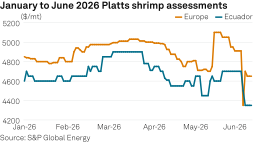
"Margins are under significant pressure, with buyers continually pushing prices lower," a producer said, adding that producers cannot sustain further reductions without incurring losses.
The pricing pressure reflects deeper structural challenges that prevent Ecuador from transitioning to the value-added products European retailers increasingly demand.
Processing constraints widen gap
Ecuador's shrimp market was originally set up to cater to demand for HOSO shrimp, market players say, and this structure has reduced incentives to invest in large-scale production of processed products. While suppliers in India, Vietnam and Indonesia developed processing capacity for retail and foodservice demand, Ecuador expanded primarily through farming efficiency and scale.
As a result, Ecuador remains highly competitive in raw shrimp but is less exposed to the labor-intensive processing segments.
"For now, even though the market is more focused on value-added products, Ecuador's installed processing capacity is already at its limit," the same producer said. "The sector needs continued investment to expand plant capacity, but also labor, which remains scarce today."
Processing infrastructure in Ecuador remains focused on basic operations rather than higher-value segments.
Export growth persists amid uneven demand
Despite these challenges, Ecuador has continued to increase its exports and remains highly competitive in large-scale production.
"Everything depends on the investment capacity of processing companies," the same producer said. "But Ecuador ... continues breaking export records month after month."
China continues to absorb around half of Ecuador's exports, accounting for about 50% in the first quarter, according to the Ecuadorean National Chamber of Aquaculture's latest report published in April.
European demand remains uneven, with weaker overall consumption but continued interest in specific value-added categories, such as cooked and cocedero shrimp. Coedero refers to a stage in shrimp processing in which the shrimp may be fully or partially cooked.
The divergence has become particularly visible in Europe, where whole shrimp flows continue moving mainly to southern destinations such as Spain, Portugal, and France, where HOSO products remain established, while other market segments concentrate on processed formats and value-added specifications.
