Agriculture, Chemicals, Biofuels, Solvents & Intermediates, Grains
June 03, 2026
US targets Brazil trade policy as ethanol sector awaits EU-Mercosur clarity

Editor:
HIGHLIGHTS
Section 301 targets 2017 ethanol tariff shift
Mercosur quota allocation remains unclear for producers
Northeast harvest challenges add to sector uncertainty
The US has determined that several Brazilian trade policies are unreasonable and burden American commerce, adding fresh uncertainty to Brazil's ethanol sector as producers await clarity on how export quotas under the recently implemented EU-Mercosur trade agreement will be allocated.
The US Trade Representative said June 1 that Brazil's acts and policies related to the ethanol market, digital trade, tariff preferences, anti-corruption enforcement, intellectual property protection, and illegal deforestation are actionable under Section 301 of the Trade Act of 1974.
The determination follows a yearlong investigation initiated at the direction of President Donald Trump. It comes as Brazilian ethanol producers navigate the early stages of the EU-Mercosur agreement, which entered into force in May with prorated quotas for the remainder of 2026.
"I launched this Section 301 investigation at President Trump's direction to address long-standing and pervasive US concerns with certain of Brazil's trade policies and practices," Ambassador Jamieson Greer said.
The USTR proposed a responsive action for public comment while continuing engagement with Brazil ahead of a July 15 statutory deadline to take action.
Market access tensions
On ethanol, the USTR determination cited Brazil's 2017 decision to "abruptly discontinue its previously balanced tariff treatment of ethanol" and its subsequent failure "to provide reciprocal tariff treatment for US ethanol exports." The finding adds a new layer of complexity for Brazilian producers already grappling with uncertainty over how the EU-Mercosur agreement's duty-free quotas will be distributed among member states and regional producers within Brazil.
Market participants in Europe and Brazil have been awaiting clarity on how the agreement's ethanol import quotas will be allocated, with expectations that a large share could be reserved for Brazil's sugarcane ethanol industry in the North-Northeast.
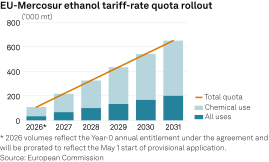
The agreement includes a duty-free quota of 450,000 metric tons/year for nonfuel ethanol for chemical use, phased in over six years, plus a separate 200,000 metric tons/year quota for ethanol for all uses, including fuel, once fully implemented.
Brazilian market participants expect sugarcane ethanol quotas to be directed primarily toward producers in the country's North-Northeast, mirroring long-standing sugar export policies designed to protect the industry from competition with the more efficient Center-South region.
The expectation is based on Brazil's Law 9.362/1996, which governs preferential export quotas for sugar and sugarcane products destined for specific international markets.
The USTR's Section 301 determination could complicate Brazil's efforts to maximize benefits from the EU-Mercosur agreement, particularly as the country seeks to expand ethanol exports amid shifting domestic production dynamics.
Sugar production in Brazil's Center-South region is expected to total 2.08 million mt in the first half of May, marking a 14% year-over-year decrease, according to an S&P Global Energy survey of 12 analysts published June 2.
| Brazil physical ethanol stocks as of May 15 (cubic meter): | ||||
| Anhydrous ethanol | Change over two weeks | Hydrous ethanol | Change over two weeks | |
| Nationwide | 1,034,676 | 32% | 2,099,551 | 29% |
| Source: Ministry of Agriculture | ||||
Mills have been shifting production toward ethanol, with total ethanol output from sugarcane and corn expected to stand at 2.134 billion liters, up 19.7% year over year.
Brazil's ethanol inventories reached 3.134 billion liters as of May 15, up 29.8% from the previous two-week period, according to Ministry of Agriculture data released May 29.
In the Center-South region, hydrous ethanol inventory levels increased 29% over two weeks to 2.078 billion liters, while anhydrous ethanol stocks rose 36% to 1 billion liters during the period.
Corn DDGS ethanol expansion
Brazil's corn ethanol sector has expanded rapidly since 2017, with production growing from 400 million liters to 7.5 billion liters in 2024, according to a January 2026 US Department of Agriculture report.
The volume of corn processed for ethanol increased from 950,000 mt in 2017 to 17 million mt in 2024, the USDA said.
As of December 2025, Brazil had 31 corn ethanol plants in operation, including 10 flex-fuel facilities capable of processing both sugarcane and corn, with total installed production capacity of 11 billion liters/year, the USDA said.
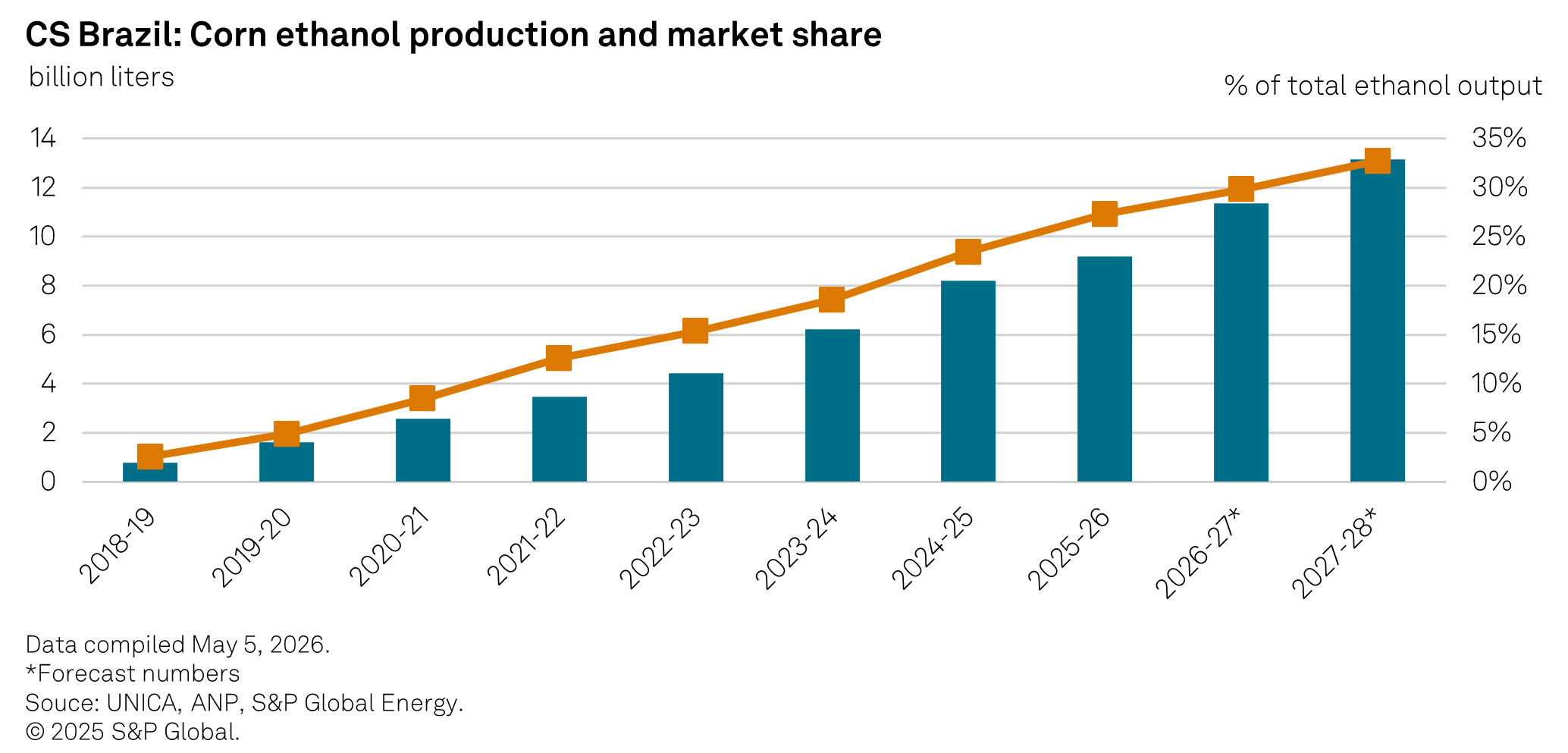
An additional 18 plants are under construction, with a combined capacity of 6 billion liters/year, while 19 more facilities are planned, adding 7 billion liters/year.
The expansion has generated significant coproduct output, with dried distillers grains and dried distillers grains with solubles production rising from 1.2 million mt in the 2019-20 marketing year to 4.2 million mt in 2024-25—a 256% increase, according to the USDA report.
On average, each mt of processed corn yields 420 liters of ethanol, 225 kg of DDG, and 15 liters of corn oil, the report said.
Broader trade implications
Beyond ethanol, the USTR determination targets Brazilian policies across multiple sectors that affect US commercial interests.
The determination also found that Brazil accords lower, preferential tariff treatment to hundreds of Mexican and Indian goods across multiple sectors through partial-scope preferential trade arrangements, covering sectors where Mexico and India are advanced, globally competitive producers.
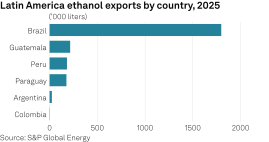
The determination comes as Brazil faces a challenging 2026-27 harvest in the North-Northeast, with the region expected to face increasing competition from new corn ethanol capacity in Bahia state and a facility already operating in Maranhão, while weaker global sugar prices pressure margins.
The EU-Mercosur quotas could provide an important safeguard for Northeastern sugarcane ethanol producers ahead of these challenges.
Platts, part of S&P Global Energy, assessed the Brazilian corn FOB Santos price for August loading at $217.70/metric ton June 2, $1.87 lower than the previous assessment.
