Agriculture, Energy Transition, Refined Products, Biofuels, Renewables, Jet Fuel
June 03, 2026
Summit's JetBio aims for a $2 billion, 1 billion-liter ATJ SAF plant in Brazil

Editor:
HIGHLIGHTS
Production aimed to start in 2030
Company to export 90% of production
Facility will use 1.8 billion liters of low CI ethanol
US private equity company Summit Agricultural Group plans to invest about $2 billion to build a sustainable aviation fuel plant in Brazil, targeting a first production timeline of 2030, the company's CEO Will Moore told Platts on June 3.
The facility, to be operated through a new company called JetBio, will produce 1 billion liters (around 254 million gallons or 770,000 mt) of alcohol-to-jet SAF annually.
To achieve these volumes, the plant will source 1.8 billion liters of low-carbon ethanol from a diverse group of Brazilian waste, second-crop corn, and sugarcane producers. "We will be targeting all low-carbon aviation markets and exporting 90% of our production," Moore said told Platts over email.
"We are currently in discussions with international airlines, freight carriers, and fuel suppliers," Moore said, adding that the export framework will maintain a "particular focus on the EU, UK, and APAC markets" to capture surging compliance demand as international carriers race to meet global emission reduction mandates.
JetBio is currently finalizing its location blueprints, with Paulinia in São Paulo state emerging as the absolute front-runner due to its advanced industrial infrastructure and strategic highway and rail connectivity.
"While we are still evaluating other potential options, Paulinia is the front-runner," Moore added. "We would expect to make an announcement on the site very soon."
The projected 254 million-gallon annual capacity makes the JetBio asset roughly 25 times larger than LanzaJet's Freedom Pines Fuels facility in Georgia, US, the world's first commercial ethanol-to-SAF operation, according to JetBio.
"Our scale is intentional to achieve the lowest production cost and lowest CI [carbon intensity] of any ATJ SAF in the world," Moore said. "This will also offer our customers supply diversity and security at meaningful volumes to their overall Jet-A supply portfolios."
The feedstock edge
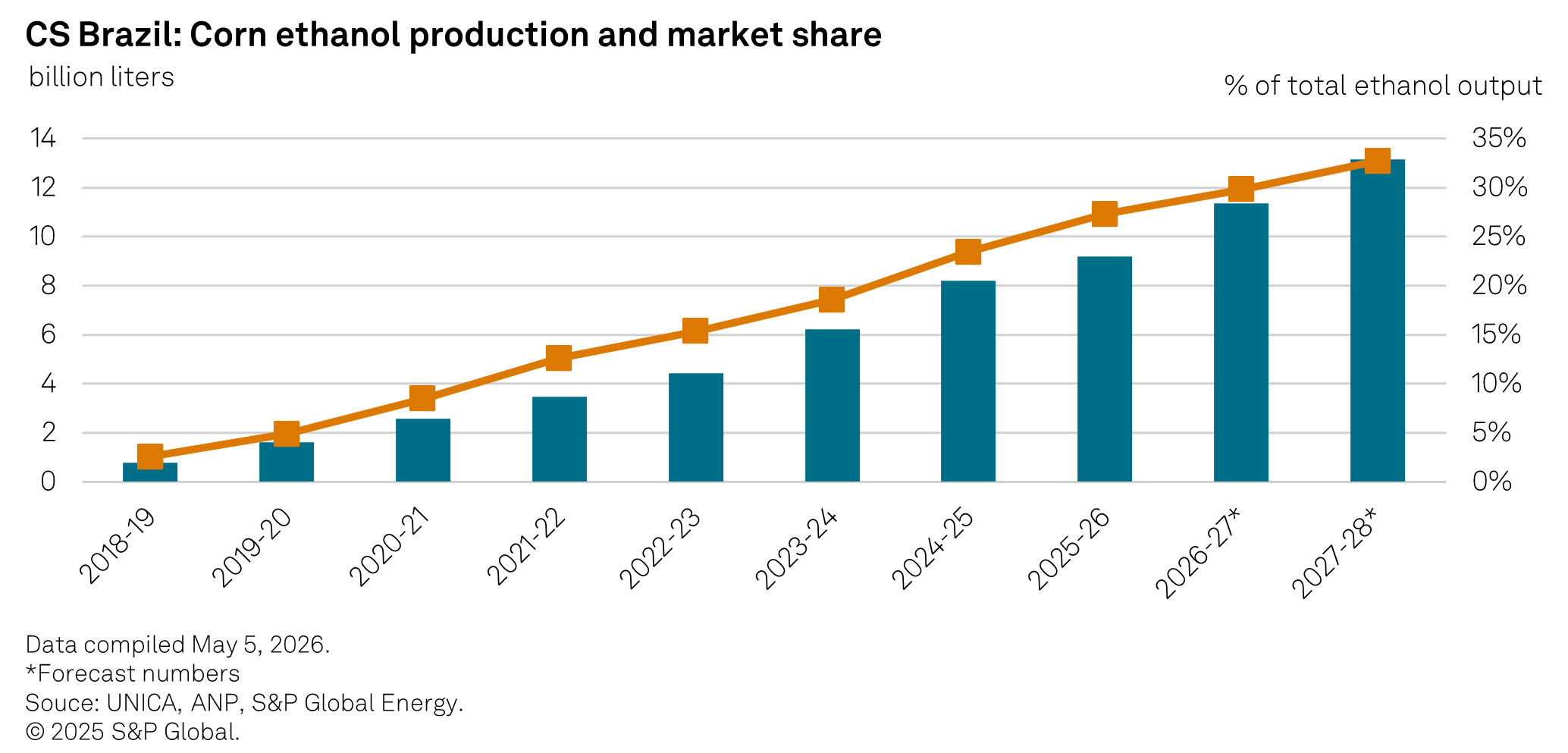
The project leverages Brazil's lower-carbon-intensity ethanol footprint compared to domestic US alternatives.
JetBio's hybrid feedstock sourcing strategy will utilize a mix of sugarcane and second-crop corn. The entity is expected to draw heavily from regional producers, including FS, Brazil's second-largest corn ethanol producer, in which JetBio's parent company, Summit Agricultural Group, already holds a significant equity stake.
The massive supply requirements come amid fluctuating regional feedstock prices.
Platts, part of S&P Global Energy, last assessed the Brazilian corn FOB Santos price for August loading at $217.70/metric ton on June 2, $1.87/mt lower than the previous assessment.
