Agriculture, Meat
June 03, 2026
China’s beef quota nears exhaustion, Australian exports brace for market shift

Editor:
HIGHLIGHTS
China's beef quota hits 90%, tariff looms
Australian export volume may drop 70%-80%
Exporters diversify markets as quota fills fast
Australian beef exports to China are rapidly approaching a key threshold, with 90% of the country's quota already exhausted as of June 1, China's Ministry of Commerce said June 2.
Once the quota is exhausted, a 55% out-of-quota tariff will take effect from the third day thereafter, raising the risk of a sharp slowdown in trade flows.
China's country-specific safeguard measures were announced on Dec. 31, 2025, following the conclusion of a safeguard investigation into beef imports launched on Dec. 31, 2024. The measures were introduced to protect China's domestic cattle farming and beef industry after a surge in imported beef volumes.
"Everybody is extremely cautious about placing goods that may breach the quota upon arrival in China," a China-based industry source said. While some market participants are testing whether the tariff burden can be shared, there is consensus that most products are not expected to remain commercially viable under a 55% tariff, the source said.
The same source estimated imports of Australian beef into China could fall 70%-80% once the quota is filled, representing a significant decline in trade flows.
Trade between Australia and China is not expected to stop entirely, but flows are likely to become more selective.
"Trade between China and Australia won't stop completely," an Australia-based trader said. Bones are expected to continue moving, while some items, including fats, are exempt, the trader added.
The quota pressure is also reinforcing efforts by Australian exporters to diversify market exposure. One Australia-based exporter said reliance on China alone is no longer sustainable, as the quota is likely to be consumed within the first few months of each year, adding that all Australian processors have been actively seeking alternative outlets.
For grain-fed beef, the US, Japan and South Korea remain the main alternative destinations, according to traders, exporters and industry sources. Grass-fed beef is seen as more flexible, with broader market access when prices are competitive, according to the same trader.
Attention is also beginning to shift to the next trading cycle. The trader and a Hong Kong-based importer said market activity is likely to increase in September as buyers seek to secure cargoes eligible under the 2027 quota of 209,000 mt.
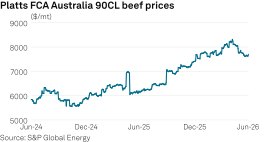
Platts assessed FCA Australia 90CL beef at $7,697/mt on June 3, down 0.8% month over month, but up 26.6% year over year. Platts is part of S&P Global Energy.