Agriculture, Meat, Livestock
June 02, 2026
US cattle slaughter drops as imports pressure prices before World Cup

Editor:
HIGHLIGHTS
US non-fed cattle slaughter drops 5.8% on year
Fresh 90CL prices fall from record $480/cwt
Imports from Australia, Brazil pressure market
US non-fed cattle slaughter has declined in 2026, with limited supply supporting prices amid rising imports, cold storage, and demand pressures ahead of the World Cup.
So far in 2026, 2.186 million heads of bulls and cows, the main source of lean trims, have been slaughtered up to May 30, down 5.8% from the same period of 2025 and 17.4% from the same period of 2024, according to the latest estimations from the US Department of Agriculture in its Daily Livestock and Poultry Slaughter reports and its Weekly Actual Slaughter reports.
The last weekly slaughter figure estimate was at 82,000 head, down 13.7% from the previous week and down 14.0% from the previous six-week average, down 10.7% from the corresponding week of 2025, and down 16.8% from the corresponding week in 2024.
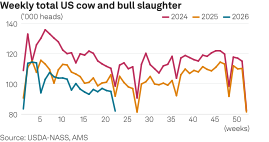
According to S&P Global Energy data, most lift in the non-fed slaughter numbers has come from Dairy Cows. During 2026, around 53% of the non-fed production was from Dairy cows, compared to around 48% for the same period the previous year.
"Dairy cow slaughter is still running above last year's levels; however, the rate of slaughter has slowed," S&P Global Energy CERA said in its last US Dairy short-term outlook report. "The more interesting story is why culling can remain active without looking like liquidation."
According to the report, "the recent pace is slower than the winter push, but beef market economics are still giving producers a reason to clean up the herd."
Limited supply supports prices
The limited domestic supply has been supporting prices for the domestic fresh 90CLs spot market.
The USDA reported in the afternoon of June 1 that four trades for fresh 90CLs spot were recorded at US central packing plants, with a weighted average of $459.24/hundredweight and a range of $456.78-$460.85/cwt.
That was below last week's trade of about $463/cwt and below the two-weeks-ago trade of about $480/cwt, which was a record for domestic fresh 90CLs spot.
"90s struggled this last week, even after a pretty considerable jump to all-time record highs the week before," Ryan Urie, global director of analysts for crops and proteins at S&P Global Energy CERA, said. "Beef is certainly facing some demand headwinds out there, with a pretty fierce competition from importers."
Despite the limited domestic supply and the strong demand for fresh, nearby deliveries to meet World Cup needs, prices have been pressured by beef in cold storage and strong imports.
"[Beef in Cold Storage] was a little bit overshadowed by the Cattle on Feed report [last week]," Urie added. "But total beef in cold storage did increase month over month, which is a slightly counter-seasonal move."
"There's quite a bit of imported cuts coming into the marketplace from Australia and Brazil," Urie said. "So, look for those to continue to put some pressure on the overall marketplace."
"Lots of cuts entering supply from the import side ahead of the World Cup," Urie said. "Beef demand is still very one-sided in trim and grind."
On the port-of-entry market, the 90CL beef FCA East Coast for a 16- to 60-day delivery period was assessed at $3.43/lb on June 1, for South American origins, unchanged day over day, up 3 cents week over week, but down 9 cents month over month.
Platts assessed the 90CL beef CIF East Coast for a 30- to 60-day shipment period at $3.52/pound on June 1, for Australia or New Zealand origin, down 10 cents day over day, and down 11 cents week over week and month over month.
Platts is part of S&P Global Energy.
