Agriculture, Energy Transition, Refined Products, Chemicals, Biofuels, Renewables, Jet Fuel, Hydrogen
May 26, 2026
INTERVIEW: Vema targets sub-$6 SAF offtake in 2029 using geological hydrogen, CEO says

Editor:
HIGHLIGHTS
Quebec offtake deal signed for 2030 delivery
Geologic hydrogen priced at $2.50/kg target
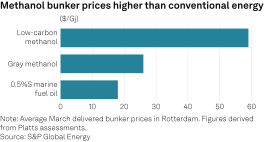
Geologic hydrogen produced by stimulating naturally occurring underground reactions rather than electrolysis could deliver sustainable aviation fuel at prices well below the current $6-$8/gallon market range and green methanol competitive with the $1,200-$1,500/metric ton decarbonized methanol market, Pierre Levin, CEO and co-founder of Canada-based Vema Hydrogen, told Platts in an interview.
The company, which accelerates subsurface serpentinization reactions to produce what it describes as ultra-low-carbon hydrogen at 0.4 kilogram of CO2 equivalent/kilogram of hydrogen, has already signed an offtake-linked agreement with an undisclosed SAF producer to develop production facilities on Vema's Quebec territory, with first SAF volumes targeted for 2030. A separate agreement is in place with an undisclosed green methanol producer for marine applications, with the first methanol molecules targeted for 2029.
"Once you have hydrogen at a reasonable price, you can basically have SAF at an acceptable price. SAF is typically priced at $6 to $8 per gallon right now. We would be able to produce below that. Quite below that," Levin said.
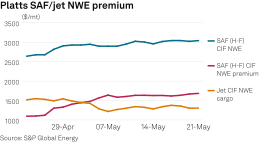
Vema's hydrogen cost target of about $2.50/kg, enabled by avoiding the electricity-intensive electrolysis process, is the commercial foundation for both the SAF and methanol plays. Levin said that the business model does not depend on subsidies or policy mandates.
"I don't believe you can make money based on either government money or on the belief that people will become virtuous and be willing to overpay to decarbonize. This never happened in history. If you want to sell, you need to be in the market," he said.
The position puts Vema's proposed SAF directly into competition with established hydroprocessed esters and fatty acids-based routes and emerging alcohol-to-jet pathways. The Power-to-Liquid or e-fuel SAF route that Vema's hydrogen would feed has historically been the most cost-challenged SAF pathway, with high green hydrogen input costs making it uncompetitive against HEFA or ATJ without significant subsidy support.
Levin said that geologic hydrogen, which avoids the capital and electricity costs of the electrolyzer stack entirely, fundamentally changes that calculus.
The methanol-to-SAF pathway is well-established technically, and Vema's 0.4 kg CO2e/kilogram hydrogen intensity would, Levin said, produce methanol and downstream SAF with a significantly better carbon footprint than biofuel-based methanol alternatives, including Chinese biomass-based methanol currently being offered into the shipping market at about $900/mt.
Marine biobunker: methanol first, ammonia later
The shipping decarbonization market is Vema's primary near-term revenue target, with methanol positioned as the first product to reach commercial scale, ahead of ammonia, which Levin said carries a four-to-five-year plant lead time versus one-to-two years for methanol or SAF.
Levin said Vema is in discussions with a major shipping company, which he declined to name, for over 250,000 tons of decarbonized methanol per year from its Quebec operations, equivalent to about 45,000-46,000 mt of hydrogen. The logistics are already partly de-risked: Vema's Quebec sites have a direct rail connection to the Port of Quebec City, which is ice-free year-round and has bunkering infrastructure for methanol.
On the International Maritime Organization's recent failure to advance a binding levy framework, which has rattled parts of the green shipping investment community, Levin said shipping majors he has spoken with are treating it as a temporary setback rather than a structural reversal.
"After the IMO failed meeting, I had discussions with high-up executives in a bunch of those large shipping companies. They said, 'This is a blip on the road. That's not changing our roadmap. That's not changing our appetite. We already have dozens of methanol-powered vessels'."
Ammonia remains a longer-horizon play. Levin noted that commercially viable ammonia plants require at least 700 mt/day of feedstock and a significant hydrogen commitment. He said that while Vema has a potential partner exploring on-site ammonia production, the timeline is substantially longer than for methanol or SAF. The shipping market's internal split between methanol-fuel advocates and ammonia-fuel advocates does not concern Vema.
"As long as we sell our hydrogen, we are very happy," Levin said.
Regulatory hurdle is the critical bottleneck
Despite the commercial logic, Levin identified regulatory permitting, not technology or economics, as the single biggest obstacle to Vema's timeline. The company requires regulatory frameworks that allow hydrogen production from subsurface stimulation, a category for which most jurisdictions have not yet established permitting pathways.
Canada, particularly Quebec and Newfoundland, is the most advanced market, with Vema actively working with federal and provincial authorities to improve regulations. In the US, Oregon and California are operable, while Minnesota, which Levin described as having "fabulous resources," currently blocks operations at the regulatory level.
Brazil has a partial legal framework in place, but has not fully implemented it. Australia is favorably disposed but remains at an early stage. Japan is in active discussions, with Vema evaluating local partners as a prerequisite for any development plan.
"We don't want the money from the government. We want the option to operate without a two- to three-year lead time before we can even start drilling a well. We need a permit for a pilot well in six months and a permit for a production well in less than 12," Levin said.
Why geologic hydrogen, not green or blue
Levin was dismissive of both green and blue hydrogen as commercially viable routes to the SAF and decarbonized marine fuel market at scale.
On blue hydrogen, Levin noted that the best achievable carbon intensity is 5 kg CO2e/kg of hydrogen and that most US carbon capture, utilization and storage projects store CO2 in sedimentary formations rather than mineralizing it, which he described as a long-term liability rather than a genuine decarbonization solution.
On green hydrogen, the arithmetic is stark: producing the 90 million mt of hydrogen already consumed globally per day would require 20% of global electricity production. At a baseload electricity cost floor of 5 cents/kilowatt-hour, the physics require 55-60 kWh to produce 1 kg of hydrogen, creating an irreducible cost floor of about $3/kg before any other costs, making a sub-$4/kg delivered price, the market viability threshold, essentially impossible without heavy subsidy.
"The maths don't work. Green hydrogen doesn't work without government," Levin said.
Vema, by contrast, targets a $2-$2.50/kg cost by accelerating subsurface reactions between water and iron-rich rocks, a process that occurs naturally over geological timescales but can be engineered.
The company describes its technology as "accelerating a natural reaction instead of breaking the water molecule at brute force with expensive electricity."
Platts, part of S&P Global Energy, assessed CFR China methanol at $399/mt on May 26, up $2/mt day over day.
