Agriculture, Energy Transition, Refined Products, Biofuels, Renewables, Jet Fuel
May 25, 2026
Acelen secures $1.5 billion for Brazil SAF biorefinery project

Editor:
HIGHLIGHTS
Acelen secures $1.5 bil for Brazil biorefinery
Facility to produce 1 bil liters SAF annually
Operations begin in 2029 in Bahia, Brazil
Acelen Renewables secured $1.5 billion in financing to begin construction of a renewable fuel biorefinery in Bahia, Brazil, marking one of Latin America's largest sustainable aviation fuel projects as the country positions itself as a key supplier in global biofuels markets.
The financing was arranged by a consortium supported and led by HSBC and the International Finance Corp., which includes ten national and international financial institutions: First Abu Dhabi Bank, Abu Dhabi Commercial Bank, IDB Invest, BNDES, Asian Infrastructure Investment Bank, Development Finance Institute Canada, KfW IPEX-Bank, Bradesco, BBVA, and Bank of China, Acelen said in a statement May 22.
The biorefinery, scheduled to begin operations in 2029, will have the capacity to produce 1 billion liters annually of SAF and renewable diesel using hydroprocessed esters and fatty acids technology, one of the leading global technologies for producing renewable fuels.
The project will position Brazil among the leading global hubs for sustainable aviation and heavy transport fuels, enhancing the country's energy security, Acelen said.
"Brazil has unique conditions to lead the global energy transition: combining agricultural scale, industrial excellence, and one of the cleanest energy matrices in the world," Leonardo Yamamoto, partner at Mubadala Capital, said. "With a consolidated presence in the country, Mubadala Capital believes in Brazil's potential to develop renewable fuels on a large scale."
Project structure
This stage marks the project's advancement and consolidates international market confidence in the country's competitive advantages for developing a new low-carbon industrial platform.
In total, the company's first integrated unit will involve an investment of over $3 billion and includes agro-industrial development encompassing the planting, extraction, and processing of macauba byproducts, Acelen said.
The IFC, a World Bank Group institution focused on private sector development, acted as the general coordinator and lead arranger, in conjunction with HSBC, to ensure the financial structuring following extensive technical, environmental, and social due diligence.
The financial structure reinforces the technical and commercial maturity of the project, which has already completed integrated engineering, negotiated strategic contracts and has about 90% of the SAF and renewable diesel commercialization structured and signed.
The project also has partners of national and global relevance, such as Honeywell UOP, Alfa Laval and Construcap, in addition to commercial agreements with companies such as Trafigura, Moeve, Bunge and BGN, Acelen said.
The biorefinery will be built in an existing industrial area in São Francisco do Conde, Bahia, the company said.
Feedstock strategy
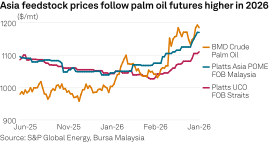
The project integrates agricultural production, industrial development and technology to produce advanced renewable fuels from traditional raw materials (soybean oil and used cooking oil) and macauba, a native Brazilian crop with high potential for advanced biofuels.
Acelen Renewables plans cultivation on 144,000 hectares in degraded areas, considering productivity gains already incorporated into the project, with 20% set aside for partnerships with family farmers and small producers.
Acelen is developing an integrated biofuels platform in Brazil based on macauba, a non-food oilseed, with planned production capacity of 1 billion liters/year of renewable fuels. The US and Europe are targeted as key export markets.
In March 2026, Acelen Renewables and Finboot signed a partnership to develop digital traceability infrastructure for biofuel production, targeting SAF and renewable diesel supply chains.
The 12-month agreement deployed Finboot's blockchain-based "Marco Track & Trace" platform to monitor the full life cycle of biofuel production, including feedstock origin, farm-level output, emissions and sustainability compliance.
Brazil's National Agency for Petroleum, Natural Gas and Biofuels plans to publish a regulation for the production and marketing of SAF in the second half of 2026.
According to the Fuel of the Future Law, enacted in October 2024, airlines operating domestic flights must reduce their emissions by 1% through the use of SAF starting in 2027. The blending mandate will gradually increase to 10% by 2037.
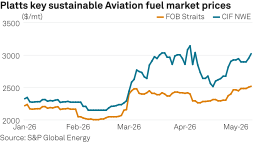
Platts, part of S&P Global Energy, assessed SAF California at 994.49 cents/gallon and SAF (H-S) CA (credits det) at 603.45 cents/gal on May 22, based on a spread of neat SAF to Jet Kero LA CA pipeline of 217.67 cents/gal.
