Agriculture, Meat
May 15, 2026
EU's removal of Brazil from approved list threatens chicken, beef exports
By Augusto Neto and Renan Araujo
Editor:
HIGHLIGHTS
Removal over non-compliance with antimicrobial use rules
Brazil has until September to prove compliance
Brazil's chicken exports to EU at 88,366 mt in Q1
The European Union's decision to remove Brazil from its list of approved exporters of animals and animal products over non-compliance with antimicrobial use rules, which is due to come into effect Sept. 3, would have the greatest impact on beef and poultry sectors in the South American country.
The EU announcement May 12 -- which comes just days after Brazil registered its first transactions under the Mercosur-EU tariff-rate quotas that took effect May 1 -- leaves Brazilian producers with just over three months to demonstrate compliance with EU sanitary and antimicrobial standards.
Chicken leads Brazil's protein exports to the EU despite trade restrictions
Among the affected proteins, chicken accounts for the largest share of Brazil's exports to the EU. In 2025, EU countries represented 4.3% of Brazil's poultry shipments, totaling 231,338 metric tons, according to Brazil's Foreign Trade Agency, Secex. In the first quarter of 2026, the bloc's share increased to 6.1%, equivalent to 88,366 mt.
Shipments include both fresh and processed chicken meat, with boneless cuts, particularly chicken breast, accounting for the majority of volumes. The EU is also a key destination for salted chicken breast, a higher-value product for Brazilian exporters.
A Brazilian exporter said boneless chicken breast is currently being sold to EU countries at around $2,800/mt, while salted product is priced at roughly $3,400/mt.
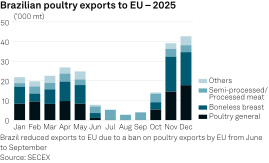
Trade in poultry between Brazil and the EU cannot be characterized as fully free trade. Brazilian exports to the bloc operate under a quota system, allowing a defined volume to enter duty-free, while shipments above that level are subject to tariffs.
Brazil has faced repeated EU restrictions in recent years, underscoring strict sanitary controls. Suspensions in 2024 followed confirmed cases of Newcastle disease, while a 2025 ban was linked to an avian influenza outbreak. In 2025, the EU halted imports of Brazilian poultry products for four months.
Market participants said the industry has already implemented the necessary adjustments to meet EU requirements. An exporter said the EU move appears to reflect concerns over the Ministry of Agriculture's enforcement of compliance.
"Everything will be clarified," the exporter said, adding that Brazil's Ministry of Agriculture and Livestock, MAPA, is expected to provide further details on its oversight.
A Brazil-based trader said European importers have also raised concerns, noting the EU decision could significantly weigh on their business.
The Brazilian Animal Protein Association, ABPA, said Brazil will provide technical clarifications to the EU, with support from the MAPA, in a bid to restore its status as an authorized country. It also highlighted that the country's poultry sector maintains sanitary standards aligned with international norms.
EU focuses on traceability, not food safety, for Brazilian beef
Brazil's beef sector is facing increased EU regulatory scrutiny, with market participants emphasizing that the bloc's actions focus on sanitary controls, traceability, and antimicrobial use rather than concerns about food safety or contaminated shipments.
According to another Brazilian exporter, the key point in the ongoing discussions is that the EU has not questioned the safety of Brazilian beef for consumption. Instead, the issue is centered on compliance.
"The discussion is regulatory. The bloc is seeking documentary proof, full traceability, and sanitary assurances across the entire production chain," the exporter said.
Meeting EU requirements, however, extends beyond the beef packers' level of compliance. Industry sources highlight that adherence depends on end-to-end monitoring, including animal origin tracking, veterinary drug controls, certification processes, and continuous audits throughout the supply chain.
The Brazilian Association of Meat Exporting Industries, ABIEC, said it is working alongside the MAPA to address the requirements ahead of implementation. Brazil has until September 2026 to present the necessary guarantees, while shipments to the EU continue uninterrupted for now.
Despite the measure's technical nature, industry participants warn of potential commercial impact. SECEX data for 2025 indicated annual export revenue of around $1 billion.
In 2025, Brazil exported 121,111 mt of beef to the EU, a 57% year-on-year increase. However, the bloc still accounted for only 3.5% of Brazil's total beef exports, highlighting its relatively small but high-value share of the country's export portfolio.
An industry participant said that while volumes to the EU are limited compared with China and other destinations, the bloc remains strategically important due to its premium pricing structure and strict standards, which often serve as benchmarks for other markets
Platts is part of S&P Global Energy.
