Refined Products, Maritime & Shipping, Fuel Oil, Bunker Fuel
May 15, 2026
Navigating shipping decarbonization options amid geopolitical uncertainties

By Chris To
Editor:
It's a big year for the global maritime sector, with the reporting and verification of FuelEU Maritime's first compliance period revealing the industry's response to greenhouse gas intensity mandates, and the second vote for the International Maritime Organization's Net Zero Framework taking place in October.
It's also turning out to be one of the most volatile years for energy markets, with the war in the Middle East contributing to market uncertainties and straining the industry's efforts to meet its decarbonization commitments.
"Climate change is still on, right? The temperature is rising, and there's no war, no political talk that can hide the facts from climate change happening," Bo Cerup Simonsen, CEO of Maersk McKinney Center, told Platts, adding that the everlasting challenge for global shipping and energy markets remains. Platts is part of S&P Global Energy.
First year in FuelEU compliance
FuelEU Maritime's first compliance period ran from Jan. 1 to Dec. 31, 2025, covering ships over 5,000 gross tonnage operating on EU/EEA routes. The regulation mandates a 2% reduction in well-to-wake GHG intensity from the 2020 baseline of 91.16 gCO2e/MJ. It applies to 100% of energy used on voyages between EU/EEA ports and 50% of energy used on voyages into or out of EU/EEA ports, regardless of flag. Operators had until April 30 to confirm their 2025 emissions exposure and compliance status.
The policy's flexibility mechanisms of banking, borrowing and pooling provide a template for shipowners to aggregate their options and assess their best course of action. But some sources Platts have spoken to have observed a misalignment between shipowners and charterers on the ownership of FuelEU compliance surplus, including pooling rights, hindering the widespread usage of FuelEU's mechanisms.
"For us, it is still the industry standard to charge the penalty [equating to around Eur640/mtCO2e for VLSFO] on small time charter operations. It doesn't make sense to pool and undertake the risk and administrative burden of pooling," a dry bulk shipowner told Platts, highlighting that they charter vessels on shorter periods and have less exposure to FuelEU mandates.
Consequently, some operators have expressed concerns over existing FuelEU clauses that entrench the pooling rights to the shipowner, allowing owners to invoke penalty surcharges should they not want to engage in pooling. Furthermore, operators in certain regions cite the lack of capability to bunker biofuels amid concerns about damage to tanks and residual complications.
"There are still many owners who are skeptical and unwilling to bunker biofuels due to complications and damage risks with the engine, as sometimes the quality of the bio-bunker is poor," a Greek operator told Platts.
FuelEU compliance surplus prices were seen at between Eur180-210/mtCO2e since the start of 2026, less than a third of the penalty cost, according to sources.
Opportunities arise with abatement
For more willing counterparties, achieving compliance through bunkering with lower-GHG-intensity fuels has created situational arbitrage opportunities against FuelEU compliance pricing in pooling.
Abatement costs -- the value in $/mtCO2e to reducing emissions by bunkering a lower GHG intensity fuel -- have favored bio-bunkers amid volatile fuel markets driven by the Middle East war.
Platts FuelEU CO2 Abatement UCOME Rotterdam (MGO), which assesses the abatement cost of burning B100 UCOME against 0.1% marine gasoil, fell from $161.50/mtCO2e on March 2 to negative territory at -$13.79/mtCO2e on April 7, before finishing April 30 at $68.73/mtCO2e. UCOME Rotterdam (VLSFO), the abatement cost of B100 UCOME against 0.5% very low sulfur fuel oil, also showed volatility, falling to $173.29/mtCO2e on March 9 and hitting $221.30/mtCO2e on April 30.
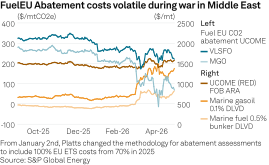
Spikes in middle distillate prices, such as 0.1% marine gasoil, typically used in Emissions Controlled Areas, improved bio-bunker abatement economics amid the war in the Middle East. The bunkering decision could in turn result in pushing more potential surplus into the markets should shipowners identify this as a window to generate compliance at much lower prices.
"If the situation continues, much more surplus would be generated as it becomes the logical thing to do," a maritime intelligence director from Germany said. "With nowhere to go for it, pooling prices could drop very far down."
IMO options splinter
FuelEU's current tools address today's compliance, but the targets from 2030 and beyond require fuels that do not yet exist at scale: low-carbon ammonia and methanol.
The IMO Net Zero Framework is facing a stern test after the conclusion of the Marine Environment Protection Committee 84 meeting at the end of April, and despite constructive dialogue taking place, some member states remain opposed to the current iteration of the NZF, and are seeking an alternative framework with adjustments.
Four different proposals -- including maintaining the Net Zero Framework as it exists -- have been offered by member states with a reconvention and a vote scheduled for the beginning of December at MEPC 85. The proposals include varied suggestions, including one that reflects a less than 1% reduction in GHG intensity requirements per year through 2045.
Despite FuelEU taking shape, voluntary green shipping markets gaining momentum and major shipping companies signaling their decarbonization commitments, uncertainties in the IMO Net Zero Framework continue to undermine investor confidence in next-generation fuel projects involving low-carbon methanol and ammonia.
Current abatement costs for low-carbon methanol and ammonia are higher than the penalty figure under FuelEU, making abatement economics unworkable until after 2030 when GHG requirements heighten.
"Investors in the low-carbon ammonia sector really needed the potential offtake volumes signaled from the downstream sector -- either in the form of agreements or orderbook optics -- and this was guaranteed with the IMO Net Zero Framework," an ammonia business development manager told Platts. "Without it, it will take big signals from sectors such as the container segment in terms of dual-fuel ammonia new builds to reinstate that confidence."
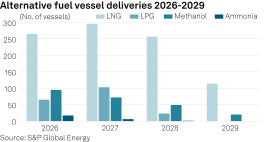
With the maritime industry having more options in a multi-fuel future than other sectors such as aviation, some future fuel suppliers caution against placing more confidence in more prominent transitional fuels such as bio-LNG and biofuels.
"Feedstock constraints for these fuels will hit home heading into 2030 with cross-sector competition," a low-carbon methanol fuel supplier told Platts. "Biofuels can be used by aviation, road and home heating, while bio-methane has always had a lack of volume availability. The shipping industry would have a dangerously short-term mindset without considering options such as bio-methanol."
A pivotal year
Against the backdrop of geopolitical turmoil, a degree of optimism remains regarding the shipping industry's united action toward maritime decarbonization, with an overall slim majority of member states supporting the implementation of the current Net-Zero Framework. But this does not change the industry's underlying predicament. Shipowners are left with a conundrum of displaying proactivity as first movers, slowing down their ambitions or ultimately being on standby for more demand from customer intent in reducing their emissions.
"Facing the uncertainty, we have to measure and adjust the pace of the development, but our drive will always be shaped by the customers that ask to reduce their scope 3 emissions, otherwise business opportunities shrink," Tatsuro Watanabe, managing executive officer of Mitsui OSK Lines, said at a panel during the Economist Sustainability Week in London in March.
The challenge of achieving large-scale commitments from both suppliers and shipping companies could persist, entrenching the gap between the levelized cost of fuel production on one side and the willingness to pay on the other. Only a global compliance framework can put an end to that.
Related interactive: Platts Global Bunker Cost Calculator
