Agriculture, Energy Transition, Refined Products, Crude Oil, Biofuels, Renewables, Jet Fuel
July 15, 2026
SAF APAC Summit 2026: Australia, New Zealand airports position for SAF growth amid infrastructure, policy developments

By Jenson Ong
Editor:
Airports in Australia and New Zealand are increasingly preparing infrastructure and operational frameworks to support sustainable aviation fuel, but policy certainty, supply frameworks and commercial viability remain critical barriers to large-scale adoption, speakers said during the SAF APAC Summit 2026 in Melbourne, Australia, on July 8-9.
Panelists discussing airport readiness for SAF noted that while airports in the region and the government are planning investments and refurbishments to handle more blended SAF volumes under existing fuel infrastructure, long-term growth will depend on coordinated policy frameworks, investment certainty and stronger collaboration across the aviation value chain.
"Airports have a responsibility to think decades ahead," said Richard Barker, chief executive officer at North Queensland Airports, adding that infrastructure planning must anticipate future fuel pathways even before large-scale demand emerges.
Unlike airlines and fuel suppliers, airports typically do not procure fuel directly, but speakers at the event said they play a critical enabling role by facilitating infrastructure development, coordinating stakeholders and providing confidence for future investment.
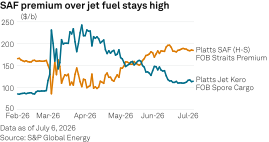
Platts assessed sustainable aviation fuel HEFA-SPK FOB Straits at $2,520/mt July 14, up $84/mt from July 13. The SAF FOB Straits premium was assessed at $1,307.50/mt over Platts Jet Kero FOB Singapore forward curve (MOPs), down $123.75/mt from July 13.
Balancing current aviation requirements and future expectations
Australia possesses sufficient existing agricultural feedstock, including canola, used cooking oil and tallow, according to a white paper released July 6, but lacks domestic SAF production. It relies on SAF imports and pilot-scale blending initiatives.
The country has yet to introduce a national SAF mandate, although policymakers are assessing options to stimulate domestic production as airlines face growing pressure from international climate commitments.
Panelists said major airports worldwide can already accommodate blended SAF through existing fuel systems, as certified SAF is designed to be compatible with conventional aviation fuel infrastructure.
Australia's first end-to-end sustainable aviation fuel storage and blending facility connected to an airport fuel system has begun operations at Brisbane Airport, marking a step forward in building domestic low-carbon aviation infrastructure as the country seeks to reduce emissions from one of its hardest-to-decarbonize sectors.
Patty Therrios, head of strategy and sustainability at Adelaide Airport Ltd., said the regional industry's challenge is less about immediate technical capability and more about ensuring infrastructure investments are sufficient and flexible enough to accommodate changing fuel pathways and future market requirements.
Airport operators also highlighted the need to consider storage, logistics and supply-chain integration when planning for higher SAF utilization rates.
Michelle Khundakar, general manager of strategy and sustainability at Queensland Airports, said airports must balance near-term operational requirements with long-term sustainability objectives, particularly as policy frameworks continue to evolve.
Regional collaboration increasingly important
Speakers emphasized that cooperation between airports, airlines, fuel suppliers and governments will be essential to accelerate SAF deployment across Australia and New Zealand.
Billie Moore, chief executive of the New Zealand Airports Association, said regional collaboration can help align industry priorities and support more consistent policy development across markets.
Speakers noted that the aviation sectors of Australia and New Zealand face similar challenges, including limited domestic SAF production, developing supply pathways and the need for long-term policy clarity.
Close coordination may reduce fragmented approaches and enable more efficient deployment of future SAF supply chains, speakers said.
The panel discussion also highlighted opportunities for airports to act as conveners, bringing together stakeholders to identify common challenges and advocate for supportive regulatory frameworks.
Policy certainty remains key
Despite increasing industry momentum, speakers said clearer and more stable policy signals remain necessary to unlock larger investment commitments throughout the SAF value chain.
Airport operators noted that infrastructure projects often require long development timelines, making policy visibility an important factor in investment decisions.
Jonathan Yeo, chief executive officer of FlyORO, said commercial realities remain central to SAF adoption, with stakeholders continuing to explore mechanisms that can improve market efficiency and support demand aggregation.
Singapore-based sustainable aviation fuel blending technology company FlyORO commissioned its AlphaLite blending unit in late 2025 at the newly established Wellcamp SAF blending terminal in Queensland, marking the company's first project in Australia and a milestone in its global rollout of modular blending systems for SAF.
Panelists pointed to emerging models such as collaborative procurement arrangements, book-and-claim systems and other transitional mechanisms that may help bridge the gap while physical SAF production and distribution networks continue to expand.
Airports positioning as long-term decarbonization partners
Looking ahead, speakers said airports are increasingly positioning themselves as long-term partners of aviation decarbonization rather than simply transport infrastructure providers.
While SAF is expected to play a central role in reducing aviation emissions, panelists agreed that scaling adoption will require continued collaboration among airports, airlines, fuel suppliers, policymakers and corporate customers.
Infrastructure readiness is steadily improving across Australia and New Zealand, but sustained policy support, greater supply availability and commercially viable market structures will ultimately determine the pace and success of SAF deployment across the region.
