Agriculture, Energy Transition, Refined Products, Crude Oil, Biofuels, Renewables, Jet Fuel, Carbon
July 03, 2026
ASAFA IPS Thailand 2026: ASEAN policy harmonization, corporate demand signals key to scaling Asia SAF uptake

By Jenson Ong
Editor:
Regulatory convergence and stronger corporate demand signals will be critical to accelerating sustainable aviation fuel (SAF) adoption across ASEAN, as airlines, logistics providers, and policymakers navigate high costs and fragmented policy frameworks, speakers said at the ASAFA 2nd Innovation & Policy Summit Thailand 2026.
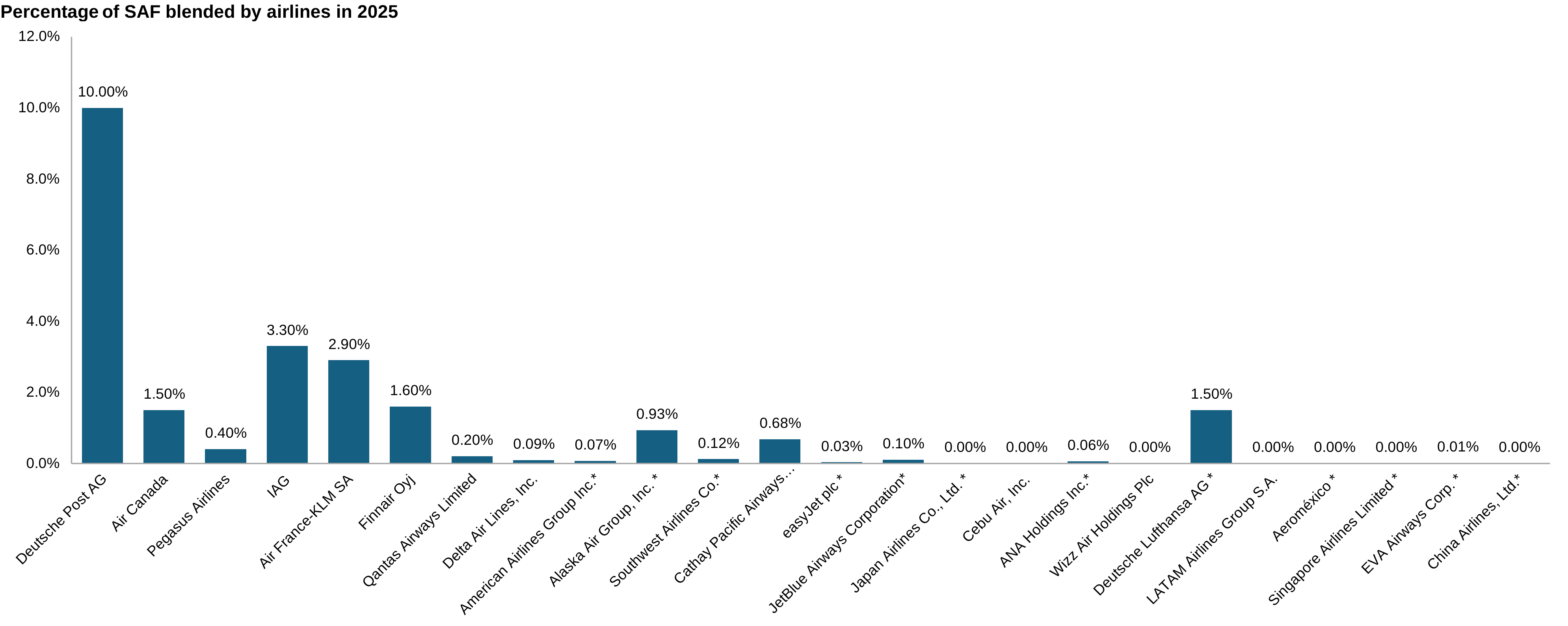
Participants said that while momentum is building, Asia has room to grow compared to mature markets such as Europe in terms of policy certainty, coordinated incentives and penalties, and price competitiveness development ahead of 2030 targets.
Regulatory fragmentation risks distorting market development
Speakers on a panel highlighted uneven SAF readiness in ASEAN, with differing mandates and policy timelines across Thailand, Singapore, Malaysia and Vietnam, among others.
"There is a real risk that fragmented regulatory systems could create distortions across borders for both producers and airlines," said Gabriel Ho, founder and chief sustainability officer at ASAFA.
Panelists emphasized that a coordinated ASEAN SAF roadmap would require alignment on mandates, certification standards and incentive mechanisms, alongside stronger political commitment.
Tharinya Supasa, head of sustainable and renewable energy at the ASEAN Centre for Energy, said that while momentum is building, significant divergence remains in policy design and implementation across member states.
Similarly, Peter Dunda, regional officer for aeronautical meteorology and environment at the International Civil Aviation Organization (ICAO), said that international coordination will be essential to ensure regional SAF frameworks remain compatible with global aviation emissions schemes.
Corporate decarbonization targets drive SAF demand
Corporate demand signals, particularly from global logistics and cargo customers, are emerging as a strong driver of SAF adoption in Asia.
Daisy Ren, Corporate Public Affairs Director at DHL, said customer-led demand from large multinational shippers with established decarbonization goals is supporting early SAF uptake, as companies look to reduce emissions across supply chains.
"Many of our customers are large cross-border players with their own decarbonization targets, and they rely on logistics partners to support that journey," Ren said, adding that SAF demand in Asia is expected to grow as regional economies adopt more structured sustainability frameworks.
Mandates provide stability, voluntary demand limited
Airlines said a combination of regulatory mandates and voluntary corporate commitments is shaping SAF demand in the region, although uptake remains uneven.
Sam Smith, head of climate action at Cathay Pacific, said mandates play an important role in providing stability and predictability, while voluntary demand remains concentrated among a relatively small group of sustainability-focused customers.
"Sustainability needs to be embedded across the entire ecosystem," Smith said, pointing to the need for broader industry alignment to support SAF uptake.
High costs remain key barriers
Elevated SAF prices relative to conventional jet fuel continue to weigh on wider adoption, particularly in price-sensitive Asian markets.
Rachtaphol Sabhavasu, head of petroleum and aviation fuel management at Thai Airways, said regulatory clarity remains the key enabler for long-term SAF planning, while high SAF prices continue to limit uptake.
"Without a clear roadmap, it is difficult to plan and operate," he said, adding that cost considerations mean airlines are still relying on transitional mechanisms such as credits.
Philip See, chief sustainability officer at Malaysia Aviation Group, said SAF implementation in Asia has been constrained by both pricing and market structure, with airlines in Europe and the US often able to secure more competitive SAF pricing due to scale and market concentration.
Participants also noted that spikes in jet fuel prices during recent geopolitical disruptions had tested demand resilience, underscoring the challenge of layering even higher SAF costs onto an already volatile fuel environment.
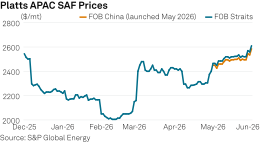
Platts, part of S&P Global Energy, assessed sustainable aviation fuel HEFA-SPK FOB Straits at $2,430/mt on June 26, up $5/mt from June 25.
The SAF FOB Straits premium was assessed at $1,568.75/mt over Platts Jet Kero FOB Singapore forward curve (MOPs), up $11.50/mt from June 25.
Collaboration, book-and-claim seen as interim transitory solutions
With supply and cost constraints persisting, stakeholders are increasingly exploring collaborative procurement models and transitional mechanisms to support SAF demand.
Kelvin Lee, head of sustainability for Asia-Pacific at IATA, said industry collaboration will be pivotal, noting that no single airline can scale SAF adoption on its own.
Panelists highlighted the role of alliance-based procurement structures and cross-industry partnerships in improving demand aggregation and cost efficiency.
Book-and-claim systems were also widely viewed as a necessary interim solution to address physical supply constraints and uneven infrastructure availability across the region.
Airlines noted that book-and-claim can help bridge geographical mismatches between SAF production and consumption, particularly in Asia where physical supply remains limited and unevenly distributed.
Policy alignment, ecosystem development critical to scale
Looking ahead, panelists emphasized that coordinated policy action and broader ecosystem development will be paramount to scaling SAF within ASEAN.
Key priorities include harmonized regulatory frameworks across ASEAN, clear, long-term SAF roadmaps, and stronger collaboration across airlines, corporates, fuel producers, and regulators.
"SAF cannot be developed in isolation," participants said, highlighting the need for cross-sector alignment to reduce fragmentation and accelerate market maturity in Asia.
