LNG, Refined Products, Maritime & Shipping, Natural Gas, Dry Freight
March 24, 2026
COMMODITY TRACKER: 5 charts to watch this week

By Staff
Editor:
European gas inventories hit record lows as summer approaches, while US crude stocks reach 21-month highs amid stronger imports. China's steel sector faces excess capacity, pressuring prices and the European feed market slows on rising costs.
1. Europe faces record low gas inventories, short supply
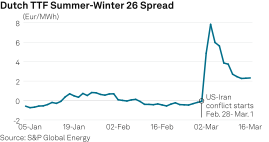
What's happening? Europe is entering the summer with record-low gas inventories and significant supply disruptions, creating an unprecedented market challenge. The QatarEnergy force majeure has further tightened the global balance, with about 17% of the supplier's export capacity taken offline by Iranian missile strikes. As such, prices on the forward curve have moved accordingly. Platts, part of S&P Global Energy, assessed the Dutch TTF Summer 2026 at Eur57.325/megawatt-hours March 23, at a 55 Eur cent/MWh premium to its winter equivalent. The Summer-Winter 26 spread has narrowed to Eur3.285/MWh average since March 2, from a peak of Eur7.830/MWh March 3, according to Platts data. This has been attributed to the risk shifting to the peak winter demand period, as the market weighs in the impact of the lost LNG cargoes in the longer-term.
What's next? Member states in the EU are currently facing a 90% gas storage filling target, which can be reduced by up to 15 percentage points in the event of difficult market conditions. EU storages stood at 28.48% fullness March 21, compared to 33.80% in 2025 and 59.26% in 2024, according to Gas Infrastructure Europe data. Moreover, with the loss of Qatari LNG supply, Asian buyers are set to enter the global LNG market more fiercely to seek alternative cargoes, pulling supply away from Europe. With such large volumes to source, the European Commission has urged member states to reduce filling targets and begin restocking as early as possible, according to a letter shared with Platts March 23.
2. US crude inventories reach 21-month highs
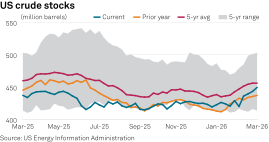
What's happening? US crude oil inventories climbed 6.16 million barrels to 449.26 million barrels for the week ending March 13, reaching the highest level since June 2024, according to EIA data released March 18. The build narrowed the deficit to the five-year average to 1.4% from 2.8%. US imports averaged 7.19 million b/d, up 12% week over week, with Gulf Coast imports at 2.39 million b/d--the highest since July 2020. Venezuelan crude imports averaged 291,000 b/d in March. Cushing, Oklahoma, inventories climbed to 27.52 million barrels, the highest since August 2023.
What's next? US refiners have largely adhered to their first-quarter maintenance schedules but are raising run rates to capture margins that have strengthened following the war in the Middle East, according to S&P Global Energy CERA analysts. The US Gulf Coast WTI MEH cracking margin averaged $25.95/barrel in March, up from $10.19/b in February, providing incentive for refiners to increase crude processing.
3. China's HRC market faces mounting capacity pressure
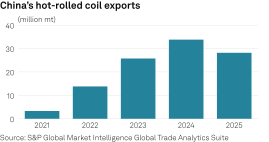
What's happening? China's hot-rolled coil steel market faces mounting pressure in 2026 as new production capacity outpaces modest demand growth, threatening to keep prices rangebound at multiyear lows and squeeze mill margins to near zero. Chinese HRC prices averaged Yuan 3,270/mt ($474/mt) in January-March 2026, down 2% from 2025 and 38.5% lower than 2021, according to Platts assessments. China commissioned two new hot strip mills with 5.2 million mt/year capacity in early 2026. Medium-thick HRC production reached 222.68 million mt in 2025, up 4.2% year over year, according to National Bureau of Statistics data. Mills report profit margins are "almost zero."
What's next? China has 10 additional hot strip mills totaling 28.3 million mt/year under construction and six more projects representing 12.36 million mt/year in planning stages, with no clear commissioning dates, according to company and local government announcements. Only coordinated production cuts by mills can support price recovery; otherwise, prices will likely remain rangebound at low levels, according to mill sources. China's HRC exports in 2026 could remain at high levels despite antidumping duties in five countries, as domestic supply pressure may push exporters to expand overseas markets, according to China-based trading sources. Shipping disruptions from the Middle East conflict could adversely impact exports, though pent-up demand could drive a rebound if the Strait of Hormuz normalizes.
4. European feed market slows amid price rises
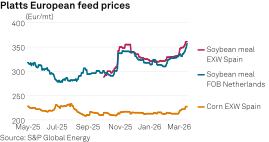
What's happening? European feed market activity has slowed significantly since early March as buyers adopt a cautious wait-and-see stance amid increased commodity prices, expensive freight and currency volatility. Platts assessed FOB Netherlands soybean meal at Eur357/mt March 17, up Eur21/mt or 6.2% week over week, while EXW Spain soybean meal rose Eur12/mt or 3.4% to Eur361/mt. EXW Spain corn reached Eur227.50/mt, up Eur5.50/mt or 2.4% week over week. Freight costs have increased 20%-25%, directly lifting delivered commodity costs. Feed millers are largely covered for near-term needs and purchasing only when necessary.
What's next? Spanish feed buyers are expected to remain cautious through May, potentially re-entering the market within two to three weeks if the Middle East disruptions persist. Purchasing strategies for June-July will likely focus on wheat, barley and corn coverage during overlapping marketing campaigns. Domestic harvest prospects will influence buyer decisions, with good yields potentially prioritizing local supply to reduce price exposure. Ample South American soybean meal availability for summer shipment windows could ease supply concerns despite cautious European buying.
5. European ethanolamines move higher amid limited availability
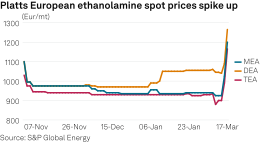
What's happening? The European ethanolamine market saw a sharp rise in buying activity amid shrinking availability amid the ongoing war in the Middle East. Offer values increased in the week, as buyers bought the material to build their inventory and better position themselves for future uncertainty. Fundamentally, demand remains unchanged.
What's next? Supply constraints and elevated energy and feedstock costs are expected to continue limiting spot availability, keeping upward pressure on prices. According to a producer, the elevated pricing could lead to some demand erosion for a few small buyers, reducing the overall buying demand in the market.
Reporting and analysis by Eniayo Adeniji, Clio Ho, Christopher Vanmoessner, Jing Zhang, Nanditha Madathil Kinavoor, Akul Gupta.
