Metals & Mining, Ferrous
March 20, 2026
China HRC market under pressure as new capacity piles up in 2026

Editor:
HIGHLIGHTS
Profit margins near zero as prices fall 38.5%
Exports face rising antidumping cases in 2026
China's hot-rolled coil steel market faces mounting pressure in 2026 as new production capacity outpaces modest demand growth from the manufacturing sector, threatening to keep prices rangebound at multiyear lows and squeezing mill margins to near zero.
The capacity expansion comes as Chinese HRC prices have fallen 38.5% since 2021, with mills struggling to maintain profitability despite efforts to offset weak domestic demand through exports that now face growing antidumping challenges in key markets.
Despite increasing trade barriers, China's HRC exports continue to be a significant outlet and could remain relatively high in 2026, according to China-based trading sources.
Rising capacity
Based on announcements from several companies and local governments, China commissioned six new hot strip mills in 2025 with a combined annual capacity of 14.8 million metric tons.
Two more mills with 5.2 million mt/year of capacity have started operations so far in 2026. An additional 10 mills totaling 28.3 million mt/year are under construction, with six more projects representing 12.36 million mt/year in the planning stages.
| China's new steel capacity | |||
| Year/status | Newly commissioned capacity* | Newly comissioned total hot strip mills | Platts HRC prices |
| 2022 | 23.85 | 8 | 4,421 |
| 2023 | 19.5 | 9 | 4,006 |
| 2024 | 23 | 7 | 3,648 |
| 2025 | 14.8 | 6 | 3,337 |
| 2026 (Jan-March^) | 5.2 | 2 | 3,270 |
| Under construction | 28.3 | 10 | |
| Planning | 12.36 | 6 | |
| Source: Companies, local government announcements, S&P Global Energy | *Capacity is in million mt/year | |||
| Platts HRC is China's domestic HRC price, averaged on an annual basis, in Yuan/mt | ^As of March 19 | |||
| Under construction, planning capacity have no clear dates for commissioning | |||
Margins under pressure
The capacity additions have pushed Chinese HRC output higher even as prices decline.
Production of medium-thick HRC, a major product category, reached 222.68 million mt in 2025, up 4.2% year over year and 24.2% higher than 2021 levels, data from the National Bureau of Statistics showed.
Output in January-February totaled 34.058 million mt, down 6.7% from a year earlier amid sluggish demand but still 14% above the same period in 2021.
But with increased Chinese HRC capacity and output, Chinese HRC prices have been in a downtrend over the past few years.
The Platts-assessed Chinese domestic HRC prices averaged Yuan 3,270/mt ($474/mt) so far in 2026, down 2% from the average in 2025 and 38.5% lower than that in 2021. Platts is part of S&P Global Energy.
"Currently, our company's HRC profit margin is almost zero," a mill source said. "This year's spring seasonal steel demand recovery in manufacturing has been below our expectations, while there is too much supply in the HRC market."
"Not only are HRC profit margins poor, but cold-rolled coil and hot-dip galvanized margins are also very thin," another mill source said.
With weak domestic demand and a challenging international environment, overall Chinese steel demand in 2026 may struggle to improve from 2025 levels, according to the mill source. Only coordinated production cuts by mills can support a price recovery; otherwise, prices will likely remain rangebound at low levels, the source added.
Some traders said steel demand in the manufacturing sector may still show year-over-year growth if manufacturing exports remain strong in 2026, but domestic HRC supply will most likely continue to exceed domestic demand as capacity expands.
"However, since steel prices are already at low levels, while raw material prices are high and shipping and energy costs are also rising, I think there is limited room for steel prices to fall further," a trader said.
Exports face challenges
Another export trader said that if HRC capacity continues to increase this year, it may not be bad news for traders' export business, as domestic supply pressure could strengthen traders' negotiating power when purchasing from mills.
"Although antidumping cases against Chinese HRC are increasing and have already caused HRC exports to decline, if there is too much domestic HRC supply pressure, it will still push exporters to expand overseas markets more," the export trader said. "So, currently it looks like HRC exports in 2026 can still remain at high levels."
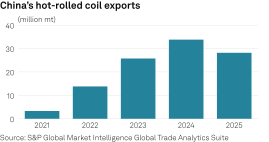
China's HRC exports in 2025 reached 28.17 million mt, down 16.6% from 2024, but still more than seven times higher than in 2021, the year when China's steel production peaked.
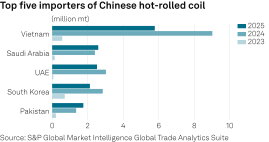
From 2025 through March 2026, China's HRC has been subject to multiple antidumping duties imposed by five countries, including Vietnam, China's largest HRC export destination, and South Korea, its fourth-largest export market, according to China Trade Remedies Information, a branch of China's Ministry of Commerce.
Moreover, three more antidumping cases against Chinese HRC are currently under investigation.
Besides trade duties, Chinese exports are also facing challenges due to the Iran war.
Several trading sources said shipping disruptions caused by the Middle East conflict could adversely impact China's HRC exports from March onward. Steel exports to the seven Persian Gulf states and Israel have almost completely stopped, two of the trading sources said.
In 2025, China exported a total of 5.779 million mt of HRC to Persian Gulf countries, 7.6% lower year over year, data from S&P Global Market Intelligence's Global Trade Analytics Suite showed.
However, if the Strait of Hormuz can gradually return to normal over the coming months, pent-up local demand could drive a rebound in China's exports, the traders said.
