Agriculture, Grains, Oilseeds
March 18, 2026
European feed buyers delay purchases amid price uptick, currency volatility

HIGHLIGHTS
European feed buyers delay amid price uptick
Soybean meal prices firm 6.2% WOW
Freight costs rise, limits demand
The European feed market has slowed from the start of March, with participants indicating limited trading activity amid higher commodity prices, expensive freight and currency volatility linked to the Middle East conflict, which is prompting buyers to delay purchases.
Buyers are largely taking a "wait-and-see" stance, market participants said.
A trader in Spain described conditions as "very slow," adding the market is "quiet with high prices," and that customers are "only buying if they are short for the next couple of days."
"Very few bids were reported recently, for the nearest delivery month," a Netherlands-based trader said, while reporting thin interest.
Recent Platts, part of S&P Global Energy's assessments, also indicated week-over-week increases across key feed inputs. FOB Netherlands soybean meal rose Eur21/metric ton or 6.2%, week over week, to Eur357/mt on March 17, while EXW Spain soybean meal was up Eur12/mt or 3.4%, during the same period, at Eur361/mt. Platts assessed EXW Spain corn at Eur227.50/mt on March 17, up Eur5.50/mt or 2.4%, week over week.
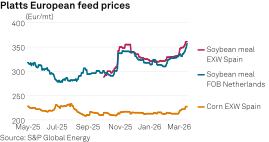
Despite firmer prices, demand remains weak, market participants based out of the Netherlands said, with a second trader in Spain adding that there is "not much demand in the market amid higher prices."
Participants also pointed to logistics and foreign exchange as key headwinds.
Freight is now "very expensive," a second trader based in the Netherlands said, estimating costs to be up 20%-25%, which has directly lifted delivered commodity costs.
Furthermore, at the start of the Middle East conflict, the euro depreciated against the dollar, but has since steadied, a third trader in Spain said, adding it "seems it has stabilized."
However, the trader added that volatility could return, citing uncertainty around interest rate expectations in the EU.
Feed millers covered near-term needs, buy only when necessary
Demand for corn and soybean meal is described as limited, with many feed mills already covered for prompt requirements. While some buyers remain uncovered, purchasing is cautious and "nobody is making any buying until it is necessary or unavoidable," participants based in Spain said.
In Spain, feed millers are currently not accepting the full impact of the recent price surge because most immediate needs are already met and buyers are hoping the Middle East conflict does not persist, participants said. However, if disruptions continue, Spanish buyers may need to re-enter the market within two to three weeks, they added.
Looking ahead, Spanish buyers are expected to focus on coverage for the period when marketing campaigns overlap in June and July, particularly for wheat, barley and corn, according to a broker based out of Spain.
For cereals, purchasing strategies may hinge on domestic output--if Spain sees a good harvest, buyers may prioritize local supply to reduce exposure to price risk, the broker added.
For soybean meal, participants expect ample South American-origin soya meal availability, including for summer shipment windows, which could ease supply concerns even if European buying remains cautious.

Editor: