LNG, Natural Gas
March 18, 2026
Europe faces summer gas crunch with low stocks and supply woes
By Eniayo Adeniji and Clio Ho
HIGHLIGHTS
QatarEnergy force majeure tightens European balance
TTF Summer 26 premium at Eur1.97/MWh, down from Eur7.83/MWh peak
Winter contracts rally amid injection season risk
The European gas market is heading into the summer season with an almost unprecedented challenge; record low inventories and significant disruptions to supply.
The most revealing signal, perhaps, lies in the inverted shape of the forward curve.
Platts, part of S&P Global Energy, last assessed the Dutch TTF Summer 2026 contract at Eur50.625/MWh on March 17, at a Eur1.965/MWh premium to its winter equivalent.
The disparity between the two instruments was most pronounced on March 3, when the Summer-Winter 26 spread registered at Eur7.830/MWh at the London market close.
The spread has since narrowed to an average of Eur3.820/MWh, according to Platts, since March 2, when QatarEnergy announced the suspension of LNG production at its Ras Laffan and Mesaieed operating facilities.
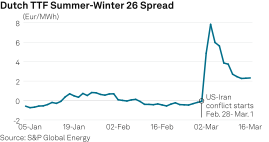
This outage further exacerbated the task of filling European gas storages over the summer period, tightening an already fragile market balance.
Qatar, the world's second-largest LNG exporter after the US, shipped 82.44 million metric tons of LNG in 2025, with 8.9% of this total directed towards European terminals, according to S&P Global Energy CERA data.
Qatar also exported a quarter of the 67.7 million mt of LNG delivered to Asian markets in 2025, the second-largest share after Australia.
Though Europe was not the primary market for Qatari LNG, this loss is expected to divert Europe-bound volumes to Asia, heightening competition for floating cargoes.
"Europe already needed like 80 million cubic meters/day more LNG this summer than last summer, now there's competition for it too... and certain parts of Asia are pretty tight," an Atlantic-based trader said.
Member states in the EU are faced with Parliament's 90% storage target, which is adjustable downwards by up to 15 percentage points in the event of difficult market conditions.
European gas stocks stood at 28.93% fullness March 16, according to the latest Gas Infrastructure Europe data. On the same dates in 2025 and 2024, reserves registered at 34.77% and 59.69% respectively.
Zooming in to Germany, levels are even more precarious. GIE data placed German gas storages at 21.93% full March 16, with industry group INES calling for the country to adjust its gas storage governance ahead of the upcoming winter period.
Germany holds the largest gas storage of EU member states by technical capacity, approximating to about a fifth of EU-wide availability.
Platts assessed the German THE Summer 26 contract at Eur51.575/MWh March 17, at an 88.5 euro cent premium to its winter equivalent.
Despite the summer premium, winter contracts have also been rallying hard, often outpacing summer in day-on-day gains. Platts data shows Winter 26 contracts in both the UK NBP and Dutch TTF hub overtaking Summer 26 rises on up-days in March.
This paradox perhaps highlights the upside risk in winter itself.
"Injection at this rate is the point of maximum strain, but the next winter is still a risk depending on how successful refilling is," a UK-based analyst said.
"Europe doesn't need the cargoes right now, but April is injection season and we're getting into dangerous territory now. For the US shipping capacity to load all the LNG US cargo right now, it is about 35 to 37 cargoes per week. Of course, the market can keep up and absorb that but last year was like 18% to Asia and zero to China," said a Europe-based trading source.
"The closer spreads... falling into the summer period are reacting less to the front movement. This basically means the market is now looking at the back of the curve, potentially Q4... Especially if we end the storage at 70-something percent," another Atlantic-based trading source said.
Editor:

Editor: