Coal, Metallurgical Coal
October 09, 2026
The hidden language of coking coal: What relativities really tell us

By Samuel Chin
Editor:
At first glance, relativities appear straightforward. One would expect coals with different coking characteristics to trade at a premium or discount to others, broadly reflecting differences in value-in-use. Ask 10 market participants why a hard coking coal trades at a particular discount to its premium counterpart, and most would likely cite quality differences.
Coke strength after reaction (CSR), volatile matter, ash, sulfur and other coking characteristics remain fundamental to coal valuation and pricing.
Ask why that discount was a different value six months ago, however, and the answer quickly becomes more complicated.
Few market participants would dispute that quality matters, but while it is the foundation for coal valuation, relativities are also shaped by supply-demand balances, buyer preferences, blending requirements and the availability of alternative sources of supply.
As these factors change, so too can the value that the market assigns to a coal, even when nothing has changed about its quality.
If benchmarks tell us where the market is, relativities can help explain what is happening around it. By looking at the relationship between Low Vol Hard Coking Coal and Premium Low Vol HCC, this article examines how buyer preferences, supply-demand dynamics and evolving trade flows influence relative value, and what those movements can tell us about the broader coking coal market.
To understand why, it is useful to start with the concept that underpins many coal purchasing decisions: value-in-use (VIU).
Relativities are more than VIU calculations
Many buyers begin by comparing coals through a VIU framework. Coking characteristics and coke replacement rates influence how a coal performs within a blend and, ultimately, the value it can generate in coke production or blast furnace operations.
VIU provides a useful framework for understanding relative coal quality and why premiums or discounts might exist between different grades.
Yet VIU alone does not always explain observed spot market values. Steelmakers do not buy coal in isolation. They purchase coals as part of a broader blend, within specific operational, logistical and commercial constraints.
For example, two coals may generate broadly similar VIU calculations, yet trade at different relativities if buyers show a preference for one brand due to blending familiarity, logistics or spot availability. Conversely, a coal's VIU may remain unchanged while its relativity weakens because supply outpaces demand.
Historically, VIU was often the primary lens through which market participants compared coal quality. Yet coal markets are ultimately traded, not modelled.
As the market has become more diverse, with a broader range of buyers, supply options and blending strategies, observed spot market values and brand-based differentials have become increasingly important in understanding relative value.
While VIU provides a theoretical framework, relativities increasingly reflect how buyers actually value coals in the market, incorporating not only quality considerations but also procurement preferences, operational requirements and prevailing market conditions.
Different buyers, different values
One reason relativities move over time is that not every steelmaker consumes coal in the same way.
A Chinese steelmaker may favour a particular LVHCC for its low-volatility characteristics and strong CSR performance because it complements domestic coals within a blend and helps achieve targeted coke quality.
An Indian merchant cokery may place greater emphasis on outright procurement cost and margin instead.
Integrated steel producers may focus on blast furnace productivity, while traders may value liquidity, arbitrage opportunities and resale potential.
Coal quality may be measured in a laboratory, but value is often determined elsewhere. One Indian steelmaker pointed to fines content as an example, noting that higher levels of fines can lead to additional handling and clean-up costs during transportation during India's rainy season, influencing how a particular coal is valued.
Factors such as these rarely appear in a laboratory specification sheet, yet they can influence buying decisions and relative value.
Historically, those differences mattered. Today, they may matter more than ever.
As the market becomes increasingly diverse, with growing Indian demand, expanding Mongolian supply and a broader range of market participants and blending options, relativities are increasingly influenced by who is buying, what alternatives are available and how those buyers assess value.
Individual participants may assign different values to the same coal, but market prices do not reflect any single buyer's opinion. Instead, they emerge from the interaction of buyers and sellers across the market, reflecting the value of competitively transactable material at a given point in time.
In practice, this means the market is not defined by the highest valuation or the lowest valuation, but by the marginal ton that is competitively transactable. As buying interest strengthens or weakens, and as competitive alternatives emerge or disappear, those marginal values can shift, influencing the relative pricing of different coal grades.
Relativity in practice
The theory sounds reasonable enough. But does it actually show up in the market?
A historical look at the Platts LVHCC FOB Australia relative to the Platts PLV HCC FOB Australia assessment illustrates this clearly. Over the past ten years, monthly average relativities have ranged from around 75% to 95%, despite the underlying quality relationship between the two coals remaining broadly consistent.
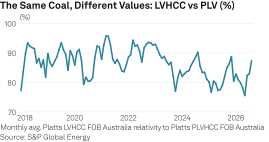
At times, LVHCC has traded at almost the same value as PLV.
At others, the discount has widened significantly.
Such shifts are difficult to explain through coal specifications alone. Rather, they demonstrate how the market continuously re-prices LVHCC relative to PLV as supply-demand dynamics, buyer participation and trade flows evolve.
Periods of stronger Chinese participation in seaborne markets have historically coincided with firmer LVHCC values, while growing competition from alternative supply sources has at times pressured relativities.
The sharp movement seen in 2026, when the monthly average relativity fell to around 76% before recovering above 87%, highlights how quickly values can change as the supply-demand balance shifts.
The coal itself changed little. The competitive landscape around it did.
Reading between the lines: relativities tell us more than quality
Relativities have long reflected differences between coal grades. What may be changing today is how much they can tell us about the market itself.
The Platts PLV HCC FOB Australia assessment remains the market's common benchmark for premium hard coking coal. A fuller understanding of the market increasingly requires looking beyond the benchmark itself. If relativities help explain what is happening around the benchmark, confidence in those signals then becomes increasingly important.
The value of a relativity as a market signal ultimately depends on the transparency of the underlying assessments.
The Platts LVHCC relativity is therefore not derived from a predetermined discount to the PLV benchmark. Instead, it reflects the relative values of two independently assessed coal grades, allowing the relationship to respond to shifts in supply, demand and trading activity rather than being derived from a fixed formula
The benchmark shows where the market is. Relativities help explain what is changing around it.
Each movement can point to a different force: shifting buyer preferences, new supply competition, changing trade flows or technological shifts across the steelmaking value chain.
In that sense, relativities do more than describe price differentials. They help explain how the coking coal market itself is evolving.
Related content: Fewer trades, broader transparency: What changing liquidity means for coking coal price benchmarking
