Metals & Mining, Non-Ferrous
July 28, 2026
COMMODITY TRACKER: 5 charts to watch this week

By Staff
Editor:
China restricts rare earths exports to European firms, while India and Australia strengthen copper trade ties. Hot weather pushes US Midwest power prices higher and Brazil shifts beef exports as China quota fills.
1. China adds European firms to rare earths control list
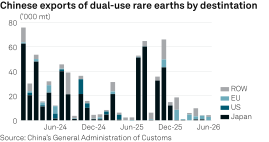
What's happening? China has added 14 European entities to its export control list, prohibiting Chinese exporters from supplying them with dual-use items without special authorization. The Ministry of Commerce said July 24 that the affected companies, based in Germany, Italy, France, Poland, the Netherlands, Czechia, Bulgaria and Lithuania, would be denied export permits. The restrictions cover rare earths including scandium, yttrium, samarium, terbium, dysprosium and lutetium, as well as gallium, germanium, graphite, antimony, tungsten, tellurium, bismuth, indium and molybdenum. Notable companies on the list include German defense firm Rheinmetall AG, Czech vehicle manufacturer Tatra Trucks, and German coating materials supplier Sindlhauser Materials, according to the ministry. Platts, part of S&P Global Energy, assessed dysprosium oxide at $2,100/kg CIF North America on June 30, unchanged month over month. Terbium oxide was assessed at $4,800/kg CIF North America in June, up from $4,700/kg in May.
What's next? China's export controls on dysprosium, gadolinium, lutetium, scandium, terbium and yttrium took effect April 4, 2025, following US Liberation Day tariffs, triggering a sharp decline in Chinese exports of rare earths and permanent magnets that have yet to recover. A second wave of export controls covering holmium, erbium, thulium, europium and ytterbium, as well as related products, equipment and technologies, is scheduled for Nov. 10.
2. India-Australia deal expected to boost copper trade flows
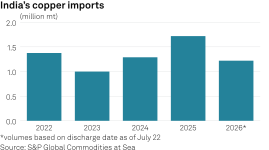
What's happening? India and Australia finalized administrative arrangements July 9 to enable Australian uranium exports to India while expanding cooperation on critical minerals, renewable energy, and secure flows of coal and LNG. The agreement is expected to strengthen copper trade between the countries, market participants and industry experts told Platts. India's copper imports from Australia reached a record 203,152 mt in 2025, up 106.2% year over year, according to S&P Global Commodities at Sea data. In 2026, copper imports from Australia stand at 124,618 mt as of July 24, based on discharge dates. Australia has the world's fourth-largest copper reserves, including Olympic Dam.
What's next? India's copper demand is projected to reach 3 million mt to 3.3 million mt by 2030, reflecting an increase of 2 to 2.2 times from current levels, and 8.9 million mt to 9.8 million mt by 2047, according to India's Ministry of Mines. The outlook is underpinned by India's targets for 500 gigawatts of renewable energy capacity and 30% electric vehicle penetration by 2030. About 95% of concentrate demand for domestic primary producers is projected to be met through imports or foreign asset acquisitions, while long-term domestic ore output is expected to meet only 4.6% of concentrate demand, the ministry said. India's government has allocated $5 billion to hunt for critical mineral deposits globally, with the majority expected to come from Australia.
3. Hot weather drives power prices higher in US Midwest
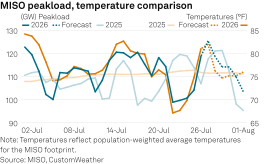
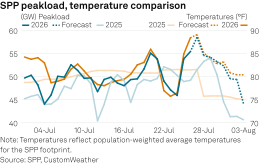
What's happening?Continued above-normal temperatures prompted the Midcontinent Independent System Operator to extend its hot weather alert through July 29, while the Southwest Power Pool extended resource advisories for its East and West balancing authorities through July 30. SPP set a new peakload record of 56.553 GW on July 27, surpassing the previous 2023 record by 369 MW. The extreme weather and grid advisories drove up wholesale power prices. The US Department of Energy issued an emergency order through Aug. 3 to maintain power supply during the energy emergency.
What's next?Power prices in the region reflected the tight supply conditions. SPP South Hub on-peak day-ahead traded at $53.75/MWh for July 28 on the Intercontinental Exchange, 17% lower than the previous day's settlement. However, the Indiana Hub on-peak day-ahead locational marginal price averaged about $117.50/MWh in July so far, 103.6% higher month over month. The emergency order remains in effect through Aug. 3 as grid operators manage the energy emergency amid hot weather.
4. Brazil's beef exports pivot as China quota nears
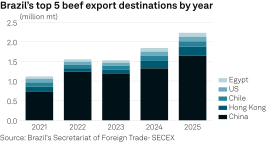
What's happening? Brazil's beef exporters are nearing exhaustion of their China quota, prompting a shift to alternative markets, according to local traders. China imposed an annual quota on beef imports from Brazil and announced an additional 55% tariff on imports exceeding the quota from 2026 through 2028, the country's commerce ministry said Dec. 31, 2025. For 2026, China set Brazil's quota at 1.1 million mt. From January through June, Brazil exported 744,155 mt of beef, 17.8% higher year over year, according to Brazil's Secretariat of Foreign Trade data released July 5. China's General Administration of Customs reported Brazil had utilized 78.9% of its safeguard quotas as of June 30. Platts assessed Brazil beef marker at $5,270/mt on July 20, down 8.7% year over year.
What's next? During January-June, Brazil's beef exports to the US rose 17.3% year over year to 183,598 mt, while shipments to Chile increased 20.6% year over year to 69,784 mt, according to Secretariat of Foreign Trade data. Brazil also sold 51,011 mt of beef to Russia during January-June, up 40.7% year over year. S&P Global Energy CERA estimated Brazil's beef production at 12.2 million mt in marketing year 2026, down 3.3% year over year, with total beef exports seen at 3.9 million mt, down 10.2% year over year.
5. Indian PMDI prices rise on higher benzene costs
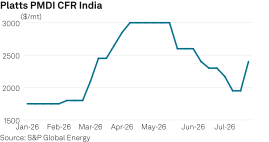
What's happening? Indian polymeric methylene diphenyl diisocyanate prices increased in the week ended July 24, driven by higher benzene costs amid renewed Middle East conflict and stronger realizations in Western markets. Platts assessed the Indian PMDI price at $2,400/mt CFR on July 24, up 23.1% week over week. Indian domestic PMDI prices rose to Rupees 260-270/kg in the week ended July 24 from Rupees 200-225/kg the previous week. Market participants observed better price realization in the West, particularly in the US, amid supply disruptions, while delayed monsoons extended PMDI demand beyond the usual summer peak in India. Platts, part of S&P Global Energy, assessed the Indian PMDI price at $2,400/metric ton CFR on July 24, up 23.1% week over week. The latest assessment remains below the 2026 high of $3,000/mt recorded over April 10-May 15.
What's next? Market sources indicated sustained demand with some end-users closing deals at $2,500/mt. South Korea-based producers increased offers due to rising raw material prices and reported maintaining high price levels. A Japan-based producer noted record sales during what is typically a low-sales season in April. The arbitrage opportunity remains favorable for moving material to Western markets, particularly the US, according to an India-based trader. Some Japanese producers continue shipping material to the US market while others maintain focus on India.
Reporting and analysis by Euan Sadden, Anthony Barich, Shivam Prakash, Kassia Micek, Ronnie Turner, Sampad Nandy and Sunaina Kura.
