Coal, Metals & Mining, Metallurgical Coal, Ferrous
June 25, 2026
Five key takeaways from Singapore Coking Coal Conference 2026

By Clement Choo
Editor:
The Singapore Coking Coal Conference 2026, a cornerstone event of the Singapore International Ferrous Week organized by SGX Commodities, brought together industry leaders to discuss the evolving landscape of the global coking coal market.
Here are five critical takeaways from the discussion that highlight how developments in Australia, China and India are reshaping supply chains, demand patterns and investment strategies across the metallurgical coal sector.
1. Challenge and change
Australian coking coal producers are navigating a challenging cost environment that is reshaping investment incentives. Australia's coking coal supply base remains strong. However, headwinds such as royalties, project approval delays and activism are "not going away soon," Stuart Bocking, CEO of Coal Australia, said.
Queensland royalties are a core economic headwind, despite a pro-coal government, Bocking said. Most spending is now directed toward extending existing mine life rather than greenfield expansion.
However, demand remains robust, even as supply shifts geographically. Overall demand is not going away, but imports are shifting. Growth in India and Indonesia has offset reductions from China, with India described as the new growth engine for metallurgical coal.
Australia-India ties and trade cooperation are expanding, according to Bocking. Even as the global steel industry works toward net-zero carbon emissions by 2050, steel-related coal demand will remain at about 90% of today's level in projection models and, as such, coal remains a critical input to steel, according to Bocking.
"Coal is a critical mineral," Bocking said. "A number of countries have certainly deemed it as such." Despite the conflict in the Middle East, fuel supply security has remained adequate, Bocking added.
2. Shortage and sufficiency
A deadly gas explosion at a coal mine in Shanxi province on May 22 that killed 82 people has tightened safety oversight and will constrain near-term output recovery in China's largest coking coal-producing region, which had been running at over 110% of rated capacity. The fatal accident may eliminate up to 30 million metric tons of coking coal supply as a flow-on effect, according to Edwin Yeo, a met coal trader at Exen Resources.
China has already lost between 6 million mt and 10 million mt this year, said Sylvia Cao, principal analyst for met coal and ferrous metals at S&P Global Energy, citing data from S&P Global Energy CERA. "The shortages are mostly Tier 1 high CSR (coke strength after reaction) materials, which are not coal you can get from Mongolia, definitely not coal you get from Russia and this forms a bread and butter for high CSR coke for big steelmakers in China," Yeo said.
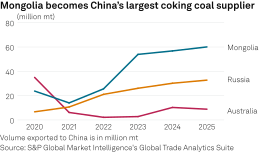
China's coking coal import pattern has undergone a dramatic rebalancing, with Mongolia emerging as the dominant swing supplier, Yeo added.
Mongolia's official target of 100 million mt/year of exports to China is supported by unified government planning and improved logistics, Chinese speakers said. Mongolia accounted for 61% of China's imports over January-April, while its coking coal imports rose 20% year over year during the same period, Cao said.
3. Demand and diversification
India is expected to continue growing its steel production capacity and, in turn, its coking coal demand. Coking coal imports rose 7% in the first quarter of 2026, with the increase attributed to higher volumes from the US, Mozambique and Canada, Cao said.
The country is reducing its reliance on a single coal type (lowering the share of certain coal blends) and diversifying supply sources to manage costs and reduce geographic concentration risk, according to Amita Khurana, group chief of raw materials procurement at Tata Steel. India is also using more adaptable charging/blending technology to switch between different coking coal qualities. Simultaneously, the country is moving toward domestic coking coal, which may take two to five years to develop, Khurana said.
India needs better ports, stockyards, blending facilities, rail evacuation and more active spot participation to gain a stronger pricing role, Khurana added. The outlook for met coal demand growth remains tightly linked to the sustained momentum of India's public investment cycle.
India's steel production per capita is still relatively early in its industrialization cycle compared with China, implying continued steel and, thus, coking coal demand growth, according to Battsengel Gotov, executive director and CEO of Mongolian Mining Corp.
4. Landlocked and limited
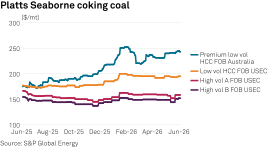
Mongolian coal has provided a partial buffer for Chinese buyers amid slower domestic demand, while overall supply chains show greater optionality even as they navigate greater complexity and geopolitical uncertainty, according to Platts, part of S&P Global Energy.
Mongolia functions as part of China's domestic supply chain as the country is landlocked and has no seaborne access, Gotov said. In 2025, Mongolia produced about 96 million mt of coking coal and exported about 90 million mt -- the overwhelming share went to China, Gotov added.
China produces about 80% of the coking coal it consumes domestically and imports about 20%, based on 2025 figures, according to Gotov. Mongolia supplies 10% of China's total consumption via land routes, accounting for half of China's imports. Mongolia is not an export-oriented one. "It really has one customer, which is in China," Gotov said.
Mongolia is less of a competitor to Australia globally and functions more as a regional supplier to specific parts of China, benefiting from geography and China's preference for minimizing seaborne exposure, according to Gotov.
5. Constrained and capable
Indonesia has emerged as a growing coking coal supplier, with production at 15 million mt in 2025, according to Patricia Lumbangaol, marketing general manager at AlamTri Resources. AlamTri posted a 12% year-over-year increase in metallurgical coal sales to 6.28 million mt in 2025.
Exports reached about 8.8 million mt, with Chinese demand already increasing and more inquiries for Indonesian coal emerging after the Chinese mine accident, Lumbangaol said.
However, Indonesia's ability to fill China's gap is constrained by logistics. Many mines operate in Central Kalimantan, and smaller- to medium-sized operations may struggle to increase output due to inadequate transport infrastructure and wash-plant capacity, according to Lumbangaol.
Indonesia could capture incremental demand but not fully solve the premium-quality gap. Logistics bottlenecks, washing capacity limitations, regulatory uncertainty and fuel costs constrain rapid expansion despite rising demand for Indonesian coal, industry participants said.
