June 15, 2026
How price transparency is reshaping global cement and clinker trade

Editor:
For decades, cement was a "local" business -- heavy, dusty and tied to nearby quarries and construction sites. Today, cement and its intermediate product, clinker, are traded globally at around 230 million metric tons per year in an industry worth over $400 billion. Historically, most of this trade was priced in the dark through bilateral deals, opaque tenders and annual contracts. That's changing rapidly.
Independently assessed reference prices have become available to the market just as volatility, policy shifts and new trade routes are transforming how cement and clinker are produced, shipped and financed. This explainer covers what's changing, why price reporting matters, and how robust benchmarks are laying the groundwork for the financialization of cement and clinker -- just as they did with iron ore and LNG.

Cement used to be a local business, but today it is global, with trade flows connecting Asia, the Middle East, Europe, Africa, and the Americas. Geopolitical risks and policy changes are driving volatility in this market and increasing the need for transparency.
Cement market dynamics: from local to global
Cement pricing starts with clinker, the semi-finished material that can be shipped efficiently and ground closer to end-use markets. Where domestic grinding capacity exists, clinker becomes the "swing barrel" -- the flexible volume that moves when regional economics shift.
Here are the factors that have brought new volatility to the market in recent years:
- War in the Middle East. Heightened tensions and conflict in the Middle East can lead to unpredictable cement and clinker prices due to supply chain disruptions.
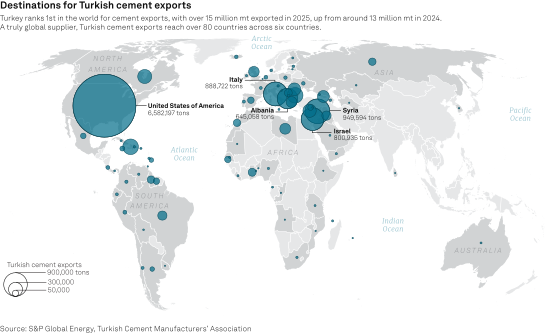
- Rising exports and shifting trade flows. In 2025, cement and clinker production hit record levels in Turkey, totalling 93.7 million mt and 82.7 million mt, respectively, up 15.5% and 6.7% from the prior year. Exports totalled over 15 million mt, and 7.49 million mt up 15.5% and 43% from the prior year, according to Turkish Cement Producers' Union (TurkCimento) data.
- Supply chain and freight disruptions. Cement and clinker are low-value-to-weight products. Small changes in freight rates or vessel availability can instantly change which origin is competitive.
- Policy and carbon costs. The EU's Carbon Border Adjustment Mechanism will add roughly Eur15-20/mt to Turkish clinker imports from 2026, depending on European carbon allowance prices.
- Geopolitics and megaprojects. Conflicts in Ukraine and the Middle East have suppressed local demand but are expected to drive reconstruction demand. Meanwhile, Saudi Vision 2030 and other infrastructure plans are drawing volumes into the Gulf, tightening supply elsewhere.
With these factors at play, the cement and clinker markets are becoming increasingly global. Turkey, the world's largest cement exporter and the second-largest exporter of clinker, ships cement to 120 countries and exports over half its clinker to Europe. As a result of the increasingly global trade, pricing arbitrage factors in significantly. Prices move sharply over weeks, not years. The old world of stable, annual pricing is gone.
Pricing structure and transparency
In many commodities, price reporting agencies, such as Platts, part of S&P Global Energy, provide independent price assessments that become reference points for contracts, budgets and derivatives. Until recently, cement and clinker lacked this infrastructure.
Historically, cement and clinker pricing involved opaque bilateral deals with potential risks in contract fulfillment and fragmented views on value. PRAs solve issues like these by collecting market data (deals, bids, offers, tenders and indications); assessing repeatable, tradable value for specific grades, volumes and delivery windows; and publishing benchmark prices for contracts, budgeting and eventually financial hedging.
The shift in the cement and clinker market mirrors earlier transitions in iron ore, coal and LNG, where transparent benchmarks enabled standardized, index-linked contracts and liquid derivatives.
Platts launched weekly cement and clinker assessments in January 2025 to build a robust price framework for global trade. Three features distinguish its approach:
Transparent methodology. Focus on tradable spot value, using a pricing hierarchy that prioritizes confirmed deals, firm bids/offers, and well-sourced indications. Each benchmark has clear specifications for quality, volume, shipment window and terms.
Deep bilateral relationships. Platts engages with producers, traders, importers and buyers across regions. Information is cross-checked, and participants see how their input shapes published assessments, building trust and participation.
Coverage of key trade lanes. Current assessments include:
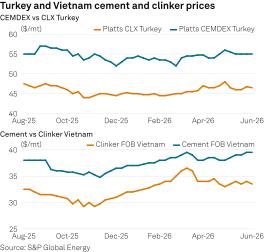
- Platts CEMDEX Turkey (FOB) – bulk CEM I 42.5R cement
- FOB Turkey clinker – grey OPC clinker
- FOB Vietnam clinker – grey OPC clinker
- CIF Houston cement – bulk ASTM Type I/II cement
These prices create a global value map, allowing participants to compare netbacks, test arbitrage and understand regional interactions.
Cement and clinker market evolution toward daily pricing
Cement and clinker are following the path of more mature commodity markets, moving from infrequent, opaque pricing toward high-frequency, structured price discovery.
Key elements:
- More frequent assessments. Weekly benchmarks are a starting point. As liquidity builds, daily pricing becomes possible.
- Market-on-Close (MOC) processes. In other Platts markets, MOC collects firm bids, offers, and trades during a set window each day, anchoring end-of-day assessments. As cement and clinker participants share live indications, similar frameworks can enhance transparency and confidence.
- Continuous stakeholder engagement. The Platts methodology adapts as trade flows change. Regular dialogue ensures benchmarks reflect market reality.
The direction is clear: more data, more structure, and more frequent price signals.
Reliable price assessments have practical impacts across the value chain. For producers, assessments help with decisions such as what and where to ship, and how to plan investments. Importers and traders can validate offers, compare origins, optimize freight and vessel use, while large buyers and public sector can use assessments to improve budgeting, use index-linked contracts and compare suppliers. Finance and risk teams can also use these to embed benchmarks in transfer pricing, model scenarios, and prepare for hedging and derivatives.
As confidence in assessments like CEMDEX grows, cement and clinker can develop a derivatives ecosystem like those in oil, gas, coal and iron ore -- allowing market participants to manage price risk separately from physical flows.
Carbon and decarbonization
As carbon prices and policies move, they add volatility -- reinforcing the need for transparent, reliable price assessments. Regulations like the CBAM and emissions trading will increasingly determine which plants and origins are competitive.
Corporate strategies are shifting toward alternative fuels, and supplementary cementitious materials (SCMs), such as granulated blast furnace slag (GBFS), have been introduced and increasingly adopted to partially replace clinker in cement production. These alternative materials significantly reduce carbon emissions and production costs while maintaining performance standards. They also have an impact on cement pricing.
The takeaway
With trade flows being more fluid and sensitive to shocks, the cement and clinker market is at an inflection point. The market is now moving toward higher-frequency pricing, supported by active participation.
Robust price data is now essential for operations, strategy and risk management -- and will underpin the coming financialization of global cement trade.
For an industry built on rock and kiln, cement and clinker are finally gaining the financial tools and transparency of a modern global commodity.
