Natural Gas, LNG, Metals & Mining, Agriculture, Chemicals, Non-Ferrous
April 21, 2026
COMMODITY TRACKER: 4 charts to watch this week

By Staff
Editor:
S&P Global Energy editors and reporters continue to monitor developments in the Middle East and their impact on commodities, including LNG trading, Australia's farming output and alumina prices.
1. Platts JKM balance-month cash differentials flip to discounts for May deliveries amid shifting supply risks
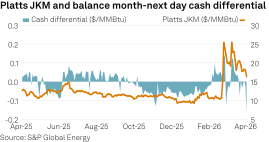
What's happening? Cash differentials in the Asian LNG market fell during the May pricing cycle, reflecting a partial unwinding of earlier geopolitical risk premiums even as underlying supply uncertainty persisted. Platts JKM balance-month next-day-linked trades for May delivery during the Asia LNG Platts Market on Close assessments process cleared at an average discount of 3.4 cents/million British thermal units, reversing the 13.8 cents/MMBtu premium seen in the previous cycle. Similarly, discount for June full-month-linked trades averaged 2.6 cents/MMBtu, indicating a shift toward weaker prompt pricing. Platts is part of S&P Global Energy.
What's next? Market direction will hinge on how supply risks evolve alongside fragile demand signals. Spot demand in Northeast Asia has remained muted due to fuel switching and softer downstream consumption. Buying interest has shifted toward South and Southeast Asia, where importers seek replacement cargoes amid constrained Middle Eastern flows. Uncertainty around the durability of the ceasefire is expected to keep risk premiums embedded in prices. However, sustained high prices may begin to erode demand, particularly in price-sensitive markets, potentially setting the stage for a gradual rebalancing if consumption weakens.
2. EU eSAF projects stall amid fall in price forecasts, mandate doubts
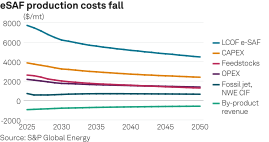
What's happening? High capital expenditures, a steeply falling cost curve and uncertainty over EU mandates and offtake terms are delaying investment decisions on dozens of synthetic sustainable aviation fuel projects, leaving many without final approval. There are about 40 eSAF projects in the EU, according to strategy firm Capstone as of April 6, and so far, there are no final investment decisions. The current environment creates timing risk for investors, where early, first-of-a-kind projects enter the market at very high production costs, said Rahul Malik, a consultant at S&P Global Energy. Malik added that later projects benefit from rapid cost reductions driven by technology learning, scale-up, and declining renewable power and electrolyzer costs.
What's next? The levelized production costs for eSAF in 2026 will be $7,471/metric ton, falling to $4,480/mt in 2050, according to S&P Global Energy analysts' forecast. The approach that worked for offshore wind and solar, where contracts are used to "give early investors certainty, even if it means early buyers pay a premium," could help address the eSAF challenge, said Izabela Santos, managing director at SAF commercial advisory StratX.
3. Oversupply in alumina market keeps prices under pressure
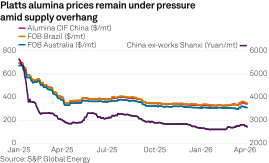
What's happening?Alumina demand fell faster than supply adjustments when the Middle East conflict resulted in smelter curtailments toward the end of the first quarter. This resulted in surplus material flowing into the spot market, limiting the potential for sustained price recovery despite intermittent arbitrage opportunities during the period. Platts assessed the FOB Australia alumina price at an average of $306.91/mt in Q1, down 2.82% quarter over quarter.
What's next? FOB Australia alumina prices are expected to remain guided by the market's capacity to absorb surplus material through trade flows, market participants said over the quarter. While Chinese import arbitrage may underpin spot activity, sustained improvement in prices will likely require clearer evidence of a recovery in alumina demand and supply-side adjustments that tighten availability, particularly as new refining capacity continues to enter the market.
Related content: Platts metals trade review
4. Strait of Hormuz disruption threatens Australia's farm economics
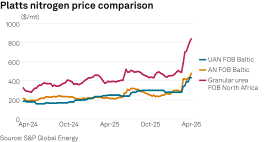
What's happening? Disruptions at the Strait of Hormuz are emerging as a severe threat to Australian agriculture, with up to 25%-32% of broadacre crop output at risk, according to an analysis by the Commonwealth Bank of Australia. In 2025, Australia sourced 64% of its nitrogen fertilizer imports from the Middle East. With flows disrupted, a 45% reduction in urea application could cut wheat output by up to 9 million metric tons, barley by 5.2 million mt and canola by 2.4 million mt in the 2026-27 season.
What's next? If supply disruptions persist into the Southern Hemisphere planting season, yield losses will become unavoidable due to fixed fertilizer-to-yield ratios, according to the CBA analysis. Even without weather impacts, reduced nutrient application is likely to lock in lower productivity, tightening exportable supply later in the marketing cycle. A further cost escalation is likely as supply chain disruptions ripple into secondary inputs, such as chemicals and logistics. The CBA expects price volatility to intensify toward end-2026 and into 2027, when reduced yields and tighter export availability begin to surface.
Reporting and analysis by Cindy Yeo, Thomas Washington, Zuyu Tian and Samyak Pandey
