LNG, Natural Gas
April 17, 2026
ASIA LNG MOC: Dual supply shocks, ceasefire uncertainty keep liquidity firm

By Cindy Yeo
HIGHLIGHTS
About 1.1 mil mt of LNG cargoes traded in Asia physical MOC
Derivatives trade activity nearly six times higher YOY
Balmo cash differentials for May delivery end negative
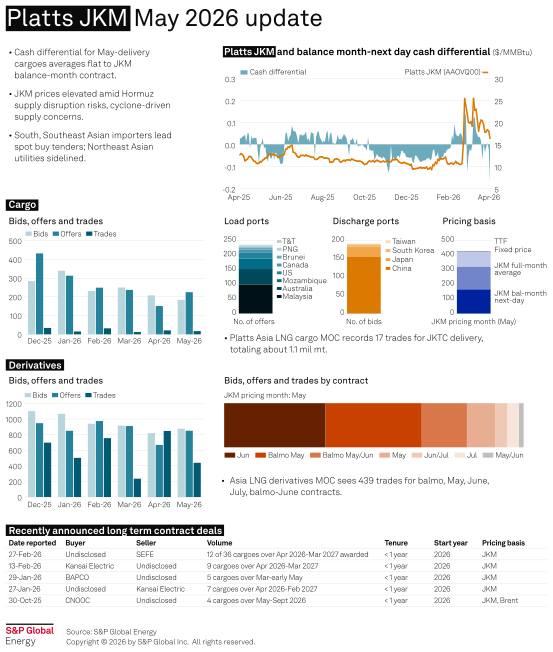
Activity in the Asian Platts Market on Close assessment process remained robust during the May pricing period (March 16-April 15), as supply disruptions linked to the Middle East conflict and cyclone damage in Australia kept participants active across both physical and derivatives markets, according to an analysis of S&P Global Energy data.
Total bids, offers and trades in the physical MOC reached 426 entries, up 12.11% month over month and 45.89% year over year.
A total of 17 trades for May-delivery cargoes into the Japan-Korea-Taiwan-China (JKTC) region were concluded between BP, Engie, Glencore, Marubeni, Mercuria, PetroChina, Shell, TotalEnergies, Trafigura, Vitol and CNOOC, totaling about 1.1 million mt.
Of these, five trades were indexed to the JKM balance-month next-day (balmo) contract, seven to the JKM June full-month contract, and five on a flat-price basis.
Balmo-linked trades for May deliveries cleared at an average 3.4 cents/MMBtu discount, reversing the 13.8 cents/MMBtu premium seen for April deliveries in the prior cycle as easing war sentiment briefly unwound risk premiums. June-linked trades averaged a 2.6 cents/MMBtu discount, while flat-price trades ranged from $15.95/MMBtu to $19.45/MMBtu.
Of total physical activity, 38.7% was linked to JKM balmo, 36.4% to the JKM full-month benchmark, 24.2% was fixed-price, and just 0.7% was indexed to Dutch TTF, highlighting a continued shift away from European gas pricing in Northeast Asian-delivery trades.
Meanwhile, derivatives trade activity retreated from April's record high. A total of 439 trades were reported in the derivatives MOC during the May pricing period, down 48.2% month over month but nearly six times higher year over year.
Total entries reached 2,165 from 24 participants, comprising 876 bids, 850 offers and 439 trades.
Trading was concentrated in the JKM June full-month contract, which accounted for 52% of volume, followed by May balance-month contracts at 41%, as participants sought to hedge for the prompt delivery window.
Dual supply shocks keep market on edge
JKM prices were driven mainly by shifting supply sentiment around the Middle East war, cyclone-related outages in Australia and later developments involving a conditional ceasefire and partial plant restarts.
Market participants said that despite supply disruptions, urgent spot demand across Northeast Asia remained limited, with fuel switching and weaker downstream consumption reducing prompt requirements.
Buy-side tender activity was instead concentrated in South and Southeast Asia, where importers sought replacement cargoes amid disrupted Middle Eastern supply. From Northeast Asia, only Taiwan's CPC and Japan's Tohoku Electric were heard seeking spot cargoes.
Several market sources questioned the durability of the conditional ceasefire, noting the continued absence of ship transits through the Strait of Hormuz and that prices had yet to return to pre-war levels. Market participants also flagged the risk of demand destruction across Asia if prices remained elevated.
"I'm not sure countries like Bangladesh and India will continue buying at these price levels," a Japan-based trader said. "Demand will eventually weaken and the market will rebalance."