Energy Transition, Renewables, Hydrogen, Battery Metals
December 17, 2025
ET Highlights: New York proposes emissions cap, UK starts carbon storage licensing round, India renewable generation rises 21% YOY
Energy Transition Highlights: Our editors and analysts bring together the biggest stories in the industry this week, from renewables to storage to carbon prices.
Top story
New York proposes reduced regional greenhouse gas emissions cap
New York agencies submitted a new update to the state's Regional Greenhouse Gas Initiative implementation plan, proposing an emissions cap of approximately 69.8 million tons of carbon dioxide in 2027.
"The proposed updates to RGGI are a strong example of how states can work together with an eye towards affordability to achieve emissions reductions that will improve air quality, protect our environment, invest in clean energy, and create healthier communities," New York Department of Environmental Conservation Commissioner Amanda Lefton said in a Dec. 10 statement.
After 2027, the updates — proposed by the DEC and the New York State Energy Research and Development Authority — would have the cap decline 89% relative to the 2024 cap through 2037. This revised cap would result in CO2 emissions decreasing by approximately 10% annually through 2033, followed by 3% annually until 2037, according to the DEC.
A DEC spokesperson said all states participating in RGGI need to finalize their updated regulations in 2026 for the RGGI program to implement them in 2027.
Benchmark of the Week
C$26.1/alw
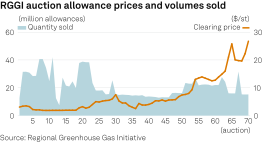
Platts, part of S&P Global Energy, assessed next-month Regional Greenhouse Gas Initiative allowance costs at $26.1 per allowance on Dec. 12, a sharp drop from record-highs seen in the first days of December. The program is entering into an oversupplied year in 2026.
Learn more: Platts Carbon Markets Specifications Guide
Editor's Picks: Free and premium content
SPGlobal.com
Low-carbon ammonia markets firm ahead of EU carbon border rules
The global low-carbon ammonia market strengthened significantly from October to November, as conventional ammonia supply constraints tightened the market and supported prices, and exporters started to lineup low-carbon cargoes to Europe ahead of the Carbon Border Adjustment Mechanism implementation. Carbon capture-enabled blue ammonia prices rose 6%-8% month over month across major regions in November, with values in Northwest Europe -- the highest-priced delivery region -- up $44/metric ton to average $739/mt.
UK launches second carbon storage licensing round for 14 sites
The North Sea Transition Authority has launched the UK's second carbon storage licensing round, offering 14 offshore locations with potential capacity for up to 2 billion metric tons of CO2 storage, the NSTA said in a statement Dec. 9. The licensing round, which runs until March 24, 2026, includes five areas in Scottish waters and nine off the English coast, comprising both depleted hydrocarbon fields selected by the NSTA and saline aquifer sites identified through industry nominations.
S&P Global Energy Core
India's renewable power generation rises 21.39% YOY to 21.49 TWh in Oct
India generated 21.49 TWh of renewable power in October, up 21.39% year over year, on the back of favorable policies and rising demand for decarbonization, data from the Central Electricity Authority showed. India’s renewable power generation accounted for approximately 15.21% of the total power
Mitsubishi Heavy Industries cracks ammonia using steam heat to produce hydrogen
Mitsubishi Heavy Industries successfully produced hydrogen by cracking ammonia using steam heating at its pilot plant in Nagasaki, Japan, a move that could potentially enable large-scale trade of renewable hydrogen in global markets. The development is significant as ammonia is attracting attention as a hydrogen carrier to store and transport hydrogen over long distances safely and in large quantities, which can be cracked to produce hydrogen at the point of use.
INTERVIEW: Refineries are 'critical enabler' for scaling green hydrogen in Europe: Shell
Shell sees refineries as central to scaling up low-carbon hydrogen production in Europe and reducing costs, leveraging its integrated energy position to manage costs across the full supply chain, the company’s President for Hydrogen Andy Beard told Platts in a recent interview. The company has taken final investment decisions on hydrogen projects in Germany and the Netherlands by leveraging existing refinery infrastructure and captive demand, Beard said.