Energy Transition, Renewables, Hydrogen, Battery Metals
December 03, 2025
ET Highlights: Rotterdam expands green bunkering, EU seeks ETS volatility curbs, US RGGIs hit record high
Energy Transition Highlights: Our editors and analysts bring together the biggest stories in the industry this week, from renewables to storage to carbon prices.
Top story
Rotterdam expands green bunker capacity, worried over IMO delay
The Dutch port of Rotterdam is pushing ahead with infrastructure expansion for sustainable marine energy, but global decarbonization rules would be required for an industry-wide low-carbon bunker transition, the port's Chief Operating Officer Berte Simons, told Platts, part of S&P Global Energy.
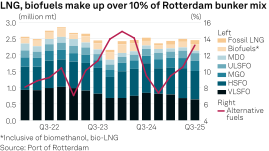
LNG and biofuel bunker sales at Rotterdam, the world's second-largest marine refueling hub, have been on an upward trend in recent years, with the port authority kickstarting its pursuit of climate neutrality by 2050.
The port reported 2.45 million metric tons of marine fuel sales during July-September, of which alternatives to conventional, oil-based fuels accounted for 13.2%, the highest among major bunker ports. Deliveries of biofuels, composed mainly of biodiesel-fuel oil blends, reached 201,319 mt, and fossil LNG amounted to 121,614 mt.
"For the next few years, we will have LNG there together with new green fuels for quite some time," Simons said in a recent interview. "We have set out to increase the volume of biofuels and to come up with bunkering facilities for new fuels, to work on imports and exports and bunkering strategies for hydrogen, ammonia and methanol."
Benchmark of the Week
$28.65
Platts assessments of US Regional Greenhouse Gas Initiative allowances, a record high.
Learn more: Platts Carbon Markets Specifications Guide
Editor's Picks: Free and premium content
SPGlobal.com
Brussels adopts measures to curb price volatility in EU ETS2
The European Commission adopted proposals to strengthen price stabilization measures for the EU's new carbon market covering road transport, buildings and small businesses, and heating fuels, it said Nov. 27. This includes the introduction of the Market Stability Reserve, which is designed to ensure stronger intervention if the price exceeds a certain level, reinforce the capacity of this mechanism to operate in the longer term, and ensure earlier and smoother intervention to stabilize the supply of allowances.
Australia, China poised to lead APAC Power-to-X SAF push
Australia and China are positioned as potential production powerhouses for sustainable fuels due to their vast renewable resources and industrial CO2 sources, while other key economies face significant infrastructure and resource hurdles, deliberations at the Roundtable on Sustainable Biomaterials show. In its first integrated assessment of the region, titled "PtX and Sustainable Aviation: A Roadmap for Asia-Pacific," the RSB identified a distinct divide in the region's capacity to scale Power-to-Liquids and Power-and-Biomass-to-Liquids fuels.
S&P Global Energy Core
RGGI carbon allowance prices reach record high ahead of auction
Carbon allowance costs in the US Regional Greenhouse Gas Initiative reached a record high on Nov. 25 ahead of the final quarterly auction of 2025 without cost containment reserve allowances. Platts, part of S&P Global Energy, assessed RGGI next-month allowance prices at $28.65 per allowance, a record high and up 2.8% on the day.
Kawasaki breaks ground on liquid hydrogen terminal for commercial demonstration
Japan Suiso Energy and Kawasaki Heavy Industries broke ground on a commercial-scale liquid hydrogen terminal in Kawasaki City, marking a pivotal step toward establishing a hydrogen supply chain that could reshape global energy trade flows by 2030, the firms said. The Kawasaki LH2 Terminal will feature a 50,000 cu m liquefied hydrogen storage tank and related facilities for maritime cargo handling, hydrogen liquefaction, and gas supply, providing critical infrastructure to position Japan as a major hydrogen import hub, according to the companies.
Australia sets 62%-70% 2035 emissions cut target as climate inaction risks A$40 bil/year hit
Australia has set an ambitious 2035 emissions reduction target of 62%-70% below 2005 levels as new analysis warns climate inaction could cost the economy more than A$40 billion ($26 billion) annually by 2050, threatening economic competitiveness in a decarbonizing world, minister of climate change and energy, Chris Bowen, said while tabling the Annual Climate Change Statement 2025. Citing the report, Bowen warned that extreme weather events pose mounting economic risks, mandating the need to accelerate energy transition and decarbonization.