Metals & Mining, Electric Power, Energy Transition, Ferrous, Non-Ferrous, Hydrogen
October 16, 2026
EU institutions split on scope of CBAM expansion

By Max Mucenic
Editor:
The EU's Carbon Border Adjustment Mechanism (CBAM) entered its definitive phase in January, applying potential carbon costs to imports of steel, aluminum, cement, fertilizer, electricity and hydrogen based on their embedded emissions.
Currently, CBAM covers semi-finished materials, such as crude steel and unwrought aluminum, while finished products made from those materials are typically excluded due to the greater complexity in determining their embedded emissions. However, EU policymakers have proposed expanding CBAM to cover certain finished goods starting in 2028. The expansion is aimed at preventing buyers from circumventing CBAM by importing finished goods instead of the CBAM-impacted materials they are made from.
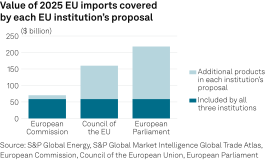
The volume of trade up for consideration is substantial. According to S&P Global Market Intelligence's Global Trade Atlas (GTA), products currently floated for the CBAM scope expansion accounted for over $255 billion of EU imports in 2025, about 2.5 times the $103 billion in imports covered in CBAM's initial scope.
Three institutions, three lists
The European Commission, the EU Council and the European Parliament have each advanced distinct proposals to expand CBAM to finished goods. While the proposals overlap across machinery, electrical equipment, vehicles, household metal goods, tools, fittings and furniture, they differ on other goods, including turbines and medical equipment.
Now that all three proposals are on the table, the EU legislative bodies will begin trilogue negotiations over the final scope of the CBAM expansion. According to GTA data, 24% of the total trade value occurs in products common to all three proposals. The remaining 76%, representing over $194 billion in annual EU imports, is contested across the three proposals.
Related podcast: ENERGY EVOLUTION PODCAST: Inside CBAM's first year: what traders, importers and policymakers learned
Clear path forward for some products
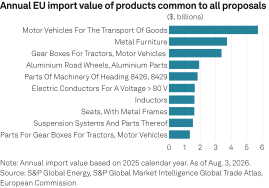
The goods included in all three proposals have the clearest path to entry into CBAM, as all three institutions already agree to their inclusion.
Some of the largest categories by trade value are commercial vehicles, metal furniture, automotive gearboxes, aluminum road wheels, machinery parts, insulated electrical wires and vehicle suspension systems, according to GTA. For manufacturers and importers of these goods, the focus turns to whether suppliers can deliver verified emissions data.
Uncertainty dominates expansion
Most goods up for inclusion are not common to all three proposals.
The Council's proposal in June expanded the scope of the Commission's proposal to include boilers, turbines, furnaces and saw blades. Notably, it also proposed removing medical equipment, such as needles, from the Commission's initial list.
Parliament's list, adopted in September, went even further, bringing the total number of products to over 400 by adding railroad components, power transmission equipment, air conditioners and solar and wind power generation equipment. In contrast to the Council, it proposed expanding the Commission's list of medical and surgical instruments rather than removing it.
US exposure depends more heavily on contested products
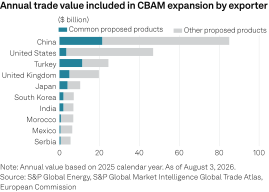
China, the US, Turkey, the UK and Japan supplied about 73% of the EU's 2025 imports of goods up for inclusion, according to GTA. While exporters in each of these countries will be affected by product expansion, the impact of the negotiations will vary by country depending on each country's product mix.
About 92% of the US' $46.2 billion exposure comes from contested goods, particularly gas turbine components proposed by the EU Council and medical equipment proposed by the Parliament. This makes the US exporter position especially uncertain until trilogue negotiations produce a final product list.
By contrast, about half of Turkey's $24.5 billion in trade exposure comes from goods common to all three proposals, primarily vehicles and vehicle parts, providing a better indication of how their exports will fare under the CBAM expansion even while the trilogue is still ongoing.
Implementation challenges ahead
After agreeing on the expanded scope, the Commission will still need to determine default emissions values and carbon accounting methodologies for the newly added products.
Collecting verified emissions data may be harder for more complex finished goods than for the materials in CBAM's initial scope. The Commission has recognized this challenge and proposed not imposing dissuasive markups on the default emissions values for finished goods. The markups range from 1% to 30% for existing CBAM products.
The proposals establish a direction of travel toward extending CBAM further down manufacturing supply chains. Negotiations over the goods covered and the emissions-accounting rules will determine the scale and cost of that expansion.
Go deeper: The S&P Global Energy CBAM Scenario Planner enables users to estimate potential CBAM compliance costs by product and country of origin under different economic and carbon-price scenarios.
