Energy Transition, Electric Power, Carbon, Emissions, Hydrogen
January 07, 2026
COMMODITIES 2026: Europe's CBAM goes live as importers grapple with rising carbon costs

HIGHLIGHTS
EU's CBAM enters definitive phase amid trade tensions
China warns of retaliation against 'unfair' policy
EU carbon prices hit multi-year highs ahead of CBAM launch
The wait is over. After years of speculation, political wrangling, and industry uncertainty, the EU's Carbon Border Adjustment Mechanism crossed the threshold from an ambitious climate experiment to a market reality, entering its definitive phase on Jan. 1, 2026.
Under the world's first carbon border tax mechanism, importers of carbon-intensive goods into the EU from six covered sectors -- aluminum, cement, electricity, fertilizers, iron and steel, and hydrogen -- will now be liable for their emissions, and they will soon purchase CBAM certificates corresponding to the embedded carbon content of their products.
This marks the end of a transitional reporting-only period that began in October 2023, ushering in what industry experts describe as the world's most radical carbon pricing policy, with far-reaching implications for global commodity trade flows.
"The period of uncertainty is over," Gabriel Rozenberg, co-founder and CEO of London-based CBAM software company CBAMBOO, said on a webinar on Jan. 6. "The world's first CBAM is a stricter and more financially impactful regulation than most people expected."
The EU's CBAM works alongside the EU Emissions Trading System to prevent carbon leakage by imposing carbon pricing on imports as Brussels phases out free allowances for domestic producers.
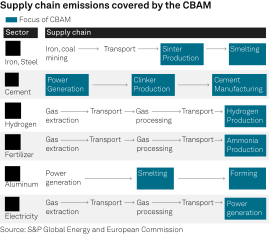
Last-minute clarity
The run-up to CBAM's definitive phase has been anything but smooth. The European Commission provided key details -- including default values, CBAM benchmarks, and emission calculation methodologies -- only in mid-December, mere days before the policy took effect.
This last-minute revelation left importers worldwide ill-prepared and anxious, frantically estimating compliance costs while assessing potential supply chain disruptions that could reshape decades-old trading relationships.
The release of these benchmarks has shattered months of market paralysis, but the aftermath reveals that many companies that relied on a wait-and-see strategy are now waking up to a reality of costlier and higher-impact consequences from CBAM.
"Now that the benchmarks have been released, we're seeing large price premiums on imports because most traders are using default values to calculate their CBAM costs rather than actual emissions," Dan Maleski, a senior environmental markets adviser and CBAM lead at Redshaw Advisors, told Platts. "This is driven by the low likelihood of being able to use verified actual emissions in 2026."
However, importers can purchase CBAM certificates starting February 2027 to cover emissions from their 2026 imports, providing businesses time to adapt to the carbon pricing mechanism. Importers also have until September 2027 to submit their first CBAM declarations for 2026 imports, creating compliance pressures across global supply chains.
EU carbon prices gain momentum
However, while companies awaited clarity on CBAM benchmarks and default values, the price of carbon, which forms the basis of CBAM certificates, underwent significant changes, particularly toward the end of 2025.
European carbon prices surged to multi-year highs in December as the supply of allowances tightened due to reduced auction volumes. The rally in the EU carbon complex was further supported by investment funds increasing their net long positions to record levels last month.
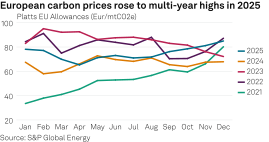
EU Allowances averaged Eur84.95/mt in December, the highest monthly average since August 2023, and up 25% compared with December 2024, according to data from Platts, part of S&P Global Energy.
"The cost of hedging that same exposure is now Eur300,000 higher than it was in October," Maleski added.
Another big issue for the industry is that the knowledge gap remains alarmingly wide, especially across the six commodity sectors covered by CBAM.
"We are still seeing a worrying lack of education in the market. Some traders with multi-million-euro CBAM exposure in 2026 still do not fully understand the basics of the system," Maleski added.
"As a result, exposure that could have been addressed months ago is either not being taken seriously due to misunderstanding or is being ignored entirely because of distractions such as safeguard measures."
China warns of response
Reactions to CBAM have been wide-ranging, with many developing and emerging economies expressing frustration over what they view as the trade protectionist nature of the mechanism.
On the day CBAM finally entered its definitive phase, China escalated its diplomatic offensive against the policy, issuing stark warnings of potential retaliation.
On Jan. 1, a spokesperson for the Chinese Ministry of Commerce said the EU's CBAM seriously damages international trust, creating a conflict between climate and trade governance rules.
"China is willing to work with the EU to address the challenges of global climate change but will resolutely take all necessary measures to respond to any unfair trade restrictions, safeguard its own development interests, the legitimate rights and interests of Chinese enterprises, and the stability of global industrial and supply chains," the spokesperson added in a statement.
The European Commission maintains that CBAM complies with World Trade Organization rules, calling it a "climate-oriented, environmental policy tool which will be applied in a non-discriminatory manner," according to a Dec. 17 statement.
The Commission's release of CBAM benchmark values and default values also drew a sharp reaction from China.
A Chinese Ministry of Commerce spokesperson said the EU "disregards the significant achievements China has made in green and low-carbon development" by setting high default values that will increase annually over the next three years, calling this "unfair and discriminatory treatment against China."
CBAM applies high default values when verified emissions data is unavailable, pushing companies to report actual figures.
Further read: The potential proliferation of CBAM: a fragmented carbon tariff landscape

Editor: