Electric Power, Coal, Energy Transition, Natural Gas, Hydrogen
July 17, 2026
India’s net-zero power transition: A strategic bet on technological leapfrogging
India's journey to net zero is not simply a climate commitment -- it is emerging as a defining national development strategy. As electricity demand accelerates alongside industrialization, urbanization and electrification, the power sector will sit at the center of this transformation, according to S&P Global Energy CERA analysis.
The question is no longer whether India will decarbonize, but how it will balance growth, affordability and energy security while doing so.
At the heart of this transition lies a strategic choice between competing -- but increasingly complementary -- pathways.
The key pathways emerge
India's power sector could evolve along two distinct trajectories. One pathway is built around renewables -- solar and wind supported by battery storage and, over time, green hydrogen for seasonal balancing, according to CERA's assessment of India's strategic options. The other retains coal as a core pillar but integrates carbon capture and storage to curb emissions.
These pathways reflect a deeper reality. India is not choosing between coal and clean energy in a binary sense; it is optimizing across multiple objectives, according to CERA. Energy affordability, system reliability and domestic resource security remain just as important as emissions reduction.
Both pathways ultimately converge. Despite different technology mixes, they can deliver comparable long-term generation costs -- reaching $80-$160/megawatt-hours by 2050 --and both outperform a business-as-usual trajectory, according to the CERA analysis. This suggests that India's net-zero transition will not hinge on a single winning technology, but on how effectively multiple options are deployed together.
Policy signals broaden the technological base
Recent policy developments reinforce this pluralistic approach. India's Union Budget 2026 signals a clear expansion of the clean energy toolkit. Alongside continued support for renewables, the government has committed significant funding -- around 200 billion Indian rupees(about $2.3 billion) -- to accelerate carbon capture technologies, while also extending support to nuclear energy and critical minerals supply chains.
In parallel, the government is also supporting the National Green Hydrogen Mission, which aims to produce 5 million metric tons/year of green hydrogen by 2030 and position India as a global hub for hydrogen production. Stressors in the oil and gas supply chain are opening new use cases for green hydrogen, for example, in the fertilizer sector, according to CERA.
At the heart of these efforts is a recognition that India's strategic ambitions are best realized through deeper electrification of end uses that rely on increasingly expensive imports. Additionally, India is advancing its Carbon Credit Trading Scheme, laying the foundation for a domestic carbon market that assigns a price to emissions and incentivizes cleaner technologies.
Taken together, these moves suggest a deliberate strategy. India's transition is being structured around a portfolio of technologies, each playing a different role over time.
'Clean coal' cost
Coal remains deeply embedded in India's power system -- currently generating 70%-75% of India's electricity -- but decarbonizing it is expensive, the CERA analysis shows. Integrating carbon capture technologies can roughly triple the cost of coal-based power generation today, with only modest reductions expected over time. Even compliance with local air pollution norms, separate from carbon capture, adds a noticeable cost burden.
These economics limit the scope for CCS to scale purely on market competitiveness. Instead, its adoption will depend heavily on policy support and carbon pricing. India's emerging carbon pricing regime could apply to the power sector by the early 2030s, making CCS viable by the mid-2040s, according to CERA.
Even then, CCS is unlikely to become a dominant solution. Its role is more targeted: enabling continued use of coal where necessary, preserving existing assets, and addressing emissions in hard-to-abate segments of the system.
Renewables and green hydrogen: the long-term backbone
Renewable energy continues to strengthen its position as the backbone of India's future power mix. Falling costs, improving integration technologies, and supportive policies are driving rapid deployment, according to CERA.
Meanwhile, green hydrogen is expected to add a new dimension to this system. While still expensive, its costs are expected to decline significantly over the coming decades, potentially reaching around $2/kg by mid-century, driven by rapidly falling renewable energy costs, according to CERA analysis.
The value proposition of green hydrogen for power lies in its ability to store excess renewable energy and recycle it during prolonged periods of low renewable generation, serving as a seasonal storage medium that traditional batteries alone cannot.
At the same time, future clean baseload options, storage-backed renewables and CCS-backed coal are both expected to deliver power in a similar cost range by mid-century. This reinforces the idea that future competitiveness will depend less on individual technologies and more on how the system is configured.
System-wide transformation
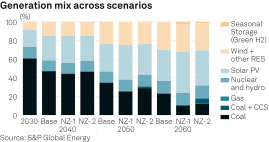
Regardless of the pathway, the structural changes to India's power system will be profound. Unabated coal's share of generation is expected to fall sharply, while renewables take on a dominant role, according to CERA scenarios.
Large-scale investments will be required in transmission networks, storage infrastructure, and flexible generation. This is not merely a shift in fuels -- it is a redesign of the entire system. Electricity markets, grid architecture and infrastructure planning will all need to evolve in tandem.
Emissions trajectories across different scenarios tell a consistent story: Power sector emissions -- which currently account for about 40% of India's total carbon footprint -- will peak in the early 2040s before declining toward net zero, CERA analysis shows. The pace and shape of this decline will depend on how quickly technologies mature and how effectively policies are implemented.
Costs converge
Encouragingly, the long-term cost outlook remains favorable toward clean technologies. Across both net-zero pathways, average generation costs decline over time as technologies mature and efficiencies improve, according to CERA analysis. Carbon costs become a meaningful component of electricity pricing, but they remain manageable relative to overall system costs.
However, the transition is not without risks. A renewables-heavy system requires massive deployment of storage and grid infrastructure, which introduces execution and financing challenges. A coal-plus-CCS pathway, meanwhile, depends on technologies that remain costly and relatively unproven at scale.
In practice, India is likely to navigate a middle path, leveraging renewables where they are most competitive, while retaining flexibility through a combination of storage, hydrogen, nuclear and selectively decarbonized thermal capacity.
Multiple pathways, one destination
India's transition to net-zero power will not follow a single, linear path. Instead, it will be defined by a dynamic interplay of technologies, policies, and market forces.
What is becoming clear is that the transition is not about choosing one pathway over another. It is about building a system flexible enough to accommodate multiple solutions -- and resilient enough to adapt as technologies evolve.
In that sense, India's strategy is as pragmatic as it is ambitious. By embracing technological diversity, the country is positioning itself to deliver the most optimal results on its three overarching energy sector goals: energy security, affordable access and emissions reduction, according to CERA.
Further reading:
The costs and pathways for technological leapfrogging in India's power sector, 2025
Switching currents: India's power sector evolution toward a low-carbon future
Related webinar:
The New Power Play: How India's net zero transition will reshape energy investments
This article contains data, views and forecasts from S&P Global Energy CERA analysts and does not represent reporting by Platts, part of S&P Global Energy.
