Energy Transition, Carbon, Emissions
July 09, 2026
Article 6.4 carbon credit uptake remains limited as signatories opt for flexibility

Editor:
The landmark signature of Article 6 of the Paris Agreement in 2021 enabled nations to exchange carbon credits to achieve their climate objectives through a centralized mechanism under the UN Framework Convention on Climate Change. Article 6.4, also known as the Paris Agreement Crediting Mechanism, was welcomed then as a potential new global benchmark for a high-integrity carbon credit market. But five years later, a clear demand for such a market has yet to emerge.
Only two Article 6.4 project methodologies have been approved so far, and credits are expected to cost more than Article 6.2 credits due to factors like stringent baselines and extensive monitoring. While Article 6.4 is centralized and has standardized rules and credit issuances, Article 6.2 is a decentralized scheme -- also established under the Paris Agreement -- that allows nations to exchange carbon credits under customized bilateral deals, project methodologies and quality standards.
Out of 194 parties to the Paris Agreement, only South Korea has so far ruled in favor of a limited use of Article 6.4 credits under its Emission Trading Scheme. The EU is proposing to use the same credits to help meet its 2040 climate goals.
Meanwhile, 10 countries have already signed agreements to purchase credits via Article 6.2 deals. A total of 111 bilateral agreements have been signed, involving 65 countries as of May, according to data from S&P Global Energy Horizons.
Article 6.2 remains the more operational pathway today, according to Eszter Bencsik, principal analyst at Horizons, and some of the demand currently forecast for Article 6.4 could be "delayed, reduced, or met through Article 6.2 instead," Bencsik added.
Johan Sulaeman, director at the National University of Singapore's Sustainable and Green Finance Institute, said that nations already allowing the use of Article 6.2 credits as part of their national carbon schemes -- such as Singapore's Carbon Tax regime under its International Carbon Credit Framework -- may struggle to also incorporate the use of Article 6.4 credits, due to the expected high price of Article 6.4 credits.
Under the ICC, Singapore allows companies within its carbon tax scope to use Article 6.2 credits to offset up to 5% of their taxable emissions.
"Without strong regulation, it will be difficult to say that companies should buy Article 6.4 credits -- they'll see this as a cost," Sulaeman added.
Sulaeman sees the Article 6.4 scheme as an important step toward establishing a common quality baseline for international credit markets, but he said he is concerned that the methodologies proposed by the UNFCCC's supervisory body are so strict that they could lead to expensive credit prices.
For example, in a white paper written with colleagues from the Sustainable and Green Finance Institute, Sulaeman has identified long-term monitoring as one of the requirements that are making Article 6.4 methodologies for removal projects too costly and impractical, if compared with those provided by the independent standards used in the voluntary carbon market and under Article 6.2 deals.
"If Article 6.4 requirements are perceived as too costly, complex or impractical, project developers may struggle to qualify, and buyers may continue relying on alternative standards," he said.
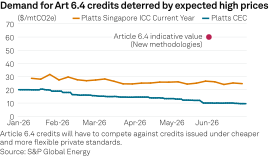
Sulaeman expects Article 6.4 credits generated under new methodologies, rather than from projects transitioning from the old Clean Development Mechanism, to be priced at $60/metric tons of CO2 equivalent, based on the cost of producing such credits under the UNFCCC's stringent methodologies.
"In this scenario, with credits at $60/mtCO2e and above, the market will die quickly," Sulaeman said.
In February this year, Platts, part of S&P Global Energy, heard credits issued by the transitioning cookstove project in Myanmar registered under CDM number 10471 -- the very first Article 6.4 credits approved by the UNFCCC -- were indicatively valued at $20/mtCO2e.
Broadly speaking, market participants expect Article 6.4 credits to be priced at the same level or above Article 6.2 credits. The latter ranged between $20/mtCO2e and $40/mtCO2e during the January 2025-June 2026 period, according to S&P Global Energy data.
As a comparison, the price of Article 6.2 credits currently being exchanged under Singapore's Carbon Tax regime under the International Carbon Credit Framework, as reflected in the weekly Platts Singapore ICC Current Year price assessment, stood at S$35.50/mtCO2e ($27.44/mtCO2e) on July 2.
On the same day, the price of credits being exchanged as part of the South Korea ETS -- where both Article 6.2 and 6.4 credits are allowed but no Article 6.4 credits have been used so far -- was at Won 18,000/mtCO2e ($11.75/mtCO2e) on July 3, based on the Platts Korean Offset Credit daily price assessment.
European demand
Questions have been raised about whether the Article 6.4 scheme is now entirely dependent on the EU's commitment to implement its proposal.
"Without European demand, the mechanism may struggle to survive, precisely because there are no other strong demand centers for Article 6.4 specifically," one market observer said.
The European Commission has proposed allowing the use of Article 6.4 credits to offset up to 5% of the EU's planned emissions reductions under its legally binding 2040 climate target. A pilot phase would only start in 2031, and no details are known so far about how the commission intends to create concrete demand for such credits within its jurisdiction or to procure them.
Andrea Bonzanni, international policy director at International Emissions Trading Association, expects the European Commission to clarify how international credits will be used to achieve its various objectives as part of the upcoming July review of its ETS.
Horizons estimates the EU's demand for Article 6.4 credits at up to 200 million between 2031 and 2040. In comparison, it estimates demand for both Article 6.4 and 6.2 credits in the South Korea ETS at up to 37.5 million between 2018 and 2030.
CORSIA
Demand for Article 6.4 credits could increase under the Carbon Offsetting and Reduction Scheme for International Aviation, established by the International Civil Aviation Organization to decarbonize international aviation, according to Bonzanni.
"PACM is not formally approved yet, but the ICAO is considering allowing the use of 6.4 credits for both Phase 1 and 2," Bonzanni said.
But the CORSIA scheme is facing its own demand challenges, with regulatory uncertainty the main factor hindering airlines' buying appetite.
Nevertheless, market participants are eagerly watching the uptake of scheme as an example of an international, credit-based compliance program. In general, airlines are emerging as price-sensitive buyers, keen to secure supply at the most competitive prices. The Platts CEC price assessment, which reflects the value of CORSIA Phase 1 eligible credits, touched its lowest level since the start of Phase 1 of the scheme on July 1, when it was assessed at $9.45/mtCO2e after reaching a peak at $22.5/mtCO2e in October 2025.
Voluntary demand
Corporations pledging to offset some of their emissions with high-integrity carbon credits could do so using Article 6.4 credits, according to Bonzanni. But challenges remain.
For example, in a November statement, TotalEnergies said it was partnering with project developer Del Agua to produce clean cookstove credits under a methodology from independent certifier Verra, which would transition to the 6.4 methodology as soon as such a framework is available. Nonetheless, a drafted migration methodology for CDM-certified cookstoves projects published a few weeks ago is already proving uneconomical, Pascal Siegwart, Vice President Carbon Markets and Economy at TotalEnergies, told Platts.
"It's too strict. It involves additional cutting of 80% of credits and a buffer, which was never demanded before for this type of project. If this is the standard methodology [for clean cookstoves credits under 6.4], we won't be able to transition. We have a business case. I'm not sure I could go for 6.4 in this case," Siegwart said.
TotalEnergies plans to use these credits to meet its own offsetting targets, but it would still seek a Corresponding Adjustment and receive internationally transferable credits in case a market develops in Europe, Siegwart said.
The Article 6.4 mechanism would need to prove competitive with other existing carbon credit schemes, both in terms of price and ease of operation.
