07 July 2026 | 03:58 UTC
Tier 1 cleantech companies 2026: Market leadership, financial strength and sustainability

By Edurne Zoco
Editor:
The 2026 S&P Global Energy Tier 1 Cleantech Companies list recognizes 15 photovoltaic module suppliers, 12 PV inverter manufacturers, 10 wind turbine suppliers, 12 energy storage system providers and 10 energy storage battery cell suppliers.
The cleantech power equipment supply chain is in a highly dynamic period, with each major technology facing distinct challenges and growth prospects.
On the demand side, global solar photovoltaic installations are forecast to decline in 2026 for the first time on record, then recover only modestly from 2027 onward, showing small annual growth through the rest of the decade. Wind power is likewise expected to see relatively modest annual capacity additions. In contrast, battery storage installations are projected to expand rapidly. The growth of storage is driven by robust power consumption growth -- fueled by electrification and surging data center needs -- and by the imperative to secure and balance grids that are increasingly critical infrastructure.
These differing growth trajectories are already having clear impacts across the supply chain.
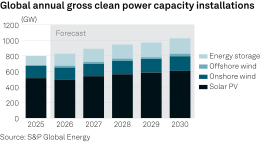
For example, the solar module supply chain has endured oversupply, intense pricing pressure and thin margins for the past three years, a combination now taking a toll on manufacturers. The industry is experiencing gradual consolidation, with some companies acquired by larger players or quietly exiting the market in a trend of “soft” consolidation. Many firms are also expanding beyond their traditional core products into adjacent domains, particularly battery energy storage systems, to capture additional value and provide more integrated solutions.
The inverter landscape is similarly dynamic and uncertain. Inverters have become a focal point of regulations now under discussion on local content and cybersecurity in certain markets, especially in Europe and the US. New requirements around where inverters are produced and how they ensure grid security are adding complexity to manufacturers’ strategies and procurement considerations.
Meanwhile, anticipation of storage demand growth has sparked a wave of new entrants in the battery and BESS segment over the past two years, as many companies position for a surge in storage deployments over the next decade. Major battery producers are running at high utilization rates to meet increasing demand. By comparison, wind equipment suppliers face steady but modest demand growth, with Chinese manufacturers playing a more prominent role in global wind markets.
In these changing market conditions, S&P Global Energy draws on its extensive cleantech supply chain data and market intelligence expertise to deliver a rigorous and differentiated assessment to identify Tier 1 cleantech companies. This framework is intended to help industry participants navigate an increasingly complex supplier landscape with greater confidence, identifying companies that meet Tier 1 criteria, including market leadership, financial strength and corporate sustainability performance.

-
PV Module Suppliers
Tier 1 PV Module Suppliers
- Canadian Solar Inc.
- Chint New Energy Technology Co., Ltd. (Astronergy)
- First Solar Inc.
- GCL System Integration Technology Co. Ltd.
- Hanwha Solutions Corp.
- Hengdian Group DMEGC Magnetics Co. Ltd.
- JA Solar Technology Co. Ltd.
- Jinko Solar Co. Ltd.
- LONGi Green Energy Technology Co. Ltd.
- Risen Energy Co. Ltd.
- Shanghai Aiko Solar Energy Co. Ltd.
- TCL Zhonghuan Renewable Energy Technology Co. Ltd.
- Tongwei Co. Ltd.
- Trina Solar Co. Ltd.
- Waaree Energies Ltd.
-
PV Inverter Suppliers
Tier 1 PV Inverter Suppliers
- Enphase Energy Inc.
- Ginlong Technologies Co. Ltd.
- GoodWe Technologies Co. Ltd
- Growatt New Energy Technology Co. Ltd.
- Huawei Technologies Co. Ltd.
- Ningbo Deye Technology Corporation
- Sineng Electric Co. Ltd.
- SMA Solar Technology AG
- SolarEdge Technologies Inc.
- Sungrow Power Supply Co. Ltd.
- TBEA Sunoasis Co. Ltd.
- Zhuzhou CRRC Times Electric Co. Ltd.
-
Wind Turbine Suppliers
Tier 1 Wind Turbine Suppliers
- Envision Energy Ltd.
- GE Vernova Inc.
- Goldwind Science & Technology Co. Ltd.
- Ming Yang Smart Energy Group Ltd.
- Nordex SE
- Sany Renewable Energy Co. Ltd.
- Shanghai Electric Wind Power Group Co. Ltd.
- Siemens Gamesa Renewable Energy S.A.
- Vestas Wind Systems A/S
- Windey Energy Technology Group Co. Ltd.
-
Energy Storage System Suppliers
Tier 1 Energy Storage System Suppliers
- BYD Company Ltd
- Canadian Solar Inc.
- Contemporary Amperex Technology Co. Ltd.
- Envision Group
- Fluence Energy Inc.
- Gotion High-tech Co. Ltd.
- Huawei Technologies Co. Ltd.
- LG Energy Solution Ltd.
- Sungrow Power Supply Co. Ltd.
- Tesla Energy Operations Inc.
- Trina Solar Co. Ltd.
- Xiamen Hithium Energy Storage Technology Co. Ltd.
-
Energy Storage Battery Cell Suppliers
Tier 1 Battery Cell Suppliers
- BYD Company Ltd
- CALB Group Co. Ltd.
- Contemporary Amperex Technology Co., Ltd.
- Envision AESC Group Ltd.
- EVE Energy Co. Ltd.
- Gotion High-tech Co. Ltd.
- Guangzhou Great Power Energy and Technology Co. Ltd
- LG Energy Solution Ltd.
- REPT BATTERO Energy Co. Ltd.
- Xiamen Hithium Energy Storage Technology Co. Ltd.


What it means to be a Tier 1 Cleantech Company and why it matters in a changing market
In 2025, S&P Global Energy introduced the Tier 1 Cleantech Companies recognition -- a new standard designed to be transparent, data-driven and built for long-term credibility. The Tier 1 Cleantech Companies list is not a ranking nor is it investment guidance. Instead, it identifies a group of suppliers within each product category that meet a high threshold of criteria across multiple dimensions, such as market presence, financial health, sustainability and more.
In today’s highly competitive and often saturated market, manufacturers are looking for a robust and credible framework to help them differentiate and strengthen their position when competing for contracts.
At the same time, the Tier 1 Cleantech Companies approach delivers clear value to other stakeholders. It helps project developers identify reliable, reputable partners and it provides the financial community with a more solid basis for decision-making by highlighting suppliers that meet a consistent and demanding set of criteria.
This classification is particularly relevant today as the industry faces increasing scrutiny around financial strength, sustainability and supply chain traceability.
A framework integrating credit risk and sustainability
The 2026 Tier 1 Cleantech Companies list introduces credit risk -- through RiskGauge™ -- as a core metric for assessing financial performance.
Expressed through S&P Global’s letter-grade system, this metric provides a clear and comparable view of how companies perform relative to their peers. This addition is particularly important as the sector faces increasing financial pressure following years of rapid expansion, persistent oversupply and compressed margins across several key components. These dynamics have weighed on balance sheets and may continue to affect future performance. In this context, a clear and consistent assessment of financial strength and credit risk is essential to accurately classify cleantech suppliers as Tier 1 cleantech companies.
Sustainability remains at the core of the S&P Global Tier 1 Cleantech Companies methodology. The Corporate Sustainability Assessment evaluates how companies manage sustainability risks and opportunities relative to industry peers. It draws on company disclosures, stakeholder input, media analysis and direct engagement through the CSA process. This approach ensures transparency, traceability and accountability across supply chains. As sustainability requirements tighten in Europe and other regions, such a framework is not only forward-looking -- it is becoming essential.
S&P Global Energy Tier 1 Cleantech Companies methodology
S&P Global Energy’s Tier 1 Cleantech Companies classification is a recognition that the company has met or surpassed rigorous, objective and clear criteria. It is designed to help cleantech manufacturers stand out in a crowded field, and to support developers and offtakers in identifying reliable partners.
The 2026 Tier 1 assessment evaluated global manufacturers across core cleantech components: PV modules, PV inverters, wind turbines and BESS. This year, the list includes energy storage battery cell suppliers.
As part of the Tier 1 Cleantech Companies selection process, S&P Global Energy first identified the top 30 companies for each of the four technology categories, based on the largest shipments or installations globally in the previous year.
Each company was then assessed across key dimensions to ensure a comprehensive and balanced evaluation:
- Market presence and share: capturing the company’s footprint and influence in global markets
- Total capacity and global diversification: evaluating operational scale and geographic spread
- Financial performance: powered by RiskGauge™ Scores from S&P Global Market Intelligence that combine a company’s financial strength with market-derived inputs to provide a holistic assessment of credit risk
- Sustainability metrics: powered by S&P Global’s Corporate Sustainability Assessment
To be classified as a Tier 1 Cleantech Company, a supplier must exceed the minimum threshold in a majority of the dimensions. This dual approach -- using both absolute performance and relative positioning against industry averages -- ensures that the classification reflects both rigor and consistency.
The methodology is built on four key pillars:
- Annual cadence: Unlike other systems that reshuffle rankings quarterly, this classification is updated annually. This reduces volatility and gives suppliers and buyers a stable reference point for planning and procurement
- Public transparency: As it was the case in the inaugural edition last year, the Tier 1 list is again publicly available, offering visibility and recognition to top-performing suppliers
- Comprehensive scope: The second edition expands from four major cleantech components to include energy storage battery cells, given the relevance of this component in today’s market
- Credibility and rigor: The methodology is grounded in proprietary data from S&P Global Energy Horizons and credit risk data leveraging the RiskGauge™ score from S&P Global Market Intelligence division, ensuring that the classification reflects real-world performance, and financial and sustainability leadership
This article contains data, views and forecasts from S&P Global Energy Horizons analysts and does not represent reporting by Platts, part of S&P Global Energy.