Energy Transition, Carbon
June 22, 2026
INSIGHT CONVERSATION: Mandy Rambharos, Verra

Editor:
The voluntary carbon market has evolved, with multiple frameworks being implemented in different countries. Verra, a leader in carbon project registrations, has one of the most widely used carbon crediting frameworks globally. Verra CEO Mandy Rambharos speaks with S&P Global Energy Price Reporter Himanshu Chauhan about methodology approvals, operational improvements and progress in assessment timelines.
Rambharos talks about interoperability challenges across the Carbon Offsetting and Reduction Scheme for International Aviation and Article 6 frameworks, as well as the structure of Indonesia's mutual recognition agreement. She also addresses the competition within the carbon standards space and outlines what an ideal VCM should look like as it approaches 2027.
As a registry, what are the biggest operational challenges in facilitating corresponding adjustments, or CAs? How is Verra working to streamline the Letter of Authorization process, and do you see a path toward standardizing CA procedures?
An LoA is a sovereign act, and what that looks like in practice varies significantly from country to country. The legal frameworks, the institutional actors, the timelines, the documentation requirements -- none of these is standardized yet.
The same is true for CAs. The accounting logic is agreed in principle; the operational mechanics are still being worked out.
The honest answer is that right now there are more questions than answers.
We work directly with host country governments to help build the institutional knowledge and processes that make these frameworks function. The path toward standardization exists and I'm optimistic about it.
What are your 2026 issuance projections and current pipeline for VM0047 (afforestation, reforestation, and revegetation) and VM0048 (reducing emissions from deforestation and forest degradation)? How is Verra balancing integrity standards with developers' concerns about long validation timelines for VM0048?
We currently have 196 and 46 projects for VM0047 and VM0048, respectively at various lifecycle stages, representing an estimated 74.3 million and 37.8 million annual emission reductions, respectively. These figures are largely preliminary estimates from project developers and validation/verification bodies (VVBs).
VM0048 represents a fundamental shift in how REDD baselines are set. The methodology relies on jurisdictional deforestation risk maps developed by Verra.
We now have available data for nine jurisdictions that represent a high percentage of REDD project activity. The supply will reach the market as soon as possible.
Verra-issued credits are being used across multiple frameworks and voluntary commitments. What are the main obstacles to ensuring seamless interoperability, and what approach is Verra taking to address fragmentation?
Our registry migration to S&P Global Energy is built specifically for cross-system interoperability, with meta-registry functionality that connects to government registries and other compliance systems. The pace of interoperability is partly a function of government readiness.
Host governments are building the legal frameworks, national registries and general capacity to issue them consistently. That all adds process: it means credits carry genuine government endorsement, which strengthens standing in compliance markets.
Indonesia's mutual recognition agreement with Verra in October 2025 enables dual registration. How will the issuance structure function under this agreement? Will credits be issued simultaneously on two registries?
Carbon credits will continue to be issued under Verra's Verified Carbon Standard program. and also to be reflected in Indonesia's national registry, the Carbon Unit Registry System.
We see this as an optimal model because it combines the strength and credibility of established international market infrastructure with a host country's ability to maintain visibility and oversight through its own registry framework.
The carbon standards scape is evolving, with new registries offering digitization, faster processing times and blockchain-based tracking as differentiators. How does Verra view this competition?
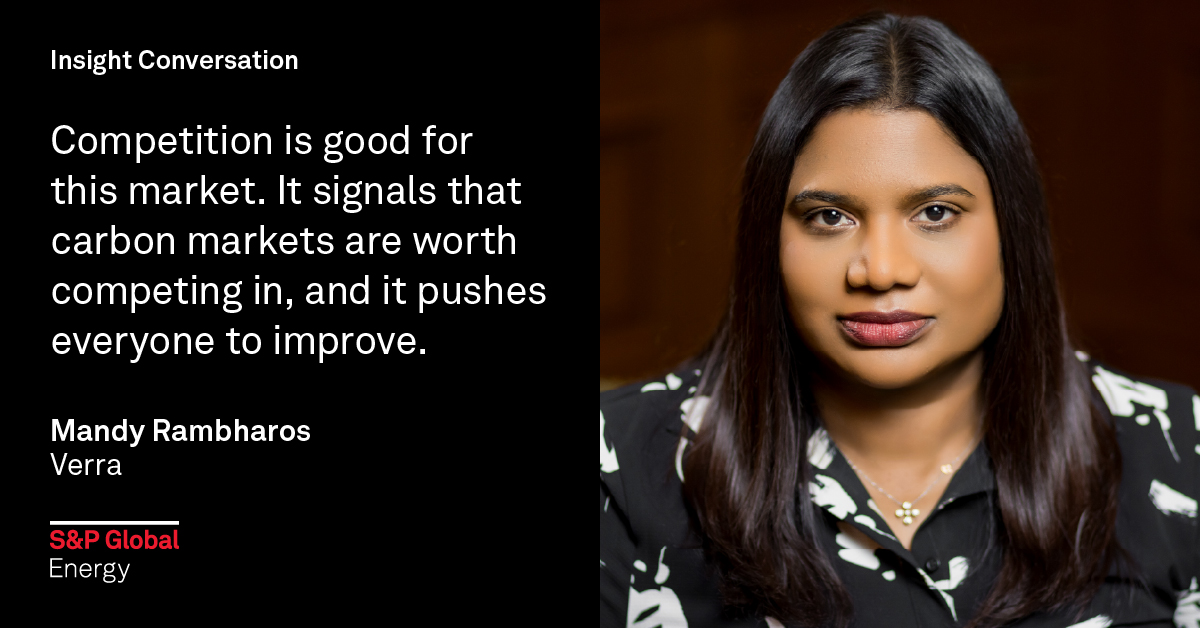
Competition is good for this market. It signals that carbon markets are worth competing in, and it pushes everyone to improve.
On the specific differentiators, the question identifies digitization, processing speed and blockchain tracking. We're investing in all of them and have been doing so for years -- the S&P Global Energy registry migration, DMRV (digital monitoring, reporting and verification) pilots. Twenty-four methodologies are being digitalized, with more in the pipeline.
Some project developers and VVBs have raised questions about Verra's project assessment timelines. Can you explain Verra's approach and how the priority assessment fee structure works?
Review timelines have been a real pain point for developers. Over the past 1.5 years, we've implemented a risk-based approach to reviews, which cut cycle times by 50%-80%, depending on project type. We've also recently published updated and more granular SLAs.
We've also digitized many of our project submission and review processes. For cookstove projects using the digital submission process, review and approval time has decreased from 163 to 63 days. Average VVB response times have also dropped 26% in the last six months. The full end-to-end review process is now averaging 127 days compared to 169 days previously.
The prioritization fee is available to developers who need an accelerated process to meet financing window obligations. It's transparent, opt-in and the fees go directly back into expanding review capacity, which benefits everyone in the regular queue.
Cookstove projects have faced scrutiny regarding the fraction of non-renewable biomass calculations, with the Integrity Council for the Voluntary Carbon Market establishing strict fraction of non-renewable biomass, or fNRB, conditions and the EU's draft CORSIA proposal targeting cookstove eligibility. How is Verra responding to these developments and what is your outlook for the future of cookstoves credits?
Verra's cookstoves methodology, VM0050, is approved by the ICVCM under its Core Carbon Principles framework. Projects seeking to apply the CCP label have to meet specific criteria that relate to the fNRB value to reflect the strict conditions around fNRB.
The methodology also aligns with the Comprehensive Lowered Emissions Assessment and Reporting methodology by the Clean Cooking Alliance.
Verra is committed to reviewing other approaches under development, like the Modeling Fuelwood Savings Scenarios (MoFuSS) model for determining the fraction of non-renewable biomass for project-specific use.
Verra believes that the MoFuSS tool includes a robust and credible approach for fNRB determination. Until the MoFuSS has been widely reviewed and endorsed, TOOL30(the mechanism used to calculate fNRB), combined with a 26% uncertainty discount, represents a reasonable path forward to ensure continuous market access for cookstove projects.
Verra is also considering adopting the marginal fNRB approach, which determines the fraction of non-renewable biomass savings directly linked to the specific intervention, rather than using an average. This is still in the early stages of development.
With Verra's rigorous assessment criteria, it will be considered for incorporation into VM0050 at an opportune time.
Looking ahead to 2027 and beyond, what does a healthy, functioning VCM look like?
A healthy VCM in 2027 looks like a market that has answered the clarity question as decisively as it answered the integrity question. The integrity architecture is built. ICVCM has established what quality means, independent ratings agencies have given buyers real tools, and the safeguards the market needed are now embedded in our standards.
The challenge now is demand, and that requires clarity. We've complicated and subdivided this market in ways that sometimes serve precision and sometimes create confusion.
The standards, the frameworks, the governance structures -- these are means, not ends.
This market exists to drive meaningful impact. When buyers, developers and policymakers stay focused on that, the rest follows.
This interview has been edited for clarity and length.
