Electric Power, Energy Transition, Renewables
May 25, 2026
India's renewable energy tender market: 5 key trends in FY 2025-26
India achieved its target of having non-fossil fuel sources account for 50% of its total installed power generation capacity in fiscal year 2025-26 (April-March), ahead of its FY 2030-31 schedule. This target was announced by the Indian government at the 26th UN Climate Change Conference (COP26) in 2021.
However, there is still a long way to go to achieve its target of having 500 gigawatts of non-fossil fuel capacity, also scheduled for 2030. As of March, India's non-fossil fuel (excluding nuclear) capacity stood at 275 GW, and 223 GW excluding large hydro assets, according to the Ministry of New and Renewable Energy.
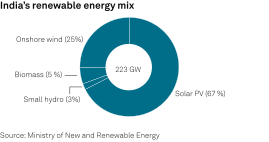
Most capacity additions stem from renewable energy tenders floated by various state and central implementing agencies. The tender market, therefore, is a key indicator of the trajectory of capacity additions.
1. Tender activity slows down
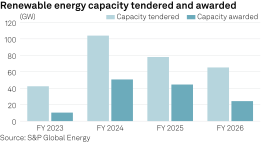
Tendered capacity floated for renewable energy declined 16% in FY 2025-26 compared to FY 2024-25, with a cumulative 65 GW tendered. Similarly, tendered capacity awarded shrank by 45%, with about 24 GW awarded by various state and central implementing agencies and power utilities, according to S&P Global Energy CERA data.
2. Tariff trends diverge across technology segments
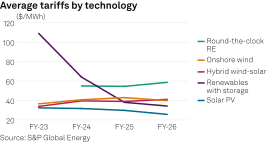
The demand for stand-alone solar and wind tenders has fallen by almost 75% cumulatively in FY 2024-25, as managing their generation profiles and grid integration has been challenging, according to CERA data. Tariffs for the same have stabilized over the past year as the market has matured and moved to higher use of domestically manufactured capital inputs.
In contrast, demand for tenders for renewable energy coupled with storage nearly quadrupled in FY 2024-25 and FY 2025-26, compared with FY 2023-24 levels, according to CERA data. Tenders for round-the-clock renewable energy have gained importance as offtakers demand a firm renewable energy supply. As a result, with rising energy storage and higher peak power demand, tariffs for round-the-clock renewable energy have increased marginally over time.
3. Pivot toward stand-alone storage
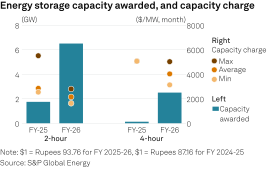
Of the capacity requested in FY 2025-26, almost 40% pertained to stand-alone energy storage tenders, up from 9% in FY 2024-25, according to CERA data.
Most of the storage pertains to two-hour dispatch, followed by four-hour dispatch, and falls under the purview of viability gap funding, which provides developers with financial assistance as a proportion of their capital costs for project setup.
Capacity charges for stand-alone storage tenders have dropped substantially over the past three years.
4. Regulatory consolidation to counter challenges
In November 2025, the Ministry of Power said that, among the tenders awarded by central renewable energy implementing agencies over April 2023-September 2025, about 44 GW of renewable capacity remained without signed power sale agreements. Consequently, actual project development has been delayed. PSAs are contracts between implementing agencies and distribution utilities.
These agencies, known as REIAs, act as intermediaries by using tenders to gather renewable energy capacity from various developers. The distribution utilities then purchase the electricity generated by these projects. Much of this capacity risks being canceled if buyers are not identified. As a result, actual project developments on the ground are also stalled. If these challenges persist, India's pace in achieving its renewable energy targets may be impeded.
In April, the Ministry of New and Renewable Energy notified that, going forward, only the Solar Energy Corp. of India will be responsible for issuing renewable energy tenders across technologies at the central level. Previously, this responsibility was held by SECI, NTPC, National Hydroelectric Power Corp. and SJVN.
The shift to an SECI-only REIA model addresses a market failure arising from a misalignment between distribution companies' dispatch expectations and the generation profile of tendered renewable capacity, according to CERA analysis.
By centralizing tendering authority, the reform aims to strengthen execution certainty and reduce the risk of stranded capacity, albeit at the cost of inter-intermediary competition, according to CERA. This centralization should be a transitional arrangement rather than a permanent change to market architecture. As offtake risks moderate, preserving a pathway back to a multi-REIA framework would be important to reintroduce competitiveness at the procurement layer, sustain innovation in tender design and avoid entrenching monopolistic intermediation, according to CERA analysis.
5. Muted outlook for FY 2026-27
Tender capacity requested and awarded is expected to remain low compared to the highs of FY 2023-24 and FY 2024-25, according to CERA analysts.
As of January, there will no longer be an annual tender auction target, according to the Ministry of Power. This is because significant tender capacity remains under execution with implementing agencies and developers. Moreover, demand for stand-alone solar and wind capacity has shrunk, with distribution utilities being wary of generation dispatch volatility.
The focus on energy storage and storage-inclusive tenders will remain, as distribution utilities look to firm up renewable supply to lower procurement costs and meet their renewable consumption obligations. Additionally, solar and wind assets have increasingly had to grapple with curtailment, as demand and transmission infrastructure are unable to keep up with generation.
India's renewable energy tender data: Assets and Projects - Asia Pacific
Further reading: India Power and Renewables Market Briefing – Q2 2026
