Energy Transition, Renewables, Emissions, Carbon
March 18, 2026
ET Highlights: Middle East conflict highlights need for more renewables, Envision eyes clean ammonia exports, US’ RGGI allowance above reserve price
Energy Transition Highlights: Our editors and analysts bring together the biggest stories in the industry this week, from renewables to storage to carbon prices.
Top story
Fog of war clouds European energy transition outlook, exposes gas ‘Achilles heel’: experts
The Middle East war is the latest wake-up call for Europe as it confronts its energy import dependency, and while early signals from policymakers point to doubling down on renewables, inflationary risks from the conflict loom, according to industry experts.
Europe faced its most severe energy shock in the wake of Russia's invasion of Ukraine in 2022, and EU policymakers responded by redoubling efforts to accelerate renewables deployment. Now, the US/Israeli war with Iran raises fresh concerns with political leaders already signposting the need for further renewables to address energy security of supply, cost, and sustainability concerns.
"This situation has really, in many ways, exhibited very clearly what Europe's Achilles heel is," France-based Societe Generale's Head of Commodity Research, Ben Hoff, told Platts in an interview. Hoff said it was too early to say if the words from political leaders translate into greater action for renewables.
The risk of an inflationary shock and rising interest rates from a protracted conflict could hamper Europe's energy transition in the short term, in what could disproportionately affect borrowing costs for clean energy projects, which are typically more capital-intensive.
Benchmark of the Week
EUR7.38/kg ($8.43/kg)
Platts assessed Netherlands Alkaline Renewable PPA Derived Hydrogen price March 13, down 14.29% from a month ago.
Learn more: Platts Carbon Markets Specifications Guide
Editor's Picks: Free and premium content
SPGlobal.com
Asia's renewable energy case strengthens amid Middle East conflict: experts
Asia's energy transition has become an urgent economic and security imperative as the ongoing Middle East conflict exposes the vulnerability of fossil-fuel-dependent nations, energy experts said. Market disruption and price volatility are making the case for a reassessment of energy security and policies, and Asian policymakers have every incentive to accelerate the move toward renewables at this time. The conflict has shown renewables supply chain is significantly less affected than the fossil fuel supply chain, owing to one-time investments and to the current lower prices of solar and wind compared with natural gas.
INTERVIEW: China’s Envision Energy eyes more renewable ammonia exports this year
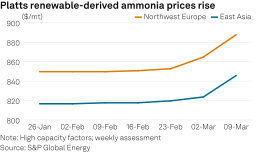
China's Envision Energy plans to expand global commercial shipments of renewable ammonia this year after its first delivery to South Korea, targeting offtakers in Asia and Europe, Frank Yu, Senior Vice President, told Platts, part of S&P Global Energy. Envision Energy delivered an undisclosed quantity of renewable-derived ammonia from its Inner Mongolia unit to Lotte Fine Chemical, marking a significant milestone in the trade of renewable fuels. The Chifeng facility is currently producing 320,000 mt/year renewable ammonia, with exports having already commenced in Q4 2025, according to Yu.
S&P Global Energy Core
INFOGRAPHIC: India boosts renewable capacity even as grid, market challenges persist
India is one of the world’s fastest-growing renewable energy markets, driven by policy support, abundant capital availability and rapidly rising electricity demand. Clean energy installed capacity, which achieved record-high additions in the country in 2025, is expected to increase further by 2030, with growth momentum anticipated to continue despite some challenges. Grid bottlenecks, curtailment risks and delayed power sale agreements are among the hurdles hindering the accelerated buildout needed to boost the share of renewable electricity in the grid.
RGGI Q1 auction empties annual carbon allowance reserves for third year in a row
The US’ first quarter Regional Greenhouse Gas Initiative auction settled well above this year’s cost containment reserve trigger price, resulting in the sale of all 7.8 million reserve allowances dedicated for 2026, according to March 13 data. RGGI’s Auction 71 cleared at $24.99 per CO2 allowance, backing off from the record-high clearing price set in the Q4 2025 auction. This represents a 6.5% decrease from the previous auction and a 26% increase year over year. The Auction 71 settlement price was 31% higher than the 2026 cost containment reserve trigger price of $18.22/allowance.