Crude Oil, Chemicals, Agriculture, Energy Transition, Maritime & Shipping, Solvents & Intermediates, Biofuel, Renewables, Grains
November 25, 2025
COMMODITY TRACKER: 5 charts to watch this week

By Staff
Global oil levels on vessels at sea have reached historic highs, driven by strong Asian demand and sanctions. Meanwhile, European carbon prices remain strong and China resumes imports of US soybeans.
1. Global oil on water hits 8-year high on sanctions, demand
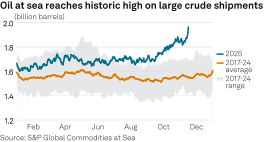
What's happening? Global oil on water has reached a historic level of 1.96 billion barrels Nov.16, the highest in at least eight years, according to S&P Global Commodities at Sea. This increase is driven by long-haul crude shipments amid tighter sanctions and seasonal demand. Asian consumers are ramping up imports from the Atlantic Basin and the Middle East. Western sanctions on Russian oil companies have prompted buyers to front-load imports before potential supply disruptions.
What's next? The International Energy Agency warns of a potential oil glut due to supply growth outpacing demand, but onshore tanks will be filled before floating storage increases due to high charter rates. Arbitrage flows could slow, but Asian buyers could shift to Middle Eastern supplies as OPEC+ increases output. The situation remains volatile, with Russia's response to Western sanctions in the market focus.
2. European carbon prices maintain bullish trend
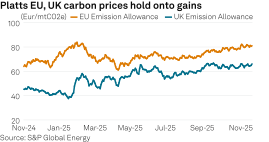
What's happening? European carbon prices have sustained bullish momentum over the week ending Nov. 21 amid strong open interest in higher call option strike prices and multi-year high net long positions held by investment funds active in the market. The Platts assessment for the nearest December EUA price was Eur80.44/metric ton CO2e on November 21. Platts is a part of S&P Global Energy.
What's next? Prices for allowances under the EU Emissions Trading System are likely to remain bullish heading into 2026. This is because of the tightening supply of carbon permits. Supplementary auctions under the REPowerEU plan are expected to come to an end and free allocations for industries will be reduced. Additionally, the aviation sector will receive no free allocations, and maritime coverage will expand, increasing demand for allowances.
3. China resumes US soybean imports after tariff rollback
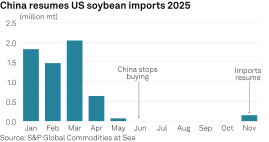
What's happening? Following a trade truce during a summit in Busan, South Korea, and the subsequent reduction of retaliatory tariffs on US-origin soybeans effective Nov. 10, China's state-owned COFCO has booked up to 20 cargoes of US soybeans on Nov. 17 for December and January 2026 delivery. This marks COFCO's largest return to the US market since January. Additional purchases continued into Nov. 18, signaling renewed trade flows after a five-month pause from June to October due to the trade conflict with the US.
What's next? The market is watching whether China's renewed buying will continue toward the 12 million mt of US soybeans China has pledged to import by year-end. According to analysts at S&P Global Energy CERA, uncompetitive US prices could limit purchases. Meanwhile, the window for US soybean sales is narrowing as Brazil moves closer to harvesting what is expected to be a record new crop, which will further pressure US competitiveness in the coming weeks.
4. US DDGS hits highest levels since mid-year
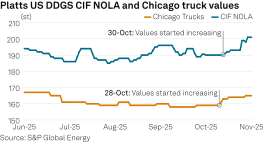
What's happening? US dried distillers grains with solubles values have increased significantly, reaching their highest values since mid-year. The Chicago truck prices values reached $165/st on Nov. 17, the strongest since June 27 at $167/st and CIF NOLA reached $201/st on Nov. 18, the highest since May 23 at $202/st. The climb accelerated since Oct. 28 for both CIF NOLA and Chicago trucks as soybean meal strengthened, improving DDGS relative value and adding upward pressure across the feed complex. Participants also reported regional tightness in supply over the past week, which helped support the market and keep pricing firm.
What's next? Demand for January shipments is described as strong, and with supportive soybean meal economics and ongoing tightness, market participants expect pricing to hold steady into early winter.
5. Monoethanolamine prices hit two-year low
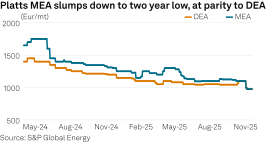
What's happening? Monoethanolamine prices have reached their lowest value in two years, down to Eur945/metric ton FCA ARA, matching diethanolamine levels amid oversupply and weak demand. Platts assessed both MEA and DEA at Eur945/mt on Nov. 20. MEA, used in surfactants for home and personal care products, and DEA, used in herbicides, are experiencing reduced demand from these sectors. Despite steady production rates, inventories remain high. A supplier noted minimal purchasing by downstream buyers, and trans-Atlantic trading is affected by unclear tariffs between the EU and the US.
What's next? Despite the approaching holiday season, which usually boosts surfactant-based purchases, trading activity is expected to remain subdued due to weak end-user demand, particularly in home and personal care and herbicides. Prices are expected to experience pressure from the ample availability, despite the chemicals producer Ineos Oxide being under maintenance in Lavera, according to the market sources. Despite the competitive pricing, market participants remained unsure of applicable tariffs for ethanolamines, which reduced the trading viability across the Atlantic to the US.
Reporting and analysis by Max Lin, Irina Breilean, Eklavya Gupte, Sayona Anna John, Paola Caballeros, Akul Gupta

Editor: