Refined Products, Agriculture, Energy Transition, Crude Oil, Metals & Mining, Diesel-Gasoil, Biofuels, Gasoline, Carbon, Non-Ferrous, Emissions
November 17, 2026
COMMODITY TRACKER: 5 charts to watch this week
By Staff
Editor:
US Gulf Coast refineries are expanding diesel exports to fill global supply gaps, while Asian refiners maintain crude diversification strategies. Biofuel supply is forecast to rise 15% by 2027 as energy security concerns drive stronger blending mandates and China's lithium market weakens despite record EV sales.
1. US refiners boost diesel exports amid global tightness
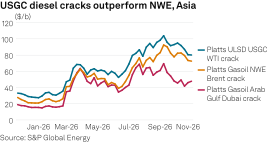
What's happening? US Gulf Coast refineries have increased their share of global diesel trade to 22% in 2026, averaging 1.3 million barrels/day out of total global flows of 5.97 million b/d, according to S&P Global Commodities at Sea. This compares with a 17% share in 2025, when the US supplied 1.2 million b/d out of 6.9 million b/d in total global trade. Month-to-date November flows are running higher at 1.6 million b/d out of 5.68 million b/d globally, representing about 25% of total supply. The increase comes as Middle East refined-product exports stood at only 3.6 million b/d in October, roughly 51% of prewar levels.
What's next? US refinery throughput is rising from about 16.57 million b/d in November to 17.01 million b/d in December as maintenance eases, according to S&P Global Energy CERA forecasts. US diesel exports are projected at 1.39 million b/d in 2027, up from 1.34 million b/d so far in 2026 and 1.17 million b/d in 2025, according to CERA.
2. Asia to maintain crude diversification
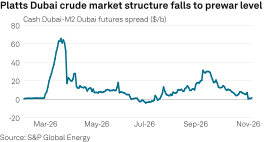
What's happening? The Dubai crude market structure has weakened, with Platts assessing the spread between cash Dubai and same-month Dubai futures falling to minus 12 cents/b on Nov. 12, the lowest level since minus 30 cents/b on July 17 and below the prewar February monthly average of 92 cents/b. This pullback may signal improved sour-crude flows through the Strait of Hormuz. However, Asian refiners remain cautious about assuming full normalization of tanker flows based solely on recent developments. Pakistan Refinery Ltd. secured two to three cargoes of Libya's El Sharara crude at a $20/b premium to Platts Dated Brent, while South Korea and Thailand have significantly increased their North African crude imports. Platts is part of S&P Global Energy.
What's next? Asian refiners plan to maintain their diversification strategy by continuing to purchase US crude and actively seeking spot cargoes from North Africa, according to government ministries and industry sources. Feedstock managers said it remains important to actively procure non-Middle Eastern crude given the fluid geopolitical landscape. South Korean Deputy Prime Minister Lee Hyung-il said proactive efforts are needed to strengthen and broaden supply chain options. Major buyers, including South Korea, Japan, Thailand and Pakistan, will continue to purchase WTI Midland crude while regularly monitoring the availability of spot cargoes from Libya and Algeria.
3. Global biofuel supply to reach 4 million b/d: IEA
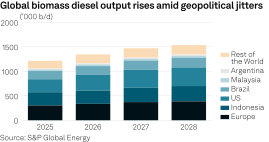
What's happening? Global biofuel supply is forecast to increase by 480,000 b/d, almost 15%, between 2025 and 2027, reaching 3.9 million b/d, the International Energy Agency said Nov. 13 in its monthly Oil Market Report. This represents an upward revision of 130,000 b/d in its previous 2027 forecast, as governments strengthen blending requirements and seek to reduce exposure to volatile refined-product prices. The push partly reflects heightened energy security concerns, as disruptions to oil supplies and trade routes resulting from the conflict in the Middle East, together with high oil prices, have increased incentives to produce transport fuels from domestic and regional feedstocks. Platts assessed ultra-low sulfur diesel on a CIF basis in Northwest Europe versus Dated Brent at $84.30/barrel on Nov. 13, up 168% from Feb. 27, before the war in the Middle East upended trade flows.
What's next? Road transport is expected to account for nearly 85% of longer-term growth in liquid biofuel, with increased use of ethanol, biodiesel, and renewable diesel displacing demand for conventional gasoline and diesel. Global biomass-based diesel supply will rise from 1.342 million b/d in 2026 to 1.533 million b/d in 2028, according to S&P Global Energy Horizons analysts on Nov. 10. Fuel ethanol demand is projected to increase to over 2.3 million b/d in 2028, with growth driven mostly by Brazil, India and the US.
4. China's EV growth slows amid export front-loading concerns
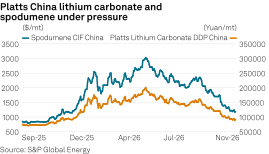
What's happening? China's electric vehicle sales reached a record 1.94 million units in October, up 13.1% year over year and 6.4% month over month, data from the China Association of Automobile Manufacturers showed on Nov. 11. New energy vehicles accounted for 64.3% of total vehicle sales during the month. EV exports remained a stronger growth driver, reaching a record 606,000 units in October, up 6.2% month over month and 140% year over year. However, lithium carbonate prices have come under renewed pressure, with Platts assessing battery-grade lithium carbonate at 91,500 yuan/metric ton ($13,718/mt) DDP China on Nov. 12, down 16.8% from a month earlier. The most actively traded January 2027 lithium carbonate futures contract on the Guangzhou Futures Exchange settled at 90,900 yuan/mt on Nov. 12, down 13.2% month over month.
What's next? Export front-loading could be particularly pronounced this year as expectations of lower export tax rebates and narrowing overseas tariff windows encourage automakers to bring forward deliveries, potentially pulling demand forward from the first quarter of 2027, according to the China Passenger Car Association. The global lithium market surplus is forecast to widen to 163,000 mt of lithium carbonate equivalent in 2027, more than double the 2026 surplus, according to an October report by CERA.
Related content: METALS MONITOR: Italy's steelmakers halt output; USGS expects critical mineral output growth
5. Southeast Asia renews carbon framework at COP31
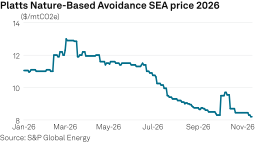
What's happening? Five Southeast Asian carbon market industry groups renewed the ASEAN Common Carbon Framework for another two years during COP31 in Antalya, Turkey, according to a Nov. 13 statement. The Malaysia Carbon Market Association, ASEAN Alliance on Carbon Markets, Singapore Sustainable Finance Association, Indonesia Carbon Trade Association and Thailand Carbon Markets Club re-signed the Memorandum of Collaboration, while Philippines-based Aboitiz Foundation joined as an observer. Platts assessed its Nature-based Avoidance Southeast Asia price at $8.20/mtCO2e on Nov. 16.
What's next? For 2026-2028, the initiative will focus on supply and demand, market infrastructure, and capacity building, including seeking greater clarity on the legal characterization of verified carbon credits and reducing cross-border barriers to harmonization. ACCF plans to develop an interim pathway for corporate use of high-integrity credits and a due-diligence framework for carbon project financing. Under the Singapore Sustainable Finance Association's chairmanship, the framework plans to seek greater recognition at the official ASEAN level as Singapore prepares to assume the ASEAN chairmanship in 2027. The framework aims to translate differing national carbon market rules into more fungible credits and stronger cross-border demand through 2028.
Related topic: COP 31 News
Reporting and analysis by Janet McGurty, Philip Vahn, Thomas Washington, Lucy Tang, Litian Wang and Aliana Zulaika Yeong.
