Refined Products, Crude Oil, Energy Transition, Diesel-Gasoil, Hydrogen
November 16, 2026
Diesel demand drives US refinery results as global supply tightens

Editor:
HIGHLIGHTS
US captures 25% of global diesel trade
Russian refining capacity drops by half
Refiners hit 100% utilization rates
What began as a global crude supply disruption after the Feb. 28 Israel-US attack on Iran expanded quickly to encompass refined products supply as well.
Now with diplomatic solutions on the horizon to reopen the Strait of Hormuz and increased crude flows, fears have shifted focus to refined products supply, particularly the increasingly tight global diesel market.
"I'd say one-third of the shortage out there roughly is just the inability to get clean products out of the Middle East and into the world markets," ExxonMobil CEO Darren Woods said during the company's third quarter results call.
"The impact of Ukrainians bombing Russian refineries is significant as well," he added, noting that ExxonMobil estimates about half of Russia's refining capacity has been taken offline, turning the country from a net exporter of diesel to a net importer.
"And that, I suspect, it's going to take some time ultimately, when the conflict stops for those refineries to get rebuilt," he said.
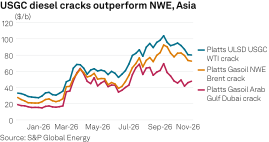
US refiners ramp up diesel supply
US refineries along the Gulf Coast have leveraged sophisticated processing capacity and export logistics to dominate the world's diesel supply, with their market share climbing to 22% of global diesel trade so far in 2026, averaging 1.3 million barrels/day out of total global flows of 5.97 million b/d, according to S&P Global Commodities at Sea.
That compares with a 17% share in 2025, when the US supplied 1.2 million b/d out of 6.9 million b/d in total global trade.
Month-to-date November flows are running even higher, averaging 1.6 million b/d out of 5.68 million b/d globally, or about 25% of total supply.
While the Gulf Coast dominates those export flows, some West Coast refineries including BP's Cherry Point, Washington, and Chevron's Richmond, California, are also shipping diesel to Peru, Chile and Ecuador, accounting for about 1% of total US diesel export volumes.
Third-quarter results showed US refiners running flat out to fill the supply gap, maximizing distillate output against a backdrop of inventories running 9%-14% below seasonal averages.
"Consistent with our commitment to safe and reliable operations, we achieved record third-quarter utilization of 100% to meet market demand while executing our planned turnaround and maintenance activity," Maryann Mannen, Marathon Petroleum's CEO, said during the company's Q3 results call.
Chevron reported US distillate yield of 46% in the third quarter at 98% crude utilization, supported by advantaged crude supply from its Venezuela, Guyana and Bakken holdings.
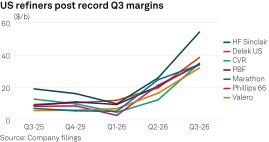
Entering the fourth quarter, the picture is uneven.
Marathon's Q4 guidance was for roughly 95% crude-capacity utilization and about 2.8 million b/d of crude processing, down sharply from its record Q3 levels, as planned work on Gulf and West Coast conversion units proceeds.
Valero, the second-largest US refiner, processed 3 million b/d out of 3.2 million b/d of capacity in Q3 at near-record utilization but signaled Q4 would be a "light maintenance quarter."
"We don't really defer any of our maintenance," Valero COO Gary Simmons said. "We'll continue on our schedule for turnarounds."
Valero's guidance for Q4 Gulf Coast throughput was for 1.855-1.900 million b/d as it prepares to restart a fire-damaged diesel hydrotreater at its Port Arthur, Texas, refinery by year-end.
PBF Energy, which deferred some work into 2027, saw Q4 system throughput at 925,000-985,000 b/d, up from 923,800 b/d in Q3, though West Coast runs at its Torrance, California, refinery face pressure from issues integrating newly acquired hydrogen plants.
Global tightness keeps US exports elevated
The tightness underpinning strong US export flows shows little sign of easing soon, according to S&P Global Energy.
Middle East refined-product exports stood at only 3.6 million b/d in October, roughly 51% of prewar levels, with about 1.6 million b/d of capacity offline through Nov. 13.
Former Soviet Union refinery outages reached 3.87 million b/d in the week ended Nov. 13 following renewed strikes, with as much as 47% of Russia's 7 million b/d of refining capacity offline.
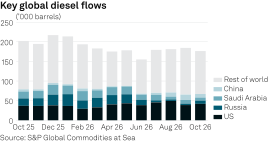
S&P Global Energy forecasts US refinery throughput rising from about 16.57 million b/d in November to 17.01 million b/d in December as maintenance eases, and it projects US diesel exports of 1.39 million b/d in 2027, up from 1.34 million b/d so far in 2026 and 1.17 million b/d in 2025.
Valero's Simmons flagged a potential headwind for next year.
"What you do hear from consultants is that there was about 1.5 million b/d of refinery turnarounds globally that was deferred, which means turnaround activity is currently a little lighter than normal, and you would expect a heavier turnaround season next year," he said.
