Maritime & Shipping, Crude Oil, Refined Products, Metals & Mining, Agriculture, Water, Diesel-Gasoil, Ferrous, Oilseeds
October 27, 2026
COMMODITY TRACKER: 4 charts to watch this week

By Staff
Editor:
The UK considers fast-tracking urgent oil field tieback licenses amid energy security concerns, while Rhine water levels rose but relief is expected to be brief. China's steel exports hit 100 million metric tons a month earlier in 2026 and Brazil's soybean planting is advancing faster year over year.
1. UK may fast-track urgent oil field tieback licenses

What's happening? The UK government could grant licenses to a small number of "urgent" tieback projects before new legislation is introduced, according to a letter from energy minister Michael Shanks to the North Sea Transition Authority released on Oct. 26. Tieback projects are designed to extend the lifespans of existing oil and gas fields. The government plans to introduce Transitional Energy Certificates, allowing companies to access known hydrocarbon deposits close to existing fields while maintaining its ban on new exploration. Shanks noted the move will apply in "urgent cases" only and the number of qualifying projects will likely be "very limited." UK crude output has fallen by about two-thirds since 2009 to roughly 600,000 barrels/day.
What's next? The tieback reforms will be brought forward through legislation when parliamentary time allows, according to Shanks. The review of urgent cases could signal a shift in approach from Prime Minister Andy Burnham's government amid rising energy security concerns. The unpopular Energy Profits Levy, which raised the headline tax rate to 78% in the North Sea, is set to be replaced with a less stringent Oil and Gas Price Mechanism in or before 2030. Energy Secretary Miatta Fahnbulleh has yet to make a decision on the 70,000 b/d Rosebank oil and gas field. Industry insiders noted that modern horizontal drilling techniques allow for hydrocarbon exploitation at considerable distances from existing fields.
2. Rhine water levels rise but relief expected to be brief
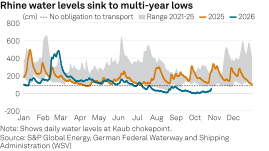
What's happening? Water levels on the Rhine at Kaub reached 56 centimeters on Oct. 26, exceeding 50 cm for the first time since Sept. 4, according to data from the German water authority WSV. The levels are forecast to hover about 70 cm in the coming days. Rhine water levels had mostly remained below 10 cm from Sept. 24 to Oct. 10 and below 20 cm from Oct. 11 to Oct. 22. The extremely low water levels forced refiners to rely more heavily on trucks, rail, pipelines, and coaster movements to transport products. Switzerland's government authorized the release of diesel inventories on Oct. 23 to address shortages connected to pipeline delivery delays.
What's next? The improvement in Rhine water levels is expected to provide only short-term relief to fuel supply chains, according to market participants. The window for barges to pass the Maxau area is expected to be too short to materially ease logistical constraints. Conditions remain particularly tight in Switzerland, where product inventories are extremely low. Germany's rail options remain limited due to the ongoing closure of the right-bank Middle Rhine Line until Dec. 12. Sammir Lesage, analyst at S&P Global Energy CERA, noted that additional freight costs are likely to be passed through the supply chain, with consumers ultimately bearing much of the burden.
3. China's steel exports hit 100 million mt milestone early
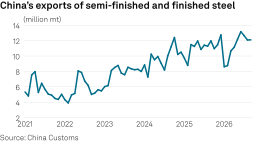
What's happening? China's combined finished and semi-finished steel exports surpassed 100 million metric tons in the first nine months of 2026, reaching the milestone a full month earlier than in 2025, according to China Customs data. Semi-finished steel exports totaled 1.609 million mt in September, down 16.5% from August but up 7.7% year over year. Over January-September, semi-finished steel exports surged 45.8% year over year to 15.655 million mt, taking combined exports to 101.296 million mt, up 2.6% year over year. Total steel exports during the period were equivalent to about 14% of China's crude steel production, up from 13% a year-earlier. Platts assessed SS400 HRC at $482/mt FOB China on Oct. 26.
What's next? Bookings for both finished and semi-finished products improved noticeably in September, pointing to a likely rebound in China's overall steel exports in October and November, according to mill and trading sources. China's combined exports of semi-finished and finished steel products in 2026 are unlikely to fall below 2025 levels, sources said. Semi-finished steel exports are expected to rebound over the coming months and remain at relatively high levels, according to traders.
4. Brazil's soybean sowing advances ahead of 2025 levels
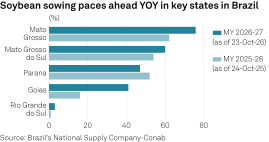
What's happening? Brazil's soybean plantation reached 42.8% as of Oct. 23, higher than 34.8% in the previous year, according to Brazil's National Supply Company, or Conab, in a crop progress report released on Oct. 26. For marketing year (MY) 2026-27, Conab estimated Brazil's soybean acreage at 49.3 million hectares, 1.4% higher year over year. Conab has estimated Brazil's soybean output for MY 2026-27 at a record 181.6 million mt, up 0.7% year over year. Platts assessed SOYBEX FOB Santos at $509.84/mt on Oct. 26, down $11.39/mt day over day.
What's next? Weather is expected to be favorable in key states like Mato Grosso, São Paulo and Mato Grosso do Sul in the coming week, according to Conab. However, parts of Goiás, Bahia and Minas Gerais may receive poor rainfall in the week to Nov. 2. Conducive weather across major growing states is likely to boost soybean yields and may push up overall output, according to Brazil-based market participants. CERA forecast Brazil's MY 2026-27 soybean output falling 2.2% year over year to 177 million mt.
Reporting and analysis by Charlie Mitchell, Matt Hoisch, Alexandra Vladimirova, David Neef, Jing Zhang and Sampad Nandy.
