Crude Oil, Natural Gas
October 26, 2026
UK floats fast-track approvals for 'urgent' oil, gas tiebacks
By Charlie Mitchell and Matt Hoisch
Editor:
HIGHLIGHTS
Regulator NSTA urged to weigh applications
Tiebacks extend existing field lifespans
Follows Jackdaw sign-off, Rosebank still due
The UK government could grant licenses to a small number of "urgent" tieback projects – designed to extend lifespans of existing oil and gas fields – before new tieback legislation is introduced, according to an intergovernmental letter released Oct. 26, in the latest sign of a shifting energy approach from Andy Burnham's government.
In a letter to Stuart Payne, chief executive of the upstream regulator the North Sea Transition Authority, Michael Shanks, the minister of state for energy, reiterated plans to introduce Transitional Energy Certificates allowing companies to go after known hydrocarbon deposits close to existing fields, while maintaining its ban on new exploration.
"These reforms will be brought forward through legislation when parliamentary time allows," Shanks wrote in the letter dated Oct. 21 and posted Oct. 26 on the NSTA's website. "In the meantime, we recognize that a small number of projects may face near-term investment and operational timelines that cannot await the passage of the legislation."
He added: "I am therefore asking the NSTA to consider whether there are any such projects that may warrant an earlier licensing decision so that the NSTA can take action to invite, assess and determine applications for them."
The minister noted that the move should not "be regarded as a new plan or program of work or wider reopening of licenses." Instead it will apply in "urgent cases," he said, adding that the number of projects meeting the criteria will likely "be very limited."
The NSTA declined to comment on which fields or projects could see rapid pre-legislation decisions.
The review of "urgent cases" was floated by the Department of Energy Security and Net Zero on the approval of Adura's contentious Jackdaw gas field last week. "This will ensure the sector can support existing oil and gas fields, while still preventing exploration in new unlicensed areas," the department said.
Alongside the Jackdaw approval, urgent tieback permits provided before the legislation is introduced could herald a shift in approach from Burnham's government, amid rising energy security concerns in the UK. Industry insiders say modern horizontal drilling techniques allow for hydrocarbon exploitation at considerable distances from existing fields.
The new prime minister has signaled he would take a more pragmatic approach than his predecessor Keir Starmer, who angered industry players by extending and increasing the unpopular Energy Profts Levy, which has raised the headline tax rate to 78% in the North Sea.
The EPL and bans on new drilling have been blamed for a wave of IOC exits and consolidation deals on the UK Continental Shelf, as well as a drop in national oil and gas production. It is set to be replaced with a less stringent Oil and Gas Price Mechanism in or before 2030, according to officials.
New energy secretary Miatta Fahnbulleh is yet to make a decision on the 70,000 b/d Rosebank oil and gas field, which like Jackdaw has been subject to legal challenges.
Failure to approve it could make the UK oil sector uninvestable, according to Rosebank stakeholder Equinor.
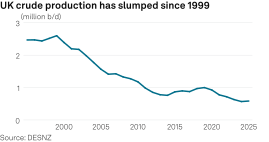
UK crude output has fallen by about two-thirds since 2009 to roughly 600,000 b/d, according to official figures. The country's Brent and Forties crude grades underpin the Platts Dated Brent benchmark, last assessed at $126.69/b on Oct. 23. Platts is part of S&P Global Energy.
