NGLs, Refined Products, Crude Oil, Metals & Mining, Electric Power, Energy Transition, Natural Gas, Agriculture, LPG, Non-Ferrous, Renewables, Biofuels
October 20, 2026
COMMODITY TRACKER: 5 charts to watch this week

By Staff
Editor:
Asian refiners are paying record premiums for Canadian heavy crude amid diversification of supply. US propane exports reached an all-time high in September, while Pacific alumina prices face downward pressure from Chinese supply expansion. The UK targets 2030 clean power goals amid rising prices and China's sustainable aviation fuel plant sees overseas demand.
1. Pacific crude flows shift toward Canadian grades
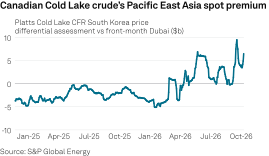
What's happening? Canadian heavy sour crude grades Cold Lake and Access Western Blend are commanding higher premiums in East Asian markets as regional refiners struggle to secure Middle Eastern heavy sour supplies, according to North Asian refinery sources and South Korean foreign affairs and trade ministries. Platts, part of S&P Global Energy, assessed Cold Lake at a record-high premium of $9.50/b against front-month Dubai on CFR South Korea basis Sept. 21. The premium averaged $4.33/b in October to date, compared with September's average of $3.67/b. In China, Canadian heavy sour crude cargoes were recently offered at premiums of up to $14/b to ICE Dated Brent futures, according to trading managers and feedstock sources at Shandong-based refiners.
What's next? South Korea is on track to import a record volume of Canadian crude in 2026, targeting 16 million barrels this year, more than triple the 4.88 million barrels imported in 2025, according to Korea National Oil Corp. data issued Sept. 25. South Korean Foreign Minister Cho Hyun and Canadian Foreign Minister Anita Anand agreed to strengthen cooperation on stable energy supplies and trade flows, highlighting major Canadian infrastructure initiatives such as the Pacific Link western oil pipeline project.
2. US propane exports hit record high
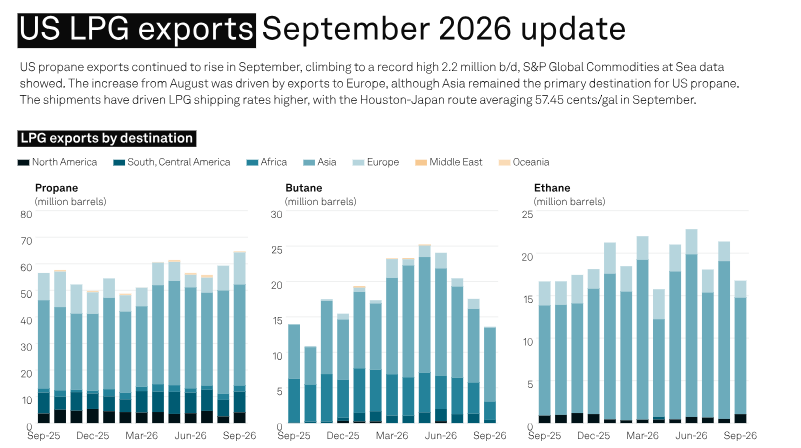
What's happening? US propane exports climbed to a record high 2.2 million b/d in September, driven by increased shipments to Europe, according to S&P Global Commodities at Sea data. Total US propane, ethane and butane exports remained steady at 3.2 million b/d. Asia remained the primary destination, importing 38 million barrels of propane, 10.4 million barrels of butane and 13.7 million barrels of ethane in September. Europe imported 12 million barrels of propane, 122,000 barrels of butane and around 2 million barrels of ethane. The average propane and butane FOB Gulf Coast premiums to their respective Mt. Belvieu prices more than doubled to 10.8 cents/gal from 5.3 cents/gal month over month.
What's next? The US is increasingly acting as the replacement supplier for constrained Middle East LPG barrels into Asia, where buyers are seeking supply security amid regional disruptions, according to an October North America NGL Market report by S&P Global Energy CERA analysts. CERA analysts said robust VLGC freight and weaker seasonal demand pose headwinds for US propane prices, with warmer weather expected to limit upward price pressure.
Related infographic: US propane exports hit record high on surging European, Asian demand
3. Pacific alumina prices face Q4 pressure
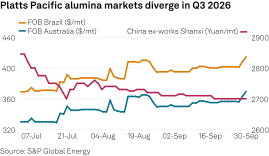
What's happening? Pacific alumina prices diverged in the third quarter, with seaborne prices rising and Chinese domestic prices falling. The Platts FOB Australia alumina assessment averaged $348.33/metric ton in the third quarter and reached $387/mt on Oct. 14, up 4.7% from the end of the third quarter. By contrast, the Platts ex-works Shanxi domestic alumina assessment averaged 2,732.54 yuan/mt in the third quarter and fell to 2,690 yuan/mt on Oct. 14. China became a net alumina exporter in August, with exports totaling 425,003 mt and imports at 349,531 mt, according to Chinese customs data. Observed spot alumina trade volume reached 1.131 million mt in the third quarter, up 38% year over year.
What's next? Pacific alumina prices could face renewed pressure in the fourth quarter as expanding Chinese refinery supply and emerging export availability weigh on markets. CERA's Sept. 28 Aluminum Medium-Term Outlook projected a global alumina surplus of about 1.5 million mt in 2026, about 36% lower year over year, and anticipated a sentiment-led correction in FOB Australia prices during the fourth quarter. CERA forecast Indonesian aluminum output at about 1.2 million mt in 2026, nearly double the previous year. Emirates Global Aluminium restarted 315 of Al Taweelah smelter's 1,262 reduction cells as of Aug. 26 and expects full production in the first quarter of 2027, supporting gradual alumina consumption recovery.
4. UK doubles down on 2030 clean power targets
What's happening? UK Energy Secretary Miatta Fahnbulleh doubled down on efforts to meet the 2030 clean power targets but called for pragmatism to keep energy affordable during the Energy UK conference in London on Oct. 14. The clean power mission calls for at least 95% of Great Britain's electricity demand to be covered by clean sources such as renewables, nuclear or carbon-captured gas plants. System operator NESO CEO Fintan Slye said a "Herculean effort" was still needed despite progress, with many large infrastructure projects facing massive challenges. Platts assessed UK year-ahead power at £137.33/megawatt-hour on Oct. 14, the highest since April 2023.
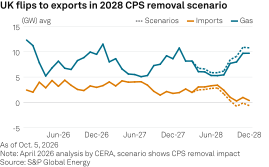
What's next? Reform to grid connection queues is key to managing network constraints amid a £70 billion grid investment plan, according to Slye. CERA analysts forecast installed wind and solar capacity in Great Britain will reach about 97 gigawatts in 2030, almost doubling within five years and broadly aligned with the lower range of NESO's Clean Power scenario, which assumes an 11% increase in annual electricity consumption. UK power prices for 2028 are currently trading below continental levels due to the removal of the UK carbon price support levy from April 2028. CERA analysts forecast this would turn GB into a net power exporter compared to net imports of about 10% of GB demand. Nuclear lifespan extensions since late 2024 added about 90 TWh of additional supply through 2030.
5. China's SAF plant targets European exports
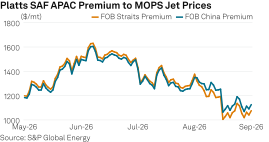
What's happening? China's sustainable aviation fuel (SAF) plant under construction on Liuheng Island in Zhoushan, Zhejiang province, is targeting European and Southeast Asian export markets when production begins in early 2027. The project, developed by Zhejiang Jianglan Biotechnology, is 50% complete and scheduled to begin trial production by the end of March 2027, according to Zhoushan Daily on Oct. 15. The facility is designed to process 320,000 mt/year of waste bio-oils and produce 225,000 mt/year of hydroprocessed esters and fatty acids-based SAF. Platts assessed Sustainable Aviation Fuel HEFA-SPK FOB Straits at $2,180/mt on Oct. 16, down $20/mt from Oct. 15.
What's next? The project's commercial strategy focuses primarily on overseas demand, with EU SAF blending mandates requiring a minimum 6% SAF blend at airports by 2030, rising to 70% by 2050. General manager Tang Huaijiang said the company has begun business negotiations with SAF traders and base airlines in Europe and Southeast Asia and is actively applying for national SAF export whitelist qualifications. The plant is designed to meet the international ASTM D7566 aviation fuel standards and is expected to obtain airworthiness certification from the Civil Aviation Administration of China, alongside EU sustainability and carbon certification, at the start of production.
Reporting and analysis by Gawoon Philip Vahn, Daisy Xu, Binish Azhar, Nick Tan, Louissa Liau, Andreas Franke and Samyak Pandey.
