Energy Transition, Electric Power, Natural Gas, Renewables, Carbon
October 15, 2026
'Herculean effort needed' for clean power 2030 as UK doubles down on plan

Editor:
HIGHLIGHTS
New minister emphasizes bills over gigawatts
'Difficult winter' ahead for consumers: Ofgem
Energy UK calls for urgency tackling energy costs
UK Energy Secretary Miatta Fahnbulleh has doubled down on efforts to reach the 2030 clean power targets, but called for pragmatism to keep energy affordable for all, while system operator NESO said a "Herculean effort" was still needed despite some progress towards the target set two years ago by the government.
The clean power mission calls for at least 95% of GB electricity demand to be covered by clean sources such as renewables, nuclear or carbon-captured gas plants.
Speaking Oct. 14 at the annual conference of sector association Energy UK in London, the new minister told industry delegates that "the public doesn't measure the success of our energy system in gigawatts — they measure it in bills and whether they can live comfortably." On that measure, the system "is not working," the minister said.
Fahnbulleh — like her predecessor in the Department for Energy Security and Net Zero, Ed Miliband — seeks to overhaul a "failing" energy system and promises a "system that delivers for all," blaming exposure to volatile global fossil fuel markets, delays to grid-connected investable projects due to network constraints, on a system that is "simply not working" for consumers.
UK gas and power bills are projected to rise sharply in 2027 as wholesale market prices hit levels not seen since 2022, while system costs are rising as well.
Fintan Slye, the CEO of NESO, which was created by Miliband in 2024 to fast-track power sector decarbonization, said that despite progress over the past two years, there was still a "Herculean effort" needed to achieve those targets as many large infrastructure projects face massive challenges, with reform to grid connection queues key to managing network constraints amid a £70 billion grid investment plan.
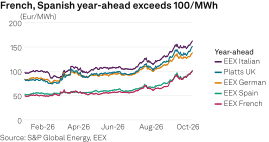
Platts, part of S&P Global Energy, assessed UK year-ahead power at £137.33/MWh (Eur162.39/MWh) on Oct. 14, the highest since April 2023, with only Italian and Irish prices higher across Europe.
'Difficult winter'
Tim Jarvis, the new CEO of gas and power regulator Ofgem, said UK energy consumers are facing a "difficult winter" with average household bills expected to reach £2,000/year, putting the focus on help for those most under pressure in the upcoming UK budget on Oct. 28.
Jarvis told the Energy UK conference that "we are embarking on a once-in-a-generation renewal of our energy infrastructure", with Ofgem ready to facilitate investment and innovation that will bring down the costs of electrification for all consumers.
Meanwhile, with the focus of the conference more on energy transition investment than current market trends, delegates largely avoided the issue of UK-EU energy reintegration ahead of a second summit with the bloc in November that will address trading divergences that may overshadow UK power and carbon markets over the coming years.
Asked about an unprecedented six capacity margin warnings for the UK grid this summer, the NESO CEO referred to an upcoming report by Ofgem on summer grid operations, noting there were "lessons to be learned," especially during extreme weather events for a system increasingly based on variable renewables such as solar and wind.
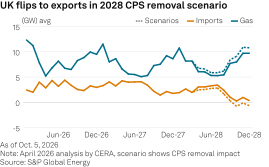
UK power prices for 2028 are currently trading below continental levels due to the removal of the UK carbon price support levy on power generators from April 2028 and the discount of UK carbon allowances to EUA.
Analysts at S&P Global Energy CERA forecast that this would turn GB into a net power exporter compared to net imports of about 10% of GB demand over recent years.
Opposition favors nuclear
Shadow energy secretary Andrew Bowie from the opposition Conservative Party called for new gas exploration licenses to be granted in the North Sea as the UK oil and gas industry was "dying" due to the current government policy banning the drilling of new fields in the North Sea.
Fahnbulleh later confirmed that a decision on Jackdaw was imminent, while a decision on the Rosebank field would take longer.
Bowie also set out his vision for a system powered by cheap, secure, abundant and reliable energy from a diverse range of sources to make the UK less dependent on energy imports.
In electricity, the main opposition party advocates faster deployment of new nuclear power plants but criticized government plans to expand ground-mounted solar.
However, like Fahnbulleh, the shadow energy minister agreed that electrification is the most obvious choice for the UK's energy security, but said it needed to be driven by pragmatic decisions that protect living standards.
Energy UK CEO Dhara Vyas opened the conference with a warning that global conflict and extreme weather have made 2026 a defining year for the UK's energy transition, calling for urgency in tackling rising energy costs.
"Energy security is national security," Vyas said, adding that it is "right to question, debate, challenge, and also scrutinize the energy transition."
CERA analysts forecast installed wind and solar capacity in Great Britain will reach about 97 GW in 2030, almost doubling within five years and broadly aligned with the lower range of NESO's Clean Power scenario, which assumes an 11% increase in annual electricity consumption and major electrification impacts only after 2030.
In nuclear, lifespan extensions for the UK's existing reactors since late 2024 added about 90 TWh additional supply through to 2030, the single biggest boost to clean power over the coming years, helping to offset potential delays to the new Hinkley Point C nuclear power plant.
UK Clean Power 2030: Selected Targets (GW)
| CP 2030* | CERA (end-2026)** | CERA (end-2028)** | |
| Offshore wind | 43-50 | 19 | 27 |
| Onshore wind | 27-29 | 16 | 19 |
| Solar PV | 45-47 | 24 | 33 |
| Battery BESS | 23-27 | 8 | NA |
| Long duration storage | 4-6 | 0 | NA |
| Consumer flexing | 10-12 | NA | NA |
| Nuclear | 3-4 | 5 | 5 |
| Low carbon dispatchable (CCS/H2) | 2-7 | 0 | 0 |
| Unabated gas | 35 | 32 | 33 |
| Interconnectors | 12-14 | 10 | 12 |
Source: NESO*, S&P Global Energy**
