Agriculture, Refined Products, Energy Transition, Crude Oil, Natural Gas, Electric Power, Biofuels, Carbon, Grains, Oilseeds, Diesel-Gasoil, Jet Fuel
September 01, 2026
COMMODITY TRACKER: 5 charts to watch this week

By Staff
Editor:
Asian refiners plan maximum distillate exports to capture elevated crack spreads in the second half of 2026. Meanwhile, European carbon allowances touched one-month highs, while corn and soybean meal prices near records on supply concerns. Indian ethanol imports and Brazil's solar investment are also in focus this week.
1. Asian refiners eye higher distillate exports amid record margins
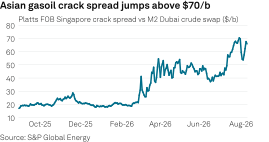
What's happening? Asian middle distillate crack spreads rose significantly above 2025 averages in August due to refinery feedstock procurement disruptions and tighter export controls, according to Platts data, the South Korean Trade Ministry and industry sources. Platts assessed the Singapore gasoil swap crack against Dubai crude at a record high $71.61/b on Aug. 19. The crack spread averaged $64.71/b in August versus the 2025 average of $18.16/b. Jet fuel crack spread averaged $44.74/b year-to-date in 2026, more than double the 2025 average of $17.32/b. Platts is part of S&P Global Energy.
What's next? South Korean refiners plan to export at maximum levels within government caps to capture robust crack spreads in the second half of 2026, officials at four refiners told Platts. Refiners in Thailand, Japan and Taiwan also intend to increase spot sales when domestic supply conditions permit, product marketers said.
2. European carbon prices reach one-month high
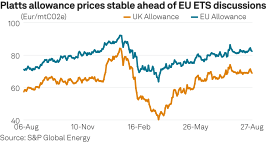
What's happening? European carbon prices touched a one-month high in the week to Aug. 28 before retreating amid subdued summer liquidity. EU Allowances traded at €82.56/metric tons of CO2e at 1302 BST Aug. 28, according to the Intercontinental Exchange Inc. (ICE), largely unchanged from the Aug. 21 settlement of €82.61/mtCO2e. Platts assessed EUAs for the December 2026 contract at €82.36/mtCO2e Aug. 27, while UK Allowances for the same contract were assessed at £59.06/mtCO2e, trading at a €13.48/mtCO2e discount to their EU counterparts. Financial sector participants cut net long EUA positions to 36.4 million allowances as of Aug. 21, down 5.85% week over week, according to ICE data.
What's next? S&P Global Energy CERA analysts expect EUAs to range between €80/mtCO2e and €86/mtCO2e from September to December. The upper end depends on "continued Middle East-driven energy strength and a colder-than-normal Q4 lifting gas-for-power demand, while the September auction step-up and any geopolitical de-escalation represent downside catalysts," CERA analysts said. The European Commission will publish bi-weekly updates starting in September on the distribution of free allocations to industry.
3. European corn, soybean meal prices near record highs
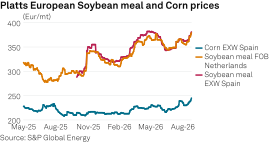
What's happening? European corn and soybean meal prices reached near-record levels, supported by stronger futures markets and firmer origin premiums due to supply concerns, according to market participants in Spain, the Netherlands and Italy. Platts assessed Spain ex-works corn at €245/mt on Aug. 26, up €6/mt month over month. Netherlands FOB soybean meal was assessed at €379/mt, up €13/mt, while Spain ex-works soybean meal reached €381/mt, up €15/mt. Factors include European heat waves, escalating Russia-Ukraine conflict and weaker Brazilian soybean crush margins.
What's next? European Commission data forecasts EU corn production at 52.11 million mt for the 2026-27 marketing year (July-June), down from 60.45 million mt in 2025-26. Spanish feed manufacturers may increasingly turn to barley as a substitute for higher-priced feed grains, a Spanish broker said. US soybean meal may become more competitive in Spain as elevated Brazilian and Argentine values make American supplies attractive, a Spain-based market participant said. However, demand remains limited during the holiday period, with consumption weaker than under normal market conditions, traders said.
4. Indian ethanol import prices rise to new high
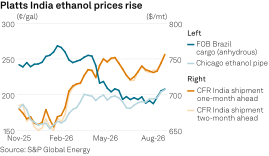
What's happening? Indian ethanol import prices hit a record high on Aug. 25 as global and domestic price gains lifted market sentiment, market sources told Platts. Platts assessed Anhydrous Ethanol CFR India shipment one month ahead at $757/mt for September, up $12/mt week over week, surpassing the previous high of $751/mt from May 26. US ethanol futures climbed above $2/gal, with Platts assessing Chicago Terminal ethanol at $2.07/gal on Aug. 25. Brazil anhydrous ethanol reached $549/cubic meter FOB Santos, its highest since May 28, supported by improved local buying interest.
What's next? Demand for imported ethanol into India remains muted as elevated CFR prices curb fresh buying interest, sources said. Indian buyers are adopting a wait-and-see approach, monitoring freight rates and price trends before placing new import inquiries. Mills are expected to start crushing early this year, with conditions improving once the festive season ends, sources said.
5. Solar investments pause in Brazil amid renewable curtailments
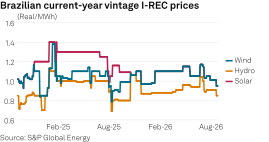
What's happening? Investments in centralized solar power plants in Brazil has frozen due to increased risk from ongoing renewable energy curtailments, according to ABSolar president Rodrigo Sauaia. From January to July, curtailments accounted for 19.5% of solar and wind generation, with August restrictions reaching 28.9% of potential generation, up from 24.9% in July, according to National System Operator data. Small distributed generation units continue growing, but at a slower pace due to higher capital costs and recent tax increases, Sauaia said. Solar photovoltaic capacity grew 16.3 GW in 2025, reaching 24.8% of Brazil's total capacity, according to the Brazilian Energy Research Bureau.
What's next? ABSolar estimates solar PV generation capacity will grow 8-9 GW in 2026, significantly slower than the 16.3 GW added in 2025. Oversupply is expected to persist and worsen once new thermal plants from a March 2026 government auction that contracted for 19 GW of capacity come online, sources said. More permanent solutions include enhancing energy exports, implementing hourly pricing, and investing in storage systems, according to Markus Vlasits, president of the advisory board at the Brazilian Energy Storage Association.
Reporting and analysis by Philip Vahn, Shu Ling Lee, Irina Breilean, Eklavya Gupte, Nanditha Kinavoor Madathil, Rishab Joshi and Felipe Peroni.
