Electric Power, Agriculture, Natural Gas, Biofuels
August 26, 2026
Brazil solar investment stalls as oversupply, curtailments deter developers

Editor:
HIGHLIGHTS
Brazilian curtailments reach 28.9% in August
Operator employs emergency plan against oversupply
Ongoing curtailments of renewable energy sources have led to a pause in investment in solar power plants in Brazil and slower growth in distributed generation units, but oversupply is expected to persist, according to the National Solar Photovoltaic Association, ABSolar.
"Investments in centralized solar power plants are frozen because of the increased risk perception due to the curtailments", ABSolar president Rodrigo Sauaia said Aug. 25, during the Smarter E South America Conference in São Paulo city.
Meanwhile, small distributed generation plants are expected to continue growing despite curtailments, but at a slower rate than in previous years.
ABSolar estimates that solar photovoltaic generation capacity will grow by 8-9 GW in 2026, although the association has been finding it difficult to track new capacity due to gaps in official data.
As a comparison, solar photovoltaic generation capacity grew by 16.3 GW in 2025, reaching 24.8% of the country's capacity, according to the Brazilian Energy Research Bureau, or EPE. More than half of this growth, or 8.8 GW, was small distributed generation units, EPE figures show.
"In distributed generation, higher costs of capital and a recent tax increase in equipment have contributed to decelerating growth," Sauaia said.
Distributed generation is at the center of the debate, as recent investments in these units have created an overcapacity problem, especially during peak solar hours. That is because the generated distribution projects launched until 2023 benefit from subsidies in transmission costs, which many claim have overstimulated the sector.
However, even as subsidies are no longer granted for new projects, lower installation costs and cheaper modules allow the sector to continue to grow.
"We are seeing an accommodation in the market; the market is still positive, but not as much as in previous years," a solar panel seller at the event said.
On Aug. 23, the ONS implemented an emergency plan to restrict generation from a wider range of sources, including renewable sources such as small hydroelectric plants and biomass. From 11 am to 1:30 pm, it curtailed 1 GW in generation, mentioning the need to balance lower demand with a higher output from small distributed generation units.
It was the second time the ONS has resorted to this measure in 2026 to balance supply and demand and to avoid system failure during periods of high generation and low consumption. The emergency measure is the last step before localized energy supply interruptions, considered a last resort to avoid a wider blackout.
To mitigate this problem, the ONS has been planning meetings with solar generators to increase its hold over distributed generation output, but talks are still at a preliminary stage, Sauaia said.
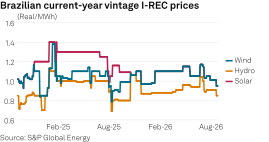
The increased share of distributed generation is also evident in Brazil's International Renewable Certificates market, sources said. Despite being priced at parity with wind I-RECs, solar I-RECs have been harder to find, as many small units are often not certified to issue these certificates.
Persistent oversupply
Beyond becoming a routine in Brazilian solar operations, curtailments haven't shown any sign of slowing, as generation continues to grow.
From January to July, curtailments accounted for 19.5% of solar and wind generation, according to data from the National System Operator, or ONS. Until Aug. 23, restrictions amounted to 28.9% of potential generation for the month, up from 24.9% in July.
Legislation does not establish any future remuneration for plants affected by curtailments, which are prevented from generating revenue during restricted hours. Also, the existing regulation does not make clear which plants to restrict in each region, sometimes leaving it up to distributors to balance supply and demand.
In addition, Brazil continues to invest in thermal plants to secure supply during peak consumption hours, when solar generation is unavailable. In March 2026, a government auction contracted 19 GW of capacity, most of it on new gas-fueled thermal power plants. Since these plants must operate at minimum output, oversupply will only worsen once these investments are completed, sources said.
A more permanent solution would include enhancing energy exports, hourly pricing and investing in storage systems, according to Markus Vlasits, president of the advisory board at the Brazilian Energy Storage Association (ABSAE).
"We invested billions of reais in a clean energy source, and now we shouldn't discuss generation cuts as a permanent solution," Vlasits said.
