Maritime & Shipping, Crude Oil, Metals & Mining, Refined Products, Natural Gas, Agriculture, Wet Freight, Non-Ferrous, Fuel Oil, Grains, LPG
August 11, 2026
COMMODITY TRACKER: 5 charts to watch this week

By Staff
Editor:
Japan's US crude imports hit a record high as refiners diversified supply sources, while China's aluminum exports fall in July after four months of gains. India's bunker fuel market faced weather disruptions, European ammonia production costs rose above import prices on higher gas values and Australian wheat prices reached a 13-month peak.
1. Japan's US crude imports hit record high in H1
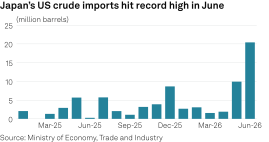
What's happening? Japan imported 680,311 b/d of US crude in June, marking the highest-ever monthly shipments, according to Ministry of Economy, Trade and Industry data released July 31. In the first half of 2026, US crude shipments more than doubled year over year to 220,619 b/d, also a record high for half-yearly imports. Major refiners actively sought alternatives to Middle Eastern crude amid disruptions to tanker flows in the Persian Gulf. Among US grades received in June, 15.6 million barrels were light sweet WTI Midland, 1.98 million barrels were medium sour Mars Blend and 1.7 million barrels were West Texas Light crude.
What's next? The Japanese refining industry is on track to meet its 2026 target of importing at least 200,000 b/d of US crude to reduce heavy reliance on Middle Eastern suppliers, according to feedstock managers at three major refiners. Refiners are treating US crude imports and broader supply diversification as a strategic priority, not merely a short-term response to market disruption. However, Middle Eastern crude remains central to Japan's refining system. With tanker flows in the Persian Gulf expected to improve as US-Iran peace talks continue, refiners are reorganizing term lifting schedules, targeting at least 15 million barrels/month of Murban and Das Blend crude combined.
2. China's aluminum exports fall in July
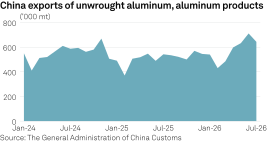
What's happening? China's unwrought aluminum exports reached 643,000 mt in July, down 9.6% from June but 18.7% higher year over year, customs data showed August 7. Exports fell after four consecutive months of gains, as widely expected by China-based analysts. For January-July, exports totaled 4.04 million mt, up 16.7% compared to the same period last year. The price ratio between London Metal Exchange and Shanghai Futures Exchange aluminum remained broadly rangebound in July, with the most actively traded Shanghai Futures Exchange contract closing at about 1.08 to the LME three-month price on Aug. 6, compared to 1.07 on July 7.
What's next? Aluminum exports are expected to remain elevated in August, an Asia-based producer said. The LME-SHFE price ratio is anticipated to influence export flows in the coming months, with traders monitoring arbitrage opportunities. China's aluminum production and export dynamics will continue to shape global supply patterns, as the country remains the world's largest aluminum producer and exporter.
3. Indian bunker fuel trading disrupted by weather
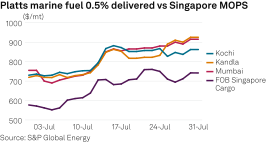
What's happening? India's bunker fuel market faced supply disruptions in July as adverse weather and barge constraints hit west coast ports. Gujarat ports experienced severe disruptions, with operations suspended at Kandla, Sikka, Vadinar and Tuna Berth from July 3, with total volume dropping to 35,000 mt. Kochi saw an Indian refining major supply close to 20,000 mt of very low sulfur fuel oil, down from June. Platts, part of S&P Global Energy, assessed marine fuel oil 0.5% delivered to Mumbai at $870/mt on Aug. 6, up $180/mt month over month, while Kandla was assessed at $878/mt, up $160/mt.
What's next? East coast ports are expected to maintain steady demand. Paradip showed improved volumes with nearly 11,000 mt of very low sulfur fuel oil supplied in July. High sulfur fuel oil demand is forecast to rise as more scrubber-fitted vessels operate. Chennai supplied about 14,000 mt, while New Mangalore saw strong demand at 7,000-8,000 mt from tankers and LPG vessels. However, product availability remained limited across the east coast.
4. European ammonia production costs rise above imports
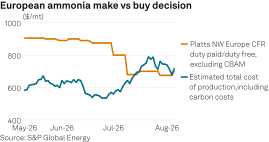
What's happening? Steadily rising natural gas prices have pushed up the estimated cost of ammonia production in Europe, even as weak international demand and a seasonal slowdown weigh on import prices, data from Platts showed. The estimated cost of production has steadily exceeded the import price since mid-July, the first extended period this has occurred since June 2025. Platts assessed Northwest Europe ammonia at $700/metric ton CFR, duty paid/duty free, on Aug. 7, up $25/mt on the day. Meanwhile, the estimated production cost was about $720/mt, based on the latest Dutch TTF front-month closing gas price of €56.01/megawatt-hour.
What's next? A regular ammonia seller to Northwest Europe said TTF prices had eased slightly in recent days, but they did not expect the trend to continue, with their outlook bullish for downstream fertilizer demand. A trader said they expected European import demand to return as production costs climbed and fertilizer requirements increased amid cooler weather. The outlook for European ammonia producers will largely depend on the trajectory of natural gas prices and whether the cost advantage of imports persists as demand for fertilizers picks up in the coming months.
5. Australian wheat prices reach 13-month peak on Black Sea disruptions
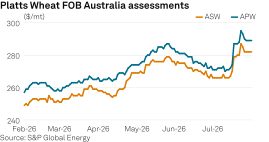
What's happening? Australian wheat prices increased to a 13-month high in July as escalating attacks on port infrastructure and commercial vessels in the Black Sea disrupted shipments from Russia and Ukraine during their harvest window. Platts assessed Australian Premium White wheat at $289/mt on July 31, up $18/mt from July 1, while Australian Standard White with no protein guarantee rose $16/mt to $282/mt. Both grades peaked on July 23 at $295/mt and $287/mt, respectively. Argentine wheat offers for August-October shipments entered the market outside their typical November-April window, with delivered prices around $290s/mt CFR, competing with Australian supplies, according to several Southeast Asian grains traders.
What's next? Asian wheat buyers are closely monitoring developments in the Black Sea, with prolonged disruptions expected to keep Australian wheat prices elevated in the near term. Feed wheat demand across the region is forecast to remain subdued, except in destinations with inelastic demand like the Philippines, as high global wheat prices continue to support a wide feed wheat-corn spread of at least $20/mt. Australia's 2026-27 wheat production is estimated near 30 million mt, though trade sources warn of potential downward revisions depending on weather developments in August-September. The timing of El Niño's onset will largely determine the crop outcome, with an October arrival potentially beneficial for harvest conditions.
Reporting and analysis by Gawoon Philip Vahn, Takeo Kumagai, Sai Deepak Tarlada, Abhishek Anupam, Lucy Tang, Mollie Gorman and Vivien Tang.
