Refined Products, LNG, Metals & Mining, Agriculture, Chemicals, Fuel Oil, Ferrous, Grains
June 16, 2026
COMMODITY TRACKER: 5 charts to watch this week

By Staff
Editor:
Singapore fuel oil stocks dropped to the lowest level in over seven years, while US LNG feedgas flows reached their highest since April. Meanwhile, China's steel exports increased in May, although orders are weakening. US DDGS values fell on weak demand, while European virgin HDPE regained its pricing discount.
1. Singapore fuel oil stocks hit seven-year low
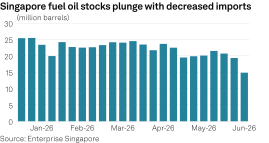
What's happening? Singapore's heavy distillate inventories fall 23.3% week over week to 14.8 million barrels in the week ended June 10, marking the lowest level since Aug. 22, 2018, according to Enterprise Singapore data released June 11. The decline came as fuel oil imports dropped 23% to 523,279 metric tons, the smallest weekly volume in five weeks, with no inflows from the Middle East, Europe or Russia. Imports from Malaysia fell 54% to 133,283 mt, while Indonesian supplies decreased 81.6% to 26,653 mt. Asian suppliers accounted for 81.5% of total imports at 426,319 mt. Stocks were 37.4% lower than the same week in 2025.
What's next? The tight supply situation is affecting downstream markets, with traders reporting limited near-term availability for marine fuel 0.5%S grade. Sellers are only able to offer products deliverable from July onward due to supply constraints, according to a Singapore-based trader. Platts-assessed Singapore-delivered 0.5%S marine fuel bunker premium over FOB Singapore Marine Fuel 0.5%S cargo values averaged $31.89/mt over June 8-12, up from $24.62/mt in the week of June 2-5. However, high sulfur fuel oil premiums remained under pressure due to sluggish demand, with Singapore-delivered 380 CST HSFO bunker premiums averaging $1.87/mt over June 8-11. Platts is part of S&P Global Energy.
2. US LNG feedgas demand hits multi-week high
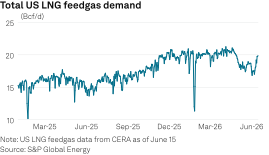
What's happening? US LNG feedgas demand reached nearly 19.9 Bcf/d on June 15, the highest level since late April, according to S&P Global Energy CERA data. This marked the third consecutive day of flows nearing 20 Bcf/d, up from an average of about 18.2 Bcf/d from early May through June 12. The increase was driven by rising deliveries to the Golden Pass export terminal in Texas, which is undergoing commissioning, and higher utilization at other facilities exiting seasonal maintenance. Flows to Golden Pass exceeded 400 MMcf/d for a second straight day on June 15.
What's next? The uptick in terminal utilization along the US Gulf supports higher US exports heading into the peak summer demand period. Global LNG spot prices remained elevated, although they softened following the June 14 announcement of an interim peace deal between the US and Iran. Platts assessed the July JKM benchmark price at $17.238/MMBtu on June 15, down 60.40 cents/MMBtu day over day but still about 61% higher than prewar levels. In the Atlantic, Platts assessed the DES Northwest Europe marker for July at $14.229/MMBtu on June 15, down $1.426/MMBtu day over day but 44% higher than before the conflict.
3. China's steel exports rise in May, but outlook dims
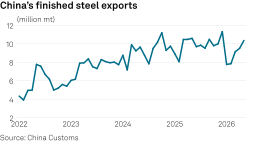
What's happening? China exported 10.341 million mt of finished steel in May, up 8.8% from April, although still 2.2% lower year over year, according to China Customs data released June 9. Over January-May, China exported 44.554 million mt of finished steel, down 8.1% from the same period of 2025. Several mills and traders said a recent slowdown in overseas orders could lead to a retreat in export shipments in June and July. The year-over-year decline was mainly due to a high base factor in 2025, with current steel exports remaining at historically high levels. Platts assessed SS400 HRC at $497/mt FOB China and BS500B-grade rebar at $503/mt FOB China on June 15.
What's next? Export orders received in May declined from April, and orders in June remain sluggish, suggesting shipments will fall in June-July, a trading source said. A mill source said that both domestic and export demand are relatively weak, warning that if crude steel output in June maintains May levels, steel inventories will begin to accumulate, putting pressure on the market. The recent decline in overseas demand was partly due to overseas buyers having previously purchased large quantities of Chinese steel, reducing current demand. With the off-season arriving and abundant steel supply, Chinese steel prices may struggle to gain upward momentum, sources said.
Further reading: METALS MONITOR: South Korea to boost steel sector; Nornickel to run Norilsk copper plant until 2028
4. US DDGS prices drop amid weak demand
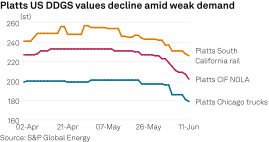
What's happening? US dried distillers grains with solubles values have moved sharply lower since the start of June, as weak export demand, high production and seasonally slower feed consumption have pressured the market. Since June 1, Platts CIF New Orleans values have fallen by about $24/short ton, Chicago truck values by $25/st and UP California rail values by $20/st. Market participants reported little international buying interest, while domestic demand has softened as summer feeding rates have slowed and competing feed ingredients have become more attractive. Sources also said product availability has increased following the spring maintenance season.
What's next? Market participants expect demand to remain subdued through June and potentially into July. Several sources said lower prices may be needed to attract international buyers and maintain ration space. Export demand, particularly from key destinations, along with ethanol production, weather and grain futures, will be critical in determining whether DDGS values can find support in the coming weeks. The market's ability to stabilize will depend on whether lower prices can stimulate buying interest from both domestic and international customers in the near term.
5. Virgin HDPE regains pricing discount over recycled
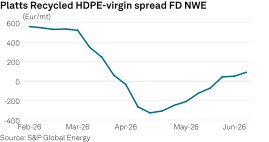
What's happening? European converters are increasingly turning to virgin high-density polyethylene after it regained its pricing discount to recycled HDPE, market participants said June 12. The price relationship between the recycled and virgin markets inverted going into June, with R-HDPE natural pellets returning to a premium over virgin material. Platts calculated the spread for R-HDPE natural pellets to virgin HDPE FD Northwest Europe at Eur91/mt on June 10, a week-over-week increase of Eur41/mt. Recycled HDPE spot pricing has continued to diverge across end-use applications, with material for cosmetic applications commanding a significant premium.
What's next? In the virgin market, a combination of well-stocked inventories, competitive import offers and a lack of interest from end-use customers has weighed on prices. Market participants said this marked a shift in market dynamics compared with the rush to procure volumes in March and April. Market participants in the virgin HDPE class held mixed views on supply, with some seeing injection grade as the weakest HDPE grade while others saw injection at parity with blowmolding grade. The pricing dynamics suggest continued preference for virgin material as long as the discount persists.
Reporting and analysis by Koustav Samanta, Iris Leung, Deborah Lee, Corey Paul, Jing Zhang, Paola Caballeros and Ishrah Ahmed.
