Crude Oil, Agriculture, Chemicals, Rice, Oilseeds, Olefins
June 09, 2026
COMMODITY TRACKER: 5 charts to watch this week

By Staff
Editor:
Medium-sour Saudi crude deliveries to South Korea through the Red Sea are becoming steady, while Venezuela redirects exports to the US and India amid shifting trade patterns. Rice markets see the Philippines diversifying toward Myanmar amid rising Vietnamese prices and European ethylene faces downward pressure from weak demand.
1. Saudi crude flows to South Korea stabilize via Red Sea
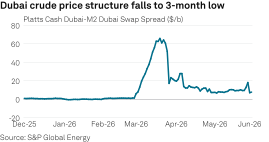
What's happening? Medium-sour Saudi crude deliveries from the Red Sea port of Yanbu to South Korean oil terminals are becoming steady, with seven VLCCs safely transiting the Bab al-Mandab Strait as of June 1, according to the Korea Shipowners' Association and the Ministry of Oceans and Fisheries. Four tankers have already berthed at South Korean ports, including Seosan, Yeosu and Ulsan. South Korea, Asia's third-largest crude buyer, imported 838,000 b/d of Saudi crude over January-April, down 7.9% year over year, according to data from Korea National Oil Corp.
What's next? South Korean refiners are expecting more frequent shipments of Oman export blend crude, as tankers will no longer need to bypass the Strait of Hormuz to import from key Omani ports, according to feedstock managers at Ulsan- and Seosan-based refineries. South Korea's Trade Minister Kim Jeong-gwan called for ongoing cooperation from the Omani government to secure stable crude and naphtha supplies during his April visit to Oman. The Platts Dubai crude forward curve backwardation has eased, with the spread between cash Dubai and the same-month Dubai swap assessed at $6.75/b June 8, the lowest level since $5.91/b March 2. Platts is part of S&P Global Energy.
2. Venezuelan crude exports to US, India rise in May
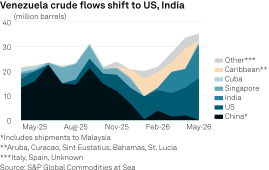
What's happening? Venezuela shipped 35.3 million barrels of crude in May, marking a notable shift in its export destinations, according to S&P Global Commodities at Sea. Exports to the US rose to 17.1 million barrels, the highest weekly volume in nearly eight years during mid-May, while Indian buyers took 13.5 million barrels as they diversified away from Middle Eastern barrels affected by Strait of Hormuz shipping constraints. The Latin American producer's customer base has fundamentally changed, with Chinese buyers completely absent for five consecutive months after previously dominating Venezuela's export slate, according to CAS data.
What's next? Venezuelan production continues to grow, with state oil company PDVSA and its foreign partners averaging 1.155 million b/d in May, up from 1.130 million b/d in April, according to preliminary Ministry of Hydrocarbons data. Production in the Orinoco Belt, Venezuela's main oil-producing area, rose to 650,000 b/d in May, 20,000 b/d higher than in April, according to the report. Venezuelan state oil company PDVSA expects to reach crude oil production of 1.37 million b/d by December, an increase of 430,000 b/d from the 940,000 b/d recorded in January, according to the company's executive vice president, Jovanny Martinez.
3. Philippine rice buyers turn to Myanmar amid high Vietnam rice prices
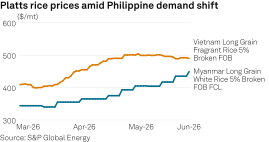
What's happening? Philippine rice importers have shifted buying interest toward Myanmar in recent weeks as elevated Vietnamese prices prompted diversification, sources told Platts June 8. The Philippines imported 23,990 metric tons of Myanmar rice in May, up 20.8% month over month, according to Myanmar Rice Federation data. Platts assessed Myanmar 5% white rice at $449/mt FOB FCL on June 5, up 12.5% month over month, the highest since Jan. 17, 2025. Vietnam Fragrant 5% rice prices increased 26.3% from a record low of $399/mt FOB on March 17 to $504/mt FOB on May 11, driven by strong Philippine demand, tightening supply after the winter-spring harvest and elevated production costs.
What's next? Market participants remain uncertain whether the shift toward Myanmar is sustainable, as the availability of preferred summer-crop varieties like GW11 is expected to tighten in the coming months, a Yangon-based exporter said. Pakistani rice has also attracted Philippine interest, with market sources estimating 70,000-75,000 mt booked for June shipment. However, a Philippines-based importer described increased purchases from Myanmar and Pakistan as "temporary," noting that Filipino consumers still favor Vietnamese rice and "will go back to DT8." S&P Global Energy CERA expects the Philippines to import 5.6 million mt of rice in the 2026-27 marketing year (July-June), up 60% year over year, amid downside production risks due to higher fertilizer costs and El Niño-related weather concerns.
4. European ethylene prices fall on weak demand, ample supply
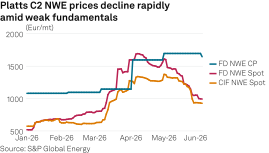
What's happening? European ethylene prices declined in the first week of June amid weak buyer appetite and ample supply. Platts assessed the FD Northwest Europe ethylene spot price at Eur980.50/mt June 8, down Eur66.50/mt from the end of May. The market remained oversupplied as domestic crackers returned from maintenance and previously imported US volumes arrived, with some cracker operating rates reduced to about 70%, according to a producer. June import volumes were heard at 60,000-65,000 mt, sharply lower than May's 174,000 mt, a trader said. The European industry contract price settled at Eur1,645/mt FD NW Europe on June 1, down Eur50/mt from May -- the first decline since February.
What's next? Market participants expect continued pressure on ethylene prices through 2026 amid structural demand weakness and high inventories. Downstream buyers remain cautious after building comfortable stock levels during the March-April panic-buying, which has limited spot trading activity, a producer noted. Key derivative markets, including polyethylene, ethylene glycol and PVC, show weak demand, with competitive import offers, particularly China-origin polyethylene, weighing on local sentiment. PVC producers' initial June offers to consumers were most commonly heard at a Eur25/mt decrease from May, following the lower ethylene settlement.
Special Report: APIC 2026: Emerging stronger
5. Argentine soybean meal prices fall below Brazil
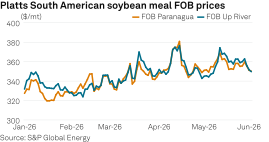
What's happening? Argentine soybean meal export prices fell below Brazilian levels on June 2 for the first time in three weeks as weakening external demand pressured port differentials. Platts assessed the FOB Up River soybean meal price for July shipment at $349.65/mt on June 2 while FOB Paranaguá cargoes loading the same month were assessed at $350.20/mt -- the first time the Argentine value dropped below the Brazilian since May 12. Weakened demand has weighed on FOB Up River export premiums, with Platts assessing the spot basis at a $9/short ton discount to Chicago Board of Trade futures on June 2. In mid-April, when the Argentine soybean harvest faced delays, the differential reached an $8/st premium to CBOT. "Demand is still lacking," an Argentine market source said.
What's next? CERA estimates Argentina will export 29.50 million mt of soybean meal in the current 2025-26 season starting in April, up from 28.72 million mt in 2024-25. However, April exports totaled 2.50 million mt, according to the Ministry of Economy, falling short of CERA's 2.80 million mt forecast. CERA analysts noted in their Global Soybean Complex Short-Term Outlook report released May 29 that delayed harvests limited soybean supplies, while strong corn export demand may have constrained soybean product exports.
Reporting and analysis by Philip Vahn, Sheky Espejo, Muskan Agarwal, Chirag Aggarwal, Mujidah Yahaya and Jose Roberto Gomes.
