Energy Transition, Natural Gas, Emissions
June 04, 2026
Maintaining momentum: Permian methane emissions intensity contracts 23% in 2025
HIGHLIGHTS
Permian methane intensity drops 23% to 0.34%
Texas emissions exceed New Mexico by 56%
Monthly flight coverage jumps to 22% in 2025
Methane emissions intensity in the Permian Basin fell 23% in 2025 to 0.34% per barrel of oil equivalent produced from 0.44% in 2024, according to S&P Global Energy CERA analysis and Insight M data.
Upstream methane intensity in the basin has sustained a downward trend since the inception of this dataset in 2022. From 2022 to 2025, basin-wide methane intensity declined by nearly two-thirds, reflecting continued improvement in upstream emissions performance.
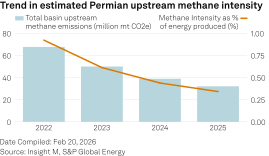
Four key trends emerged from the 2025 CERA analysis and Insight M data:
- Sustained intensity decline: Methane intensity continues a multiyear downward trajectory, with 2025 marking another step-change lower in basin-wide performance, consistent with CERA analysis.
- Stable activity context: The reduction occurred within a largely stable production environment and alongside expanded monitoring frequency, suggesting that the observed decline is not driven by reduced activity levels.
- Methodological evolution: Increased flight frequency and refined event duration assumptions have improved the temporal resolution and overall reliability of the 2025 dataset.
- Regional divergence: A persistent performance gap remains between states, with methane intensity in Texas (0.39%) materially higher than in New Mexico (0.25%), according to the latest Insight M data.
Between 2024 and 2025, upstream methane emissions in the Permian fell from 38.9 million metric tons of CO₂ equivalent to 32.1 million mt -- a decline of about 6.8 million mt, according to CERA estimates. This corresponds to roughly 0.27 million mt of CH4, assuming a global warming potential of 25.
For context, a 6.8 million mt reduction is comparable to about half the annual emissions of all data centers in Virginia, the country's largest data center hub, or to the annual emissions of roughly 1.5 million passenger vehicles.
These estimates are focused exclusively on upstream operations. Methane emissions also occur across midstream, gathering and processing systems, but those emissions fall outside this assessment's scope.
While this benchmark is primarily based on aerial survey data from CERA's partnership with Insight M, now part of Zietview, satellite-based observations from Sentinel 5P, ingested by CERA, provide an additional, independent view of methane emissions across the basin. Differences in detection thresholds, spatial coverage and temporal frequency across measurement technologies can result in variation between datasets.
Those variations highlight both the progress being made and the measurement uncertainties that persist when quantifying methane emissions at scale.
Improving accuracy with frequency
While the 2025 headline numbers highlight continued reductions in methane emissions, substantial improvements in the dataset and notable methodological evolution are raising the reliability of the CERA Permian Upstream methane intensity estimate.
Every methane detection technology has its advantages and drawbacks. The technology CERA used for the Permian benchmark -- aerial surveys -- benefits from a low detection threshold and sufficiently high resolution to attribute emissions to upstream, midstream or other sources. The Permian benchmark has consistently covered 88%+ of assets and production. In 2025, there was a significant increase in the frequency of overflights by Insight M, which underpins the CERA Permian benchmark. In 2023, only 0.62% of Permian production received monthly flyover observations. By 2025, this figure had risen to 22% of basin production.
Furthermore, over two-thirds of assets were observed at least once per quarter. This means the assets producing more than 55% of total basin oil and gas production were observed at least quarterly, representing a marked improvement.
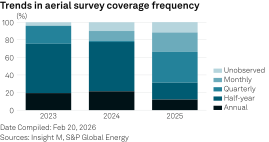
Higher observation frequency also improves duration calculations, allowing for greater precision in timing both leak repairs and long-duration emitters.
Insight M refined the event-duration methodology to improve temporal accuracy. In 2025, the default duration for detected leaks was halved from 14 to seven days, reflecting faster data processing and reporting cycles.
After detection during a flight, operators are now notified within 24 hours, rather than the previous seven days, enabling more rapid repair responses. Furthermore, maintenance-related events are now assigned a fixed one-day duration, rather than being modeled as fugitive leaks, ensuring these short-lived, episodic activities are not overstated in annualized emissions estimates.
Together, these updates improve temporal reliability and reduce the potential for duration-based error. As a result, the 2025 dataset represents a significant improvement and CERA's best available estimate of methane performance in the Permian to date.
Dissecting the Texas-New Mexico methane performance gap
A state-level comparison within the Permian Basin highlights a clear divergence in methane performance. Texas accounts for roughly 70% of total basin production and, therefore, most absolute methane emissions, based on S&P Global Energy impact production data. However, the difference is not purely a matter of scale. In 2025, methane intensity in Texas was 0.39%, compared with 0.25% in New Mexico, indicating materially higher emissions per unit of output in Texas.
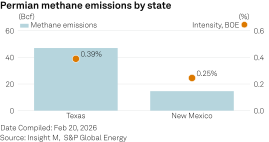
Based on a review of regulatory frameworks, one potential driver of this divergence may be differences in regulatory structure. New Mexico has implemented more stringent methane controls in recent years, including tight restrictions on routine venting and flaring. In contrast, Texas maintains a comparatively flexible regulatory framework. Differences in enforcement, infrastructure alignment, and asset maturity may also contribute to the variation in intensity outcomes.
For operators and investors, these results highlight the importance of state-level comparisons. Basin-wide averages can obscure jurisdictional differences that materially affect emissions performance. As regulatory and disclosure pressures evolve, understanding these structural differences will remain critical for asset evaluation and methane management strategies.
Why these shifts matter
The 2025 numbers tell a clear story -- when operators detect leaks sooner and fix them faster, emissions fall even when production stays flat.
But the bigger shift is happening underneath the headline figure. Two years ago, less than 1% of Permian production was getting monthly aerial coverage. In 2025, that coverage has risen to 22%. This is not a minor adjustment -- it reflects a fundamentally different picture of basin-wide activity.
The Texas-New Mexico gap drives this home. Two jurisdictions, same basin, same geology, yet methane intensity in Texas runs materially higher than in New Mexico. This difference is not about what's in the ground -- it points to regulatory choices and the degree to which operators are held accountable. As disclosure requirements tighten and investors increasingly scrutinize asset-level emissions, this is a signal that deserves close attention.
Ultimately, better data is not just a technical gain. It's what makes the headline reductions credible --and what will sustain momentum toward further cuts.
Further reading:
Cleaning Up: Overflight data show Permian methane emissions intensity down further 28% in 2024
Turning the tide: Upstream Permian methane emissions drop 26% in 2023
