Crude Oil, Maritime & Shipping, Refined Products, Agriculture, Energy Transition, Dry Freight, LPG, Biofuels, Renewables
March 31, 2026
COMMODITY TRACKER: 5 charts to watch this week

By Staff
Editor:
Asian refiners shift to US crude amid war in the Middle East, while aluminum costs in Japan rise on production constraints. Meanwhile, Brazil solidifies its position as the dominant soybean producer amid US-China trade tensions.
1. US crude premiums rise amid Middle East war
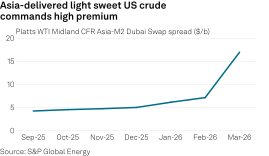
What's happening? Asian refiners are significantly increasing WTI Midland crude imports to compensate for reduced Middle Eastern cargo deliveries, driving spot premiums higher. Platts, part of S&P Global Energy, assessed WTI Midland on a CFR Asia basis at an average premium of $16.30/b to second-line Dubai crude swaps in March, up from $7.20/b in February and $6.20/b in January. Taiwan's CPC purchased two VLCCs for June delivery at premiums exceeding $12/b to Platts Dated Brent, while a South Korean refiner secured a cargo at approximately $16/b to Platts front-month Dubai. South Korea's February US crude imports rose 29% year over year to 15.9 million barrels, according to state-run Korea National Oil Corp., data released March 27.
What's next? US upstream producers, particularly shale operators, are expected to benefit substantially from higher prices and premiums. SK Innovation estimates $5 billion in additional revenue for US producers in March as prices rose approximately 47%, according to the company's chief research analyst Choi Joon-young in the March market analysis report. Higher US production incentives may increase Atlantic Basin exports over time, potentially offsetting Middle East supply risks, Choi said. South Korea took 174.9 million barrels from the US in 2025, while India imported 116.4 million barrels and Taiwan purchased 84.8 million barrels, positioning the US as a critical alternative supplier.
2. Japan aluminum premiums surge on Middle East conflict
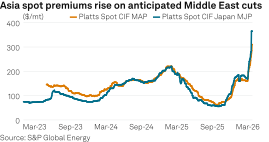
What's happening? Platts assessed second-quarter premiums for imported primary aluminum to Japan at $350-$353/mt plus London Metal Exchange cash, CIF main Japanese ports, on March 26, representing a 79.5%-81% surge from Q1's $195/mt. The assessment, based on nine trades between March 13-25, reflects the highest quarterly premiums in a decade. Geopolitical tensions in the Middle East have tightened global aluminum supply, with the Gulf Cooperation Council--the world's third-largest primary aluminum producer, accounting for 8.3% of global output-- experiencing production disruptions. Qatar's Qatalum operates at 60% of capacity, Aluminium Bahrain shut three production lines representing 19% of capacity, and South32 idled its Mozal smelter in Mozambique due to power constraints.
What's next? Supply tightness is expected to persist as concerns mount about the security of Middle Eastern facilities and export capabilities during the conflict. Karen Norton, associate director at S&P Global Energy, noted that shipment delays are inevitable due to longer shipping routes. A prolonged closure of the Strait of Hormuz could trigger additional production cuts or shutdowns due to failures in alumina deliveries. Idled production could take 3 months to 1 year to resume, according to market participants. Japanese market participants anticipate restocking activity beginning in Q2 amid the fiscal year start, potentially depleting main port stocks currently at 302,300 mt--the lowest since November 2024. Buyers may increasingly accept Indian and Indonesian-origin aluminum as alternatives to preferred Western brands, as per Japanese market participants.
3. Brazil dominates global soybean market amid tensions
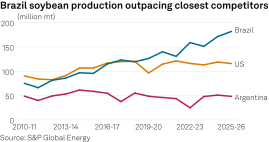
What's happening? Brazil is cementing its status as the leading global soybean player with record production and export shares. The 2025-26 harvest enters its final stages as trade tensions between the US, the world's second-largest exporter, and China, the largest global buyer, intensify. S&P Global Energy CERA analysts project Brazil will produce a historic 182 million metric tons of soybeans in 2025-26, accounting for 42.2% of global output, a record share. Ten years ago, Brazil's share was 30.3%.
What's next? Brazil's dominance is reshaping the global soybean market and commodity prices. The correlation between Brazilian and US soybean prices has steadily decreased, reaching its lowest level in 2025 amid the US-China tariff dispute. On March 24, Platts assessed Brazilian soybeans FOB Santos for May shipment at $431.39/mt, up 6.5% year over year. US soybeans FOB New Orleans for May loading were valued at $456.72/mt, up 13.8% year over year.
Related article: Brazil sets new records as global soybean leader amid US-China trade tensions
4. LNG bunker fuel gains price edge over marine fuels
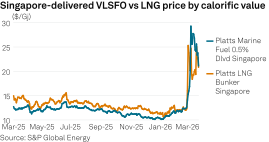
What's happening? LNG bunker fuel in Asia has become more cost-competitive than conventional marine fuels, prompting shipowners with dual-fuel capability to consider switching. Singapore-delivered LNG bunker prices have been lower than delivered marine fuel 0.5% bunker prices on a unit basis over the past 12 Asian trading sessions, according to Platts data. On March 24, Platts assessed Singapore-delivered LNG bunker at $20.836/GJ compared with $21.22/GJ for Singapore-delivered marine fuel 0.5% bunker, implying a $0.38/GJ discount for LNG. The spread first flipped to a discount on March 9, reaching a record $8.49/GJ discount on March 12.
What's next? LNG's price advantage over low-sulfur fuel oil is expected to narrow soon as Singapore market participants offer LSFO more competitively amid tepid demand. However, LNG's advantage over low-sulfur marine gas oil is expected to persist longer due to tightness in LSMGO ex-wharf cargo supply. Ships with dual-fuel LNG technology account for 7.8% of total tonnage in operation while representing 36.8% in the order book, according to DNV Energy Transition Outlook 2025. In February, 14 of 17 new alternative-fueled ship orders were for LNG-fueled vessels.
5. European RD-SAF spread narrows as China boosts imports
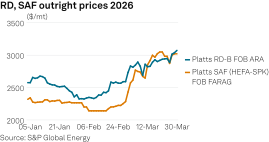
What's happening? Chinese renewable diesel exports jumped over 200% in February, according to data released by the General Administration of Customs on March 20. Nearly all volumes arrived into the Netherlands and Belgium as stronger European prices created attractive arbitrage opportunities. Competitive pricing for Chinese RD, even amid anti-dumping duties, has supported the surge, with European demand bolstered by RED II legislation and broader end-use flexibility compared with sustainable aviation fuel. Chinese SAF exports fell sharply, down nearly 74%, largely due to a weaker immediate focus on SAF markets.
What's next? RD exports to Europe are likely to remain strong if pricing and geopolitical volatility persist. SAF supply may tighten if reduced Chinese flows continue, but most market participants expect limited disruption, with alternative supply sources and softer aviation demand likely to offset any shortfall. The narrowing RD-SAF spread reflects fundamental support for RD prices, encouraging imports from China into Europe.
Reporting and analysis by Philip Vahn, Leon Wong, Charles Lee, Louissa Liau, Joao Queiroz Cezar Pessoa, Jose Roberto Gomes, Gwen Teo, Yue Wang, Daniel Workman and Olly Wroe.
