Crude Oil
March 25, 2026
Asian refiners pivot to US crude on Hormuz disruptions, lifting WTI spot premium
By Gawoon Vahn and Leon Wong
Editor:
HIGHLIGHTS
Asian refiners boost US crude purchases
WTI Midland premium surges to $16.7/barrel
China resumes US imports amid supply crisis
Spot premiums for US crude grades are expected to continue rising as Asian refiners ramp up WTI Midland crude imports to bridge the gap caused by reduced Middle Eastern cargo deliveries, making US suppliers and producers clear winners in the latest Persian Gulf conflict, according to refinery feedstock managers and industry analysts.
US crude oil suppliers are among the biggest winners in the latest Middle East conflict from a geopolitical and energy market perspective, as higher oil prices and spot premiums would boost their revenues, South Korea's top refiner SK Innovation said in its March market analysis report, citing chief research analyst Choi Joon-young.
Among recent spot market deals concluded in the Asian market, Taiwan's CPC purchased two VLCCs of WTI Midland crude for June delivery at a premium of more than $12/b to Platts Dated Brent, while a South Korean refiner based in Seosan took a cargo of the light sweet US grade for June arrival at a premium of around $16/b to Platts front-month Dubai, traders based in Singapore and feedstock managers at South Korean, Taiwanese, Japanese and Thai refiners with close knowledge of the matter told Platts, part of S&P Global Energy, over March 16-25.
CPC Taiwan did not respond to Platts' March 24 email request for an official comment on the deal, while the South Korean refiner said March 25 it would not deny the spot cargo purchase.
Platts assessed WTI Midland on a CFR Asia basis at an average premium of $16.7/b to second-line Dubai crude swaps so far in March, compared to the February premium of $7.2/b and January's average premium of $6.2/b.
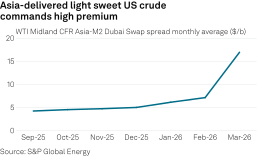
US upstream producers—particularly shale—are expected to benefit from the rally, with an estimated $5 billion in additional revenue for March as prices rose approximately 47%, according to Choi in SK Innovation's market analysis report.
"Higher US production incentives may increase Atlantic Basin exports over time, partially offsetting Middle East supply risk," Choi said.
In 2025, South Korea – Asia's third largest crude importer – was the region's biggest US crude customer, taking 174.9 million barrels from the North American supplier, latest data from state-run Korea National Oil Corp. issued Feb. 27 showed.
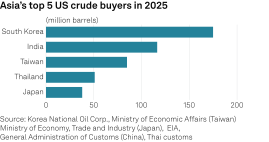
India was Asia's second-largest US crude buyer in 2025 at 116.4 million barrels, while Taiwan was third at 84.8 million barrels in 2025, according to data from the US Energy Information Administration and Taiwan's Ministry of Economic Affairs.
Fierce competition
Meanwhile, Japanese refiners and traders are cautiously monitoring China's revived interest in US crude, as demand from non-regular buyers could tighten supply across the entire Asian refining community.
The Middle East accounted for 94% of Japan's crude oil imports in 2025, and the Japanese refining industry must make greater efforts to bring it below 90%, Platts reported previously, citing feedstock managers at two major Japanese refiners.
Chinese state-run refiners may resume US crude imports after a nine-month suspension amid the supply crisis in the Middle East, despite the additional 20% tariffs remaining in place, according to crude procurement strategists from two state-run Chinese refining groups and four refinery sources.
"Difficulty in receiving Middle Eastern sour crude is affecting everyone... this clearly means everyone [including Chinese traders] will be competing for US and other crude grades from the Americas region," a feedstock inventory manager at ENEOS told Platts during market discussions over March 23-25.
Due to US-China trade tensions, Chinese refiners had suspended US crude imports since June 2025, leading annual trade flows to fall 72.6% year over year to 2.29 million mt, or around 16.8 million barrels, China's official customs data showed.
On the contrary, Japan imported 103,784 b/d or 37.9 million barrels of light sweet WTI Midland and West Texas Light crudes from the US in 2025, almost double the 56,714 b/d purchased in 2024 and marking the highest annual shipment from North American suppliers, data from the Ministry of Economy, Trade and Industry released Jan. 30 showed.
