Agriculture, Meat, Livestock
October 20, 2026
Australia's beef industry competes on value as quotas, trim quality shift
By Sheryl Leao and Yuh nien Chow
Editor:
Industry sentiment is shaped by one hard fact: Australia produces far more beef than it can consume at home. Across the industry — producers, packers, traders, feed suppliers, financiers, shippers and advisers — sources agreed on one point: the country isn't just selling more beef, it's selling smarter.
Australia produces enough beef to feed about 65 million people — more than double its population of 28 million — according to an Australian industry adviser. The same adviser described the country as a "nation of exporters," whose key strength is staying flexible enough to avoid "drowning under a mountain of beef." Tighter quotas, shifting trim specifications, rising feed and fuel costs, and stronger competition from Brazil are testing that flexibility.
China's quota race
Packers are moving quickly. Industry sources expect China's quota for Australian beef to fill by March or April 2027, earlier than 2026, with Wagyu packers already booking 2027 arrivals and commodity packers likely to follow. One large packer reported that grain-fed cattle slaughter has been running at peak levels since October and is expected to continue. They described demand signals from China as the strongest of any market.
The rush comes despite concerns over the quota's design. An association source said the quota relies on an outdated reference period and includes bone weight toward the meat total, a structure that would weigh most heavily on chilled and Wagyu exports if confirmed. Chinese cold storage also remains heavily stocked with Brazilian beef, a trader said.
Logistics add further pressure: a producer cited very high shipping costs with vessels booked out for October and November, while a logistics source said delayed-arrival shipping options are helping cargoes land when buyers need them, with premium cuts still moving even under a 55% import duty.
Safeguards push diversification
China and South Korea apply different safeguard mechanisms — a country-specific import quota and a free trade agreement (FTA) tariff-rate quota, respectively — but both are reshaping export strategies. One producer said South Korea's 2027 quota has already been used by 13%. Many companies that were once comfortable with 50%–60% of their business in China now cap exposure at about 30%; because China's safeguard volumes can be tracked through the year, the industry can see triggers coming, though he expects Australia to keep hitting them while production stays strong, an adviser said.
Demand is uneven elsewhere. The US herd recovery is further out than expected, keeping demand strong for manufacturing beef and higher-value cuts, with Australian firms now owning US cutting, packing and grinding plants. The UK's rising FTA tariff-free quota is a positive. The EU is more difficult, with existing supply chain and antimicrobial-use rules plus new deforestation-free sourcing rules from December, though Australia's low-risk status means lighter due diligence. Southeast Asia is a high-growth market for South Korean/Japanese barbecue and premium burgers. Indonesia is a big market but volatile amid policy shifts. The Middle East is a growing focus but at risk from regional instability, the adviser notes
Platts 90CL FCA Australia: Key reference for lean trimmings prices
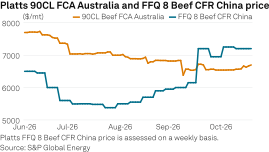
Platts 90CL FCA Australia assessment remains the anchor around which the trim market is priced. ("CL," or chemical lean, measures the percentage of lean meat in a batch of beef trim.) But as more cattle are grain-fed, 90CL itself is getting harder to produce, and the market is increasingly defined by how far supply sits below that specification. It makes a lot of 85CL, priced off 90CL, because 90CL is difficult to reach when more than half of a plant's kill is grain-fed, a packer said. Platts is part of S&P Global Energy.
That spread away from 90CL FCA Australia widens further at the fattier end: Wagyu packers produce a lot of 50CL and 55CL, sources call 50CL average and 55CL a poor return, prompting some to trim fat back toward 65CL for sale.
Sources also described a blending pattern — pairing lean Brazilian 90CL–95CL with Australian 50CL to reach the 75%–83% lean range used in burger patties. The practice is visible among some US buyers, though not yet established as a market-wide, a trader said. Alongside 90CL FCA Australia, a trader tracks Platts FFQ8 Beef CFR China price (forequarter eight cuts) as a read on Brazilian pricing into China and how that competition is shaping the market.
Feed, weather and policy headwinds
Grain-fed production is spreading beyond its traditional Queensland base, as Victorian and South Australian processors raise their grain-fed share amid drought and labor shortages that favor steady programs.
Rations lean on wheat and barley, blended close to 50:50 this year as barley runs cheaper, plus cottonseed, canola meal and hay or straw, though the mix varies by feedlot; higher fuel costs have also raised trucking costs, a grain trader said.
Weather remains a key price driver — and participants are watching El Niño for its effect on grain supply, herd rebuilding and heat stress. Labor shortages, visa delays and high compliance costs remain major constraints across farms, feedlots and processors.
Tariff and safeguard volatility doesn't cut production so much as shift where margins sit between farmers, feedlots and processors, with processors always limited by what the global market will pay, sources said.
Tallow moves center stage
By-products are gaining attention as biofuel feedstocks. Tallow, historically a lower-value product, has fetched higher prices amid biofuel demand, including sustainable aviation fuel, a rendering source said. A US tariff gap has also made Brazilian tallow less competitive than the Australian supply.
Platts' weekly Australian beef tallow FOB East Coast assessment rose from $948/mt on Jan. 7 to $1,200/mt on June 24, 2026. It stood at $1,202/mt on Oct. 14, even as US buyers sought lower-priced Argentine and Uruguayan alternatives. Under the feedstock-origin rules for fuel produced after 2025, fuel made from Australian-origin tallow does not qualify for the US Section 45Z Clean Fuel Production Credit.
Biofuel incentives could also encourage more canola planting and affect competition for land and feed crops, though the extent of any effect remains unquantified, a feedlot industry source said.
Together, these forces show an industry adapting on every front: filling China's quota while hedging its safeguards, stretching the trim curve as grain-fed supply turns fattier and extracting new value from by-products like tallow as margins on traditional cuts tighten.
Weather, labor and feed costs will keep testing that discipline. Brazil's competition and shifting global demand are redrawing where and how Australian beef sells. The industry's bet is clear: compete on value, not volume.
Further reading
Australian tallow prices fall as US buyers shift to competitive origins
INTERVIEW: Australian beef supply to hold steady in 2027, pressure to maintain exports
