Agriculture, Maritime & Shipping, Chemicals, Grains, Containers, Oilseeds, Olefins, Polymers
August 25, 2026
COMMODITY TRACKER: 5 charts to watch this week

By Staff
Editor:
Black Sea disruptions curtail grain exports, while Panama Canal restrictions push Platts container freight rates to 2026 highs. European soybean meal prices climb on Brazil supply concerns and US battery storage grows in western regions.
1. Black Sea attacks disrupt grain export logistics
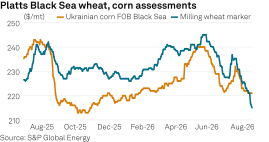
What's happening? Escalating attacks on Black Sea ports, grain terminals and commercial vessels since July have disrupted grain export logistics from Russia and Ukraine during a key post-harvest shipping period. Ukraine reported 67 attacks on port facilities in July, while Russian strikes on Odesa-region ports removed about one-third of Ukraine's grain export capacity, according to S&P Global Energy CERA. Restrictions on the Kerch Strait and the Azov-Don channel affected a route that handles an estimated 28% of Russia's wheat exports. Ukrainian wheat exports fell to 935,332 metric tons in July from 1.6 million mt in June, while Russian wheat exports dropped to 1.6 million mt in July 2026 from 2.1 million mt a year earlier.
What's next? US Department of Agriculture projects Russian wheat exports at 46 million mt and Ukrainian exports at 13.5 million mt in marketing year 2026-27 (October-September), while CERA projects Russian wheat exports at 48.5 million mt and Ukrainian wheat exports at 15.5 million mt. For corn, USDA projects Ukrainian exports at 22 million mt in MY 2026-27, while CERA forecasts 26.5 million mt. Ukraine could face a domestic grain-storage shortfall of 8 million-11 million mt if exports remain slow, according to Agriculture Minister Taras Vysotsky.
2. Platts container freight rates hit 2026 high on Panama Canal restrictions
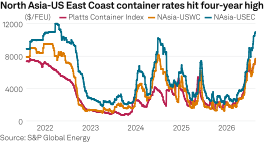
What's happening?The Platts Container Index, a weighted average of key container routes, rose to $7,565/FEU on Aug. 21, increasing by $3,052.3/FEU and surpassing the previous 2026 high of $4,512.7/FEU recorded on June 1. North American trade lanes reached a four-year high on Aug. 19 as Panama Canal draft restrictions tightened, causing space constraints and widening the spread between North Asia to East Coast and West Coast North America routes to $3,300/FEU as of Aug. 21. Weather disruptions during typhoon season led to delays at Shanghai and Ningbo ports, with 77 container vessels at anchorage off Shanghai as of Aug. 23. Indian subcontinent spot container freight surpassed $10,000/FEU in August, reaching $10,700/FEU on Aug. 21. European market rates declined slightly in August, with North Asia to North Europe assessed at $4,500/FEU on Aug. 21, down $200/FEU from Aug. 3. Platts is part of S&P Global Energy.
What's next? Market sources expect rates to remain strong until the Golden Week holidays in Japan in October, though sentiment toward carrier-led rate hikes has been mixed. Some customers have accepted surcharges imposed by carriers, while others have delayed cargo shipments in anticipation of lower rates. Shippers on the Indian subcontinent trade lane reported accepting higher peak season surcharges for September shipments to secure spot bookings. Carrier Hapag-Lloyd announced a €50/TEU congestion surcharge for all inland shipments via Antwerp and Rotterdam, effective Sept. 1.
3. European soybean meal prices rise on Brazil supply concerns
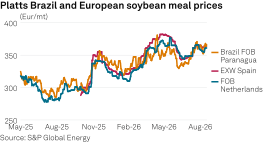
What's happening? European soybean meal prices moved higher as market participants voiced growing concern over the reliability of supply from Brazil, the EU's primary source of the protein feed. Platts assessed FOB Netherlands soybean meal at €361/ mt Aug. 18, up €6/mt week over week, while ex-works Tarragona soybean meal was assessed at €364/mt, up €2/mt over the same period.A Dutch broker said soybean meal offers have gone up from €366/mt to €370/mt over the past five days, citing higher futures and firmer premiums as the main drivers. A Dutch trader said weaker crush margins in Brazil had lifted premiums. Platts assessed the Brazil Soybean Crush Spread at $13.76/mt Aug. 18, near the lowest level since mid-October 2025.
What's next? Brazilian crushers have soybean coverage of around 45 days, according to a Brazil-based broker, who warned of a potential short squeeze in September if buyers with limited coverage are forced back into the market to rebuild positions. The soybean meal FOB Paranaguá basis for September delivery reached a $24/short ton premium to Chicago Board of Trade futures on Aug. 13, the highest level for a spot shipment since Oct. 15, 2024, and was assessed at plus $17.50/st to the CBOT benchmarks on Aug. 18. Analysts at CERA estimate Brazil will crush 63.50 million mt of soybeans in 2026, with soybean meal exports projected at 27 million mt.
4. WECC leads US battery storage additions with 2.2 GW in Q2
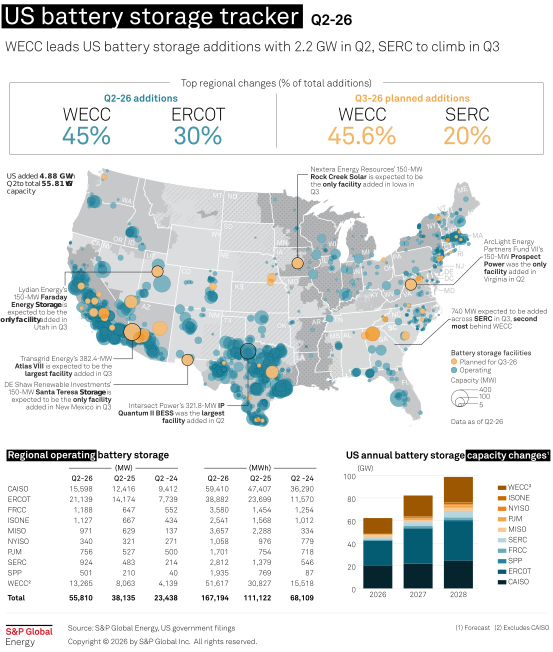
What's happening? The Western Electricity Coordinating Council (WECC) region accounted for 45% of the 4.883 gigawatts of utility-scale battery storage capacity installed in the US in Q2, while ERCOT accounted for 30% of additions, according to an S&P Global Energy compilation of various government filings. The Western US and ERCOT have dominated utility-scale battery storage capacity additions in the US for the last several years. WECC added 2.197 GW in Q2, followed by ERCOT with 1.461 GW or 29.9% of US additions and the California Independent System Operator region with 924 MW or 18.9% of the total, the data showed.
What's next? WECC is expected to lead Q3 additions, accounting for 45.6% of the 3.762 GW planned to come online, according to the data. The SERC Reliability Corp. footprint is expected to be one of the top regions for additions, with 20% of Q3 additions, followed by the California Independent System Operator footprint at 15%, the data showed. Outside of those regions, an additional nearly 740 MW are slated to come online in Q3. If all planned third-quarter additions are completed, the US total would surpass 59.5 GW of battery storage capacity, an increase of 7% quarter over quarter, according to the data.
5. Europe's ethylene producers face margin pressure
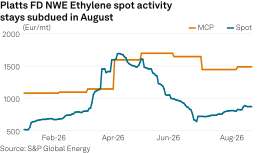
What's happening? Europe's ethylene market entered August with higher feedstock costs and a firmer contract settlement at €1,487.50/mt, up €42.50/mt from July. However, derivative producers struggled to pass these costs downstream due to weak end-user demand. The European FD NWE PVC spot price fell to €890/mt on Aug. 19, down €60/mt from July, according to Platts data. The European LDPE gross contract price remained unchanged at €2,500/mt FD NWE on Aug. 19. Supply-side support from cracker maintenance at Shell's Wesseling site and earlier outages at BASF's Ludwigshafen facility created localized tightness, but spot ethylene fell to €872/mt FD NWE by Aug. 21.
What's next? Market participants said that supply disruptions alone are insufficient to restore pricing power without stronger derivative demand. The disconnect between upstream cost pressure and actual purchasing appetite suggests producers may struggle to achieve full cost pass-through in derivative negotiations. Converters remain cautious, maintaining tightly managed inventories and preferring to delay commitments until clearer evidence of post-holiday restocking emerges.
Reporting and analysis by Lalita Avd, Tanya Kalra, Nanditha Kinavoor Madathil, Jose Roberto Gomes, Kassia Micek and Mujidah Yahaya.
