Agriculture, Meat, Livestock
May 25, 2026
INSIGHT CONVERSATION: Andrew Cox, Meat & Livestock Australia

Editor:
In this Insight Conversation series on global protein markets, leaders from the shrimp, pork and beef sectors examine the forces reshaping international trade. This is the third of five in-depth interviews where industry executives share their insights on how tariffs, import quotas, regional conflicts and cost inflation are redirecting protein trade flows and challenging established market dynamics.
Australia's beef industry is facing challenges from global supply chain turbulence, volatile weather patterns and shifting trade dynamics. S&P Global Energy Platts Senior Editor Aditya Kondalamohanty speaks with Meat & Livestock Australia General Manager of International Markets Andrew Cox. Cox, who oversees the Australia's beef marketing strategy across more than 100 markets worldwide, discusses how the sector is building resilience through market diversification, strategic customer relationships and adaptive supply chain management.
Australia's beef export supply chains have faced significant turbulence over the past year. How is the sector navigating these challenges?
The supply chains have been very much challenged in the last 12 months, but they are still intact. The key to being in an export-exposed supply chain is customer relationships, the business-to-business relationships that we have and the trust of consumers globally. We actively cultivate diversification, which means we're not overly exposed to any single region. That nimbleness has helped us weather volatility and has allowed us to keep exports flowing.
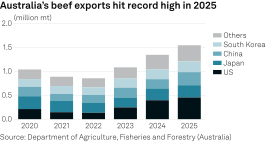
For example, while China remains an important market for Australian beef, we've seen record beef sales last year in (South) Korea, Japan hit its highest imports in five years and North America had record demand. Even in Southeast Asia, markets like Thailand and Vietnam are showing tremendous growth potential.
China has set a quota of 205,000 mt for Australian beef imports for 2026. How is MLA responding?
Traditionally, China has been a very strong market. The quota situation risks nearly $750 million of trade, particularly for chilled beef, which has a shorter shelf life. But we are taking a long-term view. But we maintain and have maintained a team.
We are maintaining -- as a marketing organization -- our staffing levels in Beijing and Shanghai and more broadly in Hong Kong and Taipei, and the marketing and business development program that we have established with customers. This is the first year of a three-year quota arrangement safeguard that China has put in place. We don't know exactly when it will trigger, but it will be in the next couple of months. Obviously, the later it triggers, the less impact we will have because the supply chain will be able to put in place measures to work around it with shelf life and product storage.
Input costs have been rising globally, putting pressure on margins. How is this affecting the Australian beef industry?
Farmers are grappling with high energy, fertilizer and shipping costs. While the exact rise in input costs varies from region to region in Australia and the weather conditions. But certainly, the whole sector is very exposed to diesel prices. A lot of Australian farms buy fertilizer, which -- a lot of which originates from the Middle East, so certainly exposed to the increase in costs there. And of course, shipping has become an issue. So certainly, the production environment is more difficult. And as I said earlier, it's a global problem.
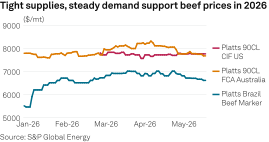
So, on the other side, customers are also exposed to high costs, high input costs, which are affecting their margins. Consumers are feeling the pinch and quite nervous about inflation spikes and the cost of living. But at the same time, there are some great tailwinds for animal proteins. Demand for beef globally is extremely strong. Consumers are recognizing the health benefits of beef. They're searching for products they can trust. I think the key is that we keep demonstrating the value of the protein that we are producing.
Drought and varying weather conditions have forced herd adjustment across Australia. Can you describe what's happening on the ground and how the supply chain is adapting?
It's a bit of a mixed bag. Farmers in New South Wales and southern Queensland are facing very dry conditions and have been destocked. But at the same time, the more northern parts of Australia have had a tremendous wet season. A lot of cattle have been heading north. Further south in Victoria, South Australia, they had very dry weather for a couple of years. Some of those regions had their driest years on record, but they've since recovered. They have additional demand for livestock. Overall, it's hard to say, and it obviously depends on future rain events. But the supply chain is responding by moving cattle to areas of Australia that have more pasture.
Looking ahead, where do you see the strongest growth opportunities for Australian beef exports?
Actually, both the US and Canada were record years last year -- very strong protein demand and of course, short supply in North America because of cyclical and seasonal conditions. Canada has grown from just 7,000 metric tons in 2021 to over 50,000 mt last year, and we're opening an office in Toronto to deepen engagement.
In North Asia, we have Japan, and South Korea, both of which are very strong. But beyond those big four markets, we're also seeing increased demand in Southeast Asia, which is where we also see significant future growth potential. We had a record year in Thailand last year for beef sales. Vietnam was the second highest on record. And across that region, we see a tremendous opportunity to grow a stronger market position. Even in markets such as the UK and the Middle East, we're seeing very strong demand for Australian beef.
Given the heightened volatility of the past year, has your approach to managing change evolved?
Yes. It's been a dynamic year. I've been in this role for six years and I would say there have not really been any normal years. I think if you're in food production and food marketing, then maybe a normal year is not the norm. COVID was hugely disruptive. I think some supply chains are still struggling from that. The food supply chain and restaurants are not as busy as they used to be. I think in some countries, tourism has not quite recovered yet.
It's an interesting time. But if you look through the history of Australian beef exports, there's always volatility in the supply chain, whether it's because of the weather or the market conditions, the economy, geopolitics and of course, unforeseen events like global pandemics. We need to have a strong strategy that can not only predict specific issues but is also designed to withstand volatility.
This interview has been edited for length and clarity.
