


Maritime & Shipping, Refined Products, Wet Freight, Jet Fuel
June 19, 2025
Middle East jet fuel demand drops as flights disrupted in Israel-Iran conflict
HIGHLIGHTS
Military demand increases
Regional commercial jet fuel demand drops over 10%
Arab Gulf jet fuel prices climb
Middle East jet fuel demand for civilian aircraft is estimated to have slumped more than 10% since the beginning of the Israel-Iran conflict, but airlines are still seeing higher costs in line with rising freight rates and gains in Dated Brent, according to the latest analyst and pricing reports.
Estimated jet fuel demand in the region has dropped to an estimated 480,000 b/d from 550,000 b/d before the conflict started June 13, Dong Wang, senior Middle East oil analyst at S&P Global Energy, said in an interview.
Israel's Ben Gurion airport was closed on June 13 and remains so, although evacuation flights to nearby Cyprus are being operated.
Flights across the Middle East were disrupted, with airlines canceling or rerouting flights to avoid airspace used for Iranian and Israeli missile exchanges.
"The Middle East region has experienced a loss of nearly 1,500 flights per day, leading to a significant reduction in jet fuel demand, estimated at up to 75,000 b/d for each day the conflict persists," Dong said. The estimate does not include military use of jet fuel, he added. The UAE is the biggest jet fuel user in the region, followed by Iraq and Saudi Arabia, according to Platts' estimates.
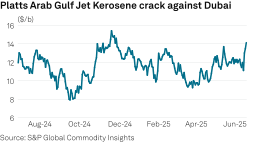
Platts-assessed jet fuel/kerosene FOB Arab Gulf was $87.63/b on June 18, the highest since Feb. 25 and up from $79.43/b on June 12.
Freight rates for VLCCs, Aframaxes and LRs have all shown increases since before June 13. Freight rates for the benchmark Persian Gulf-East Africa route have climbed by more than w100 over the same period. Shell placed a Vitol-relet, the Elandra Oak, on subjects at w335 for June 27 diesel and jet fuel loading on the Kuwait-East Africa route, sources said. Shell declined to comment.
Platts-assessed Dated Brent rose to $77.05/b on June 18 from $70.85/b on June 12.
"Just a few days ago, everyone was bullish on jet fuel due to the risk of supply disruptions, but now everyone is bearish because they're seeing air travel demand go down," a jet fuel trader said.
Assessing actual jet fuel demand during conflicts is challenging, as heightened military demand can offset lower commercial demand, Linus Bauer, founder and managing director of Bauer Aviation Advisory, told Platts.
"In most cases, war increases jet fuel demand in the short to medium term due to both military activity and commercial aviation disruptions," he said, noting that demand is also affected by the nature and scale of the conflict, as well as the geography.
When conflicts disrupt tourism or economic activity in war zones or nearby countries, commercial flight demand may drop, partially offsetting overall increases. Military demand can represent 10%-20% of jet fuel consumption in conflict-affected years, though it varies significantly, he said.
"The net impact is often a shift in demand from civilian to military use, not necessarily a decline," Bauer said.
Tourism drives Gulf countries' efforts to diversify their economies away from oil, especially in Dubai, where tourism is central to the economy. Saudi Arabia has also worked to enhance its appeal to tourists, hosting global events like the 2029 Asian Winter Games and the 2030 World Cup.
"Not sure anyone wants to fly to Iran and Iraq now, and there should be a lot of flights out," a Europe-based market source added.
Saudi Arabia in December stated it is the fastest-growing tourism destination in the G-20, with more than 100 million visitors in 2023. The country's proposed King Salman International Airport and Riyadh Air are being developed simultaneously as part of Saudi Arabia's Vision 2030 to revamp the economy.
The UAE reported over 1 million "air traffic movements" for the first time in 2024, up 11% year over year. Aviation is a cornerstone of the UAE's economy, with plans to expand Al Maktoum International Airport (DWC) in Dubai, which will be five times larger than Dubai International Airport (DXB) and completed by 2034. DWC, located 65 km (40 miles) south of DXB, will replace DXB upon completion.
The UAE's domestic refining capacity meets most of its jet fuel demand, making it a net exporter, Bauer said.
"Barring extreme supply chain disruptions," the UAE's jet fuel supply will remain at least self-sufficient, he said.
Bauer estimates Dubai-based airline Emirates' fuel consumption climbed to about 138,000 b/d-172,000 b/d in 2024 from about 103,000 b/d in 2010. Emirates did not respond to a request for comment.
Dubai's flagship carrier is the largest in the region, but alongside Qatar Airways and Abu Dhabi's Etihad decade-long expansion, 258,500 b/d have been added to regional jet fuel demand over the same period, he said.
"Given ongoing capacity expansions and stockpiling policies, imports are not a major contributor to UAE jet fuel supply under normal circumstances," Bauer said. If geopolitical tensions disrupt maritime flows or trigger demand spikes, "we could see temporary imports or shifts in distribution logistics may rebalance stocks across airports," he added.
Regional refineries expanded to meet rising demand. Oman's jet exports surged in the first half of 2025, averaging 80,000 b/d in Q2 2025, as the 255,000 b/d Duqm refinery operated at 110% of its design capacity, with over 80% of exports shipped to East and Southern Africa, according to a May 30 Energy report.
A fire at a power plant supplying electricity to Israel's largest refinery halted jet fuel, gasoline, and diesel production at the Haifa refinery.
Israel's jet fuel imports may grow from zero to 15,000 b/d to meet demand, and they may pull those volumes from nearby Mediterranean markets, according to Energy analysts.
On May 14, during US President Donald Trump's visit to the region, Qatar Airways announced an order for up to 210 Boeing widebody jets, the largest order of its kind in Boeing's history.
Finding enough jet fuel is a "big exercise," Qatar Airways CEO Badr al-Meer told Platts in May.

Editor: